Not every psychotic patient has schizophrenia—and mistaking Psychotic Depression or Delusional Disorder for schizophrenia (or for each other) is one of the most heavily tested diagnostic traps in clinical psychiatry. One is an acute, life-threatening mood-congruent storm where antidepressant monotherapy fails and urgent combination therapy or ECT saves lives; the other is an encapsulated glass capsule of fixed non-bizarre belief that leaves daily functioning remarkably intact across decades.
In this high-yield visual masterclass, we place two iconic NotebookLM clinical cases side by side—Case 3 (Psychotic Depression) and Case 4 (Delusional Disorder)—so you can lock in their diagnostic architecture, neuroclinical differences, mnemonics (PSYCHOTIC DEPRESSION vs. DELUSIONAL DISORDER), treatment protocols, and exam traps.
Clinical Vignette — Case 3: Low Mood with Psychotic Symptoms
A 37-year-old woman presents with a 3-month history of worsening severe low mood. She hears the voices of dead relatives telling her she is better off dead and is a useless wife and mother (suicidal command hallucinations). She also reports a constant unpleasant smell emanating from her body (olfactory/somatic hallucination), causing her to refuse to leave home. She firmly believes the world is ending and feels personally responsible (mood-congruent delusional guilt). Crucially, she has failed antidepressant monotherapy.
Clinical Vignette — Case 4: Long History of Persecutory Ideas
A 45-year-old man presents with recent secondary low mood under “intolerable pressure” from perceived neighbor persecution. Despite having zero legal convictions, he firmly believes someone spread a grave false criminal rumor about him to his neighbors and that they spy on him to drive him out. He has a 20-year history of frequent house moves (last moved 18 months ago, believing his persecutor found him again). Yet he otherwise leads a relatively normal, intact life—described as “prickly” with few friends, with no prominent hallucinations and a single non-bizarre, encapsulated delusion.
1. Mental Images & High-Yield Mnemonics
Memory Palace — The Mood-Flooded Storm vs. The Encapsulated Glass Bubble
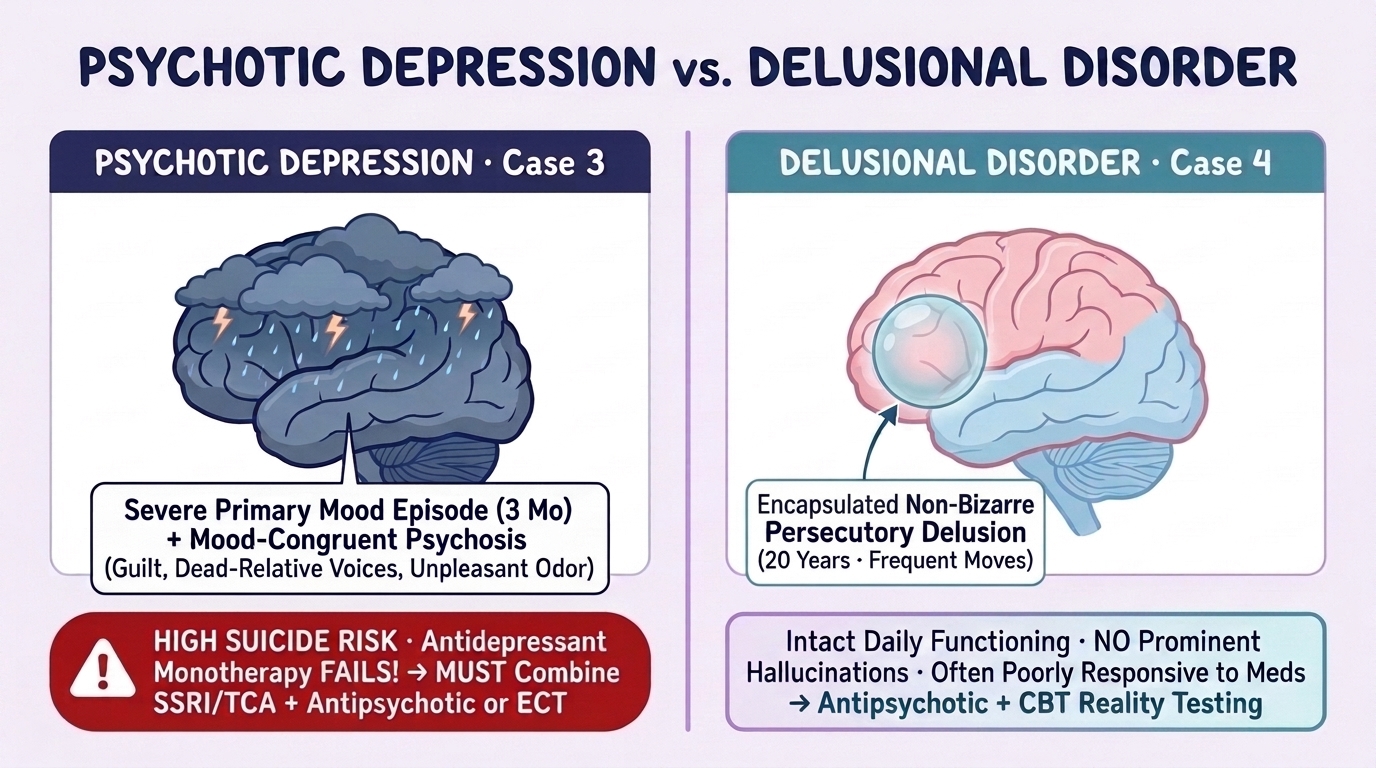
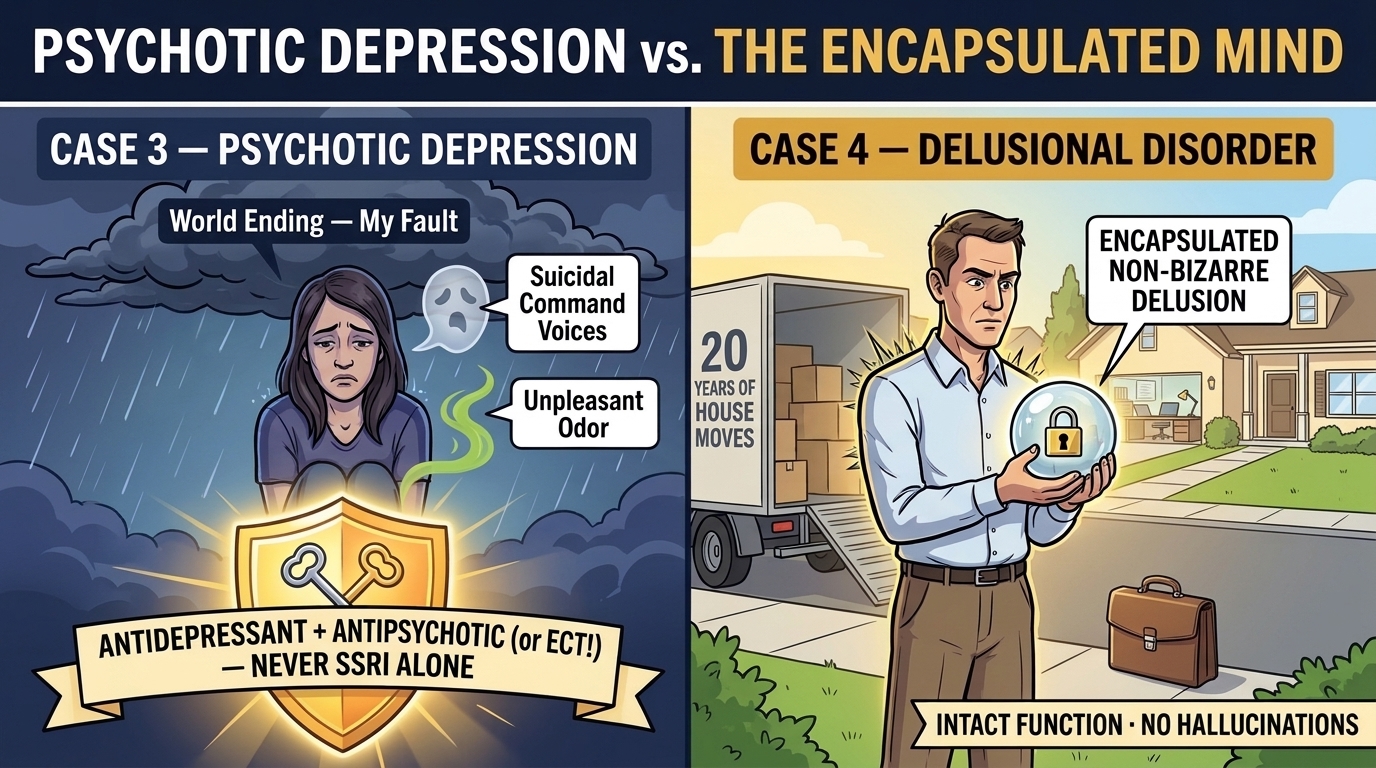
Case 3 — Psychotic Depression (“The Mood-Flooded Storm”): Picture a 37-year-old mother trapped inside a storm of severe depressive despair. Every psychotic symptom—dead relatives’ voices commanding suicide, a rotting body odor, and believing she caused the end of the world—matches (is congruent with) her crushed mood. Giving an SSRI alone is like bringing a single umbrella to a hurricane; you MUST combine Antidepressant + Antipsychotic or deliver rapid ECT.
Case 4 — Delusional Disorder (“The Encapsulated Glass Bubble & 20-Year Moving Truck”): Picture a 45-year-old man loading a moving truck every few years for two decades while carrying one sealed glass bubble labeled “Neighbors are spying on me.” Outside that single non-bizarre glass capsule, his job, speech, grooming, and daily life remain completely intact—and there are no prominent hallucinations.
Mnemonic 1 — Case 3: “PSYCHOTIC DEPRESSION”
P — Pervasive Guilt
Delusional self-blame and nihilism (believes the world is ending and feels personally responsible).
S — Suicidal Voices
Command auditory hallucinations from dead relatives telling her she is useless and better off dead — extreme suicide risk!
Y / B — Body Awareness (Somatic)
Olfactory/somatic hallucinations (constant unpleasant body odor) causing homebound withdrawal.
C — Clinically Severe Mood
3-month worsening severe major depressive episode driving the entire clinical picture.
H — Hopelessness
Profound despair and worthlessness (“useless wife and mother”) that fails standard SSRI monotherapy.
T — Tied to Mood (Congruent)
Psychosis occurs exclusively during the severe mood episode and aligns with depressive themes (guilt, death, decay, poverty).
Mnemonic 2 — Case 4: “DELUSIONAL DISORDER”
D — Delusions Persistent
Fixed false belief lasting ≥ 1 month (here, a 20-year history of persecutory flight and house moves).
E — Encapsulated One Theme
Single, circumscribed, non-bizarre delusion (could theoretically happen in real life: false rumor/neighbor spying).
L — Lone PresentationNo prominent hallucinations (any minor olfactory/tactile perceptions, if present, are strictly secondary to the delusional theme).
U / Q — Quality of Life Maintained
Outside the delusional sphere, behavior is neither bizarre nor markedly impaired—leads a relatively normal life.
S — Social Isolation
Described as “prickly”, guarded, litigious, or suspicious with very few close friends.
I — Intact Functions
Preserved cognition, organized speech, work capacity, and ADLs (contrasts sharply with schizophrenia!).
O — Onset Insidious
Typically mid-to-late adult onset (40s) with gradual entrenchment rather than abrupt adolescent breakdown.
N — Narrative Fixed
Ego-syntonic, unshakeable narrative—even 18 months after moving, he is convinced the persecutor tracked him down; often poorly responsive to antipsychotics.
Figure 1 — Clean Clinical & Diagnostic Diagram: Side-by-side comparison of Mood-Congruent Psychotic Depression (severe depressive episode flooding perception with guilt delusions, suicidal command voices, and olfactory hallucinations—mandating Antidepressant + Antipsychotic or ECT) vs. Encapsulated Non-Bizarre Delusional Disorder (single fixed persecutory belief with intact daily functioning and no prominent hallucinations).Figure 2 — Illustrated Memory Palace: Anchor Case 3 (PSYCHOTIC DEPRESSION: dead-relative suicidal voices, constant foul body odor, world-ending guilt) against Case 4 (DELUSIONAL DISORDER: a 20-year moving truck carrying one sealed persecutory glass capsule inside an otherwise intact mind).
Select any of the four clinical diagnoses below—starting with Case 3 (Psychotic Depression) and Case 4 (Delusional Disorder)—to inspect its live SVG Mind Architecture. Then test each treatment strategy in the Treatment & Prognosis Selector to prove why SSRI monotherapy fails in Case 3 while Combination Therapy / ECT succeeds!
Interactive Psychosis Differential Matrix: Mind Architecture & Therapy Lab
Toggle diagnoses to inspect cortical architecture, then stress-test treatment choices.
Case 3 · Psychotic Depression
Psychosis Architecture
Mood-Congruent Storm
Hallucinations
Suicidal Voices + Smell
Daily Functioning
Homebound / Acute Collapse
Acute Risk & Prognosis
VERY HIGH SUICIDE RISK
Case 3 Key Pattern: 3-month severe depression + dead-relative suicidal command voices + foul body odor + world-ending guilt. Psychosis is strictly tied to the depressive episode. Better long-term prognosis than schizophrenia once treated aggressively!
Live Treatment & Prognosis Selector (Test Against Selected Diagnosis)Click each regimen to check efficacy & exam verdict
FAILS in Case 3 (Classic Exam Trap!): Our 37-year-old patient already failed antidepressant monotherapy. Psychotic depression responds poorly to an SSRI or TCA alone—leaving command hallucinations and lethal suicide risk active. Switch immediately to Antidepressant + Antipsychotic or urgent ECT!
3. Master Differential Matrix: Four Psychotic Presentations
Use this comparison table on USMLE, PLAB, and OSCE exams to cleanly separate Psychotic Depression, Delusional Disorder, Schizophrenia, and Schizoaffective Disorder in seconds.
Clinical Domain
Psychotic Depression (Case 3 · 37yo Woman)
Delusional Disorder (Case 4 · 45yo Man)
Schizophrenia
Schizoaffective Disorder
Core Timeline & Mood Link
Psychosis occurs exclusively during a severe MDE (≥2 wks; Case 3 = 3 mos).
Delusion ≥1 month (Case 4 = 20 yrs); any mood Sx are brief/secondary.
≥6 months total (≥1 mo active psychosis); mood episodes brief or absent.
≥2 weeks psychosis WITHOUT mood Sx + mood episodes for majority of total illness.
Delusion Character
Mood-congruent: guilt, worthlessness, nihilism (“world ending, my fault”).
Non-bizarre, encapsulated single theme (persecution/neighbor spying).
Often bizarre, fragmented, multiple themes (thought broadcasting, control).
Bizarre or non-bizarre; may persist independent of mood state.
Hallucinations
Common & mood-congruent (dead relatives’ suicidal voices, foul body odor).
Absent / Not Prominent (if any, strictly minor & linked to theme).
Antipsychotic (2nd-gen 1st-line; Clozapine if refractory) + psychosocial rehab.
Antipsychotic (paliperidone/SGA) + antidepressant or mood stabilizer.
Prognosis
Better than schizophrenia once depression & psychosis treated.
Chronic & fixed belief, yet functional quality of life preserved.
Often chronic relapsing course with residual negative symptoms.
Better than schizophrenia, worse than pure mood disorders.
4. Decoding Psychosis Content: Mood-Congruent vs. Mood-Incongruent
In Major Depressive Disorder with Psychotic Features, recognizing mood congruence prevents the classic mistake of mislabeling a depressed patient as schizophrenic.
Feature
Mood-Congruent Psychotic Features (Classic Case 3)
Content does not align with depressed mood (e.g., thought insertion, thought broadcasting, external mind control, grandiose missions).
Auditory Hallucinations
Voices of dead relatives calling her a useless wife/mother and commanding suicide (“you are better off dead”).
Neutral running commentary or third-person voices arguing about unrelated external plots.
Somatic / Olfactory Features
Constant unpleasant odor emanating from her body (feeling rotten/corrupted inside) → refuses to leave home (Cotard-spectrum decay).
Bizarre somatic beliefs unrelated to personal guilt or decay (e.g., alien microchips controlling limbs).
Diagnostic & Prognostic Value
Strongly confirms Psychotic Depression when confined to an MDE; generally carries a more favorable response to combination therapy / ECT.
Still classified under MDD with psychotic features if limited to MDE, but prompts closer follow-up for bipolar/schizoaffective spectrum evolution and slightly poorer prognosis.
5. Case 3 Management Protocol: Combination Therapy, Hospitalization & ECT
Emergency Clinical Rule — Suicide Risk & Mandatory Dual Treatment
In Case 3, the triad of severe depression + delusional guilt + suicidal command hallucinations (“dead relatives telling her she is better off dead”) constitutes a psychiatric emergency. Antidepressant monotherapy fails and prolongs lethal danger. Admit to an inpatient psychiatric unit and initiate Combination Pharmacotherapy or urgent ECT.
Intervention Step
Protocol & Specific Agents
Clinical Rationale (Case 3 Application)
Key Monitoring / Pearl
1. Safety & Admission
Inpatient Hospitalization (voluntary or involuntary MHA if refusing).
Command auditory hallucinations + world-ending guilt = very high acute suicide risk; homebound self-neglect.
Prognosis is better than schizophrenia once the depressive episode remits, though psychotic depression has high recurrence risk if stopped early.
Screen for past hypomania/mania (bipolar depression with psychosis requires mood stabilizer + antipsychotic).
6. Case 4 Deep Dive: Delusional Disorder Subtypes & Management
In DSM-5 and ICD-11, Delusional Disorder requires ≥1 month of one or more delusions (typically non-bizarre and encapsulated) without ever meeting Criterion A for schizophrenia, while daily functioning remains largely preserved. Note that Case 4 fits the most common subtype—Persecutory—and also illustrates why clinicians must manage secondary depression and social isolation without triggering defensive hostility.
DSM-5 Subtype
Core Fixed Delusional Theme
Typical Presentation & Clinical Management Focus
Persecutory Most Common · Case 4
Being spied on, smeared, harassed, or conspired against despite zero evidence.
Case 4: 45yo man with zero convictions believing neighbors falsely accuse him of a grave criminal offense → 20 years of moving house, “prickly”, secondary low mood.
Jealous (Othello)
Unshakeable belief that spouse/partner is unfaithful based on trivial “clues”.
High risk of domestic conflict/violence—always assess partner safety carefully!
Erotomanic (de Clérambault)
Belief that another person (often higher status/celebrity) is secretly in love with them.
May lead to repeated letters, calls, or stalking behavior; manage boundaries and legal risks gently.
Grandiose
Conviction of possessing unrecognized great talent, discovery, or special identity.
Must rule out bipolar mania (no decreased need for sleep, pressured speech, or flight of ideas).
Somatic
Fixed belief of bodily defect, infestation (delusional parasitosis), or foul odor without severe MDE.
Frequent dermatology/plastic surgery visits; distinguish from Case 3’s odor hallucination driven by severe depression!
Comprehensive Management Plan (Case 4)
1. Therapeutic Alliance First (never directly argue or collude) 2. Antipsychotic Trial (e.g., risperidone/aripiprazole/olanzapine) 3. CBT & Social Support
Realistic expectation: Antipsychotics are often poorly responsive in 20-year rigid delusions (and adherence is tough). Focus on CBT for reasoning biases (reality testing, distress reduction), treating secondary low mood, and building social support. Hospitalize ONLY if acute decompensation or danger to self/others.
7. Five High-Yield Exam Traps to Never Fall For
Trap 1: “Treat Psychotic Depression with SSRI monotherapy”
Truth: Monotherapy fails! You MUST combine Antidepressant (SSRI/TCA) + Antipsychotic, or use ECT for severe/suicidal cases.
Truth: Psychosis occurring exclusively during a severe depressive episode with mood-congruent guilt, nihilism, and suicidal voices = Psychotic Depression!
Trap 3: “20 years of persecutory delusions = Schizophrenia” (Case 4)
Truth: A non-bizarre, encapsulated single delusion with intact daily functioning and NO prominent hallucinations = Delusional Disorder!
Trap 4: “Manage Case 3 safely as an outpatient”
Truth: Command hallucinations from dead relatives + delusional guilt = extreme acute suicide risk! Requires urgent inpatient admission and strong consideration of ECT.
Truth: Chronic rigid delusions are often poorly responsive to antipsychotics alone (unlike treatable Psychotic Depression). Pair with non-confrontational CBT, reasoning-bias work, and social support.
8. Quick USMLE / PLAB Self-Check Quiz
Test Your Clinical Mastery (4 High-Yield Vignettes)Score: 0 / 4 answered
1. A 37-year-old woman with 3 months of severe low mood hears dead relatives telling her she is a useless mother and better off dead, smells a constant foul odor from her body, and believes she caused the end of the world. She failed sertraline monotherapy. What is the most appropriate next step?
Correct: C! This is textbook Psychotic Depression (Case 3) with mood-congruent delusions and suicidal command hallucinations. Antidepressant monotherapy fails; inpatient safety + Antidepressant + Antipsychotic or rapid ECT is lifesaving.
2. A 45-year-old man with no criminal record has moved house repeatedly over 20 years because he believes someone spread a grave false criminal accusation about him to his neighbors and they spy on him. He maintains steady work and self-care, has no hallucinations, and recently feels down under the stress. What is the single most likely diagnosis?
Correct: B! A non-bizarre, encapsulated single persecutory delusion lasting ≥1 month (here 20 years) with intact daily functioning, no prominent hallucinations, and only brief/secondary low mood defines Delusional Disorder (Case 4).
3. Which clinical feature best differentiates Schizoaffective Disorder from Major Depressive Disorder with Psychotic Features?
Correct: A! By DSM-5 criteria, Schizoaffective Disorder requires ≥2 weeks of delusions or hallucinations WITHOUT mood symptoms (alongside mood episodes for the majority of illness duration). In Psychotic Depression, psychosis happens exclusively during the mood episode.
4. Regarding treatment expectations and prognosis in Case 4 (20-year Delusional Disorder) compared to Case 3 (Psychotic Depression), which statement is most accurate?
Correct: C! Direct confrontation destroys rapport and entrenches distrust. Long-standing Delusional Disorder is often poorly responsive to antipsychotics, so clinicians combine a cautious antipsychotic trial with CBT (reality testing & reasoning-bias work) and social support, reserving hospitalization only for acute decompensation or danger.
Need Immediate Mental Health Support? This article is for medical education. If you or someone you know is experiencing a mental health crisis or thoughts of self-harm, free confidential support is available 24/7: call or text 988 (US & Canada), dial 111 or 999 (UK), or find local emergency helplines worldwide at findahelpline.com.
Educational Medical Disclaimer & Editorial Standards
This article was authored and medically reviewed by Dr. Belh strictly for educational and informational purposes. It is not a substitute for professional medical advice, diagnosis, or individualized clinical treatment. Never ignore professional medical advice or stop prescribed medications without consulting a qualified physician. View our full Medical Disclaimer and Privacy Policy.
Written by Dr. Belh, ENT surgeon and clinical hypnotherapist. This article is for educational purposes only and does not replace a consultation with a qualified health professional. Read our medical disclaimer.