When a previously healthy 21-year-old university student arrives in the emergency department terrified, pacing, and convinced the radio is broadcasting messages about him, your first clinical reflex determines everything. Is this the sudden onset of lifelong schizophrenia—or a pharmacologically driven mesolimbic dopamine surge from weekend stimulants or heavy cannabis?
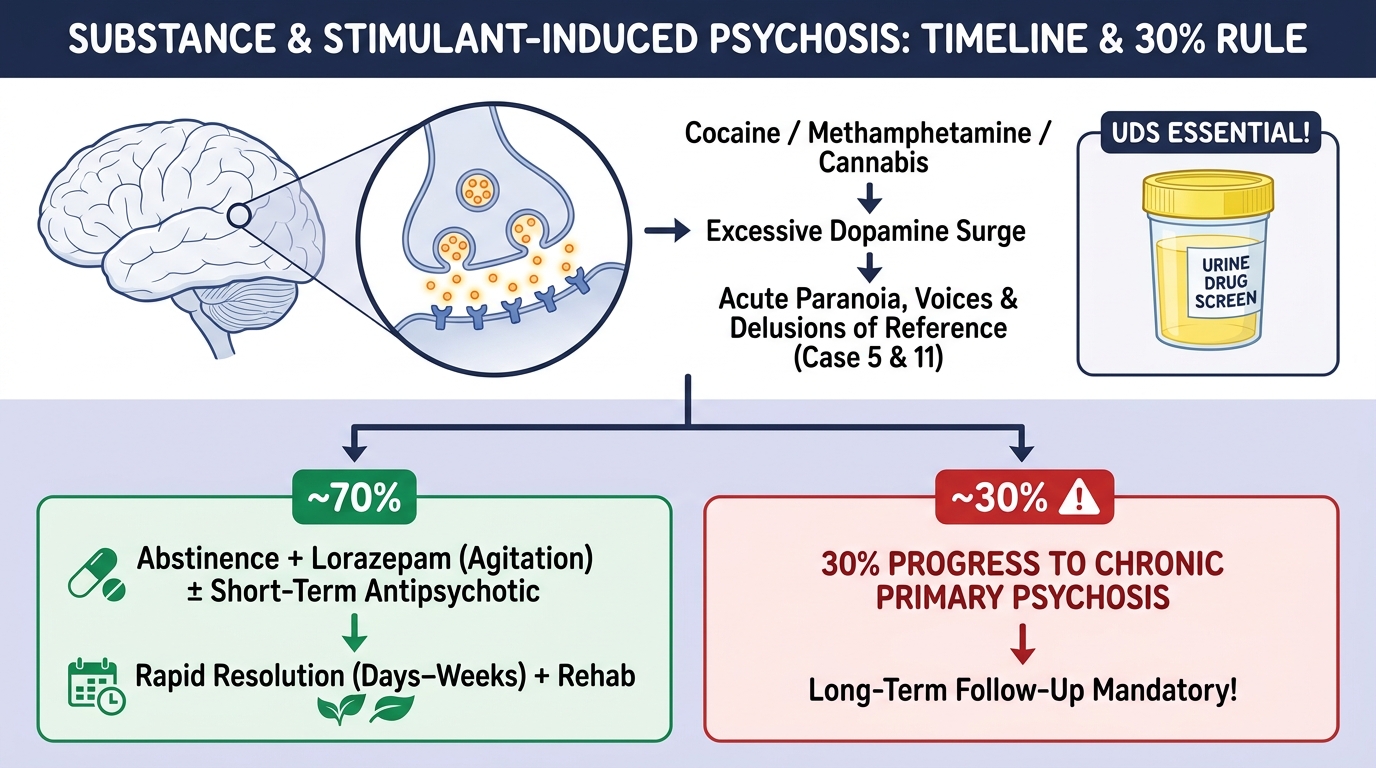
Substance- and stimulant-induced psychosis is one of the highest-yield differential traps across USMLE, PLAB, and psychiatry OSCEs. Mastering it requires three clinical superpowers: checking a urine drug screen (UDS) early, recognizing that sustained abstinence is the primary treatment, and never forgetting the 30% Conversion Rule—nearly one in three patients will later progress to a chronic primary psychotic disorder if longitudinal follow-up is missed.
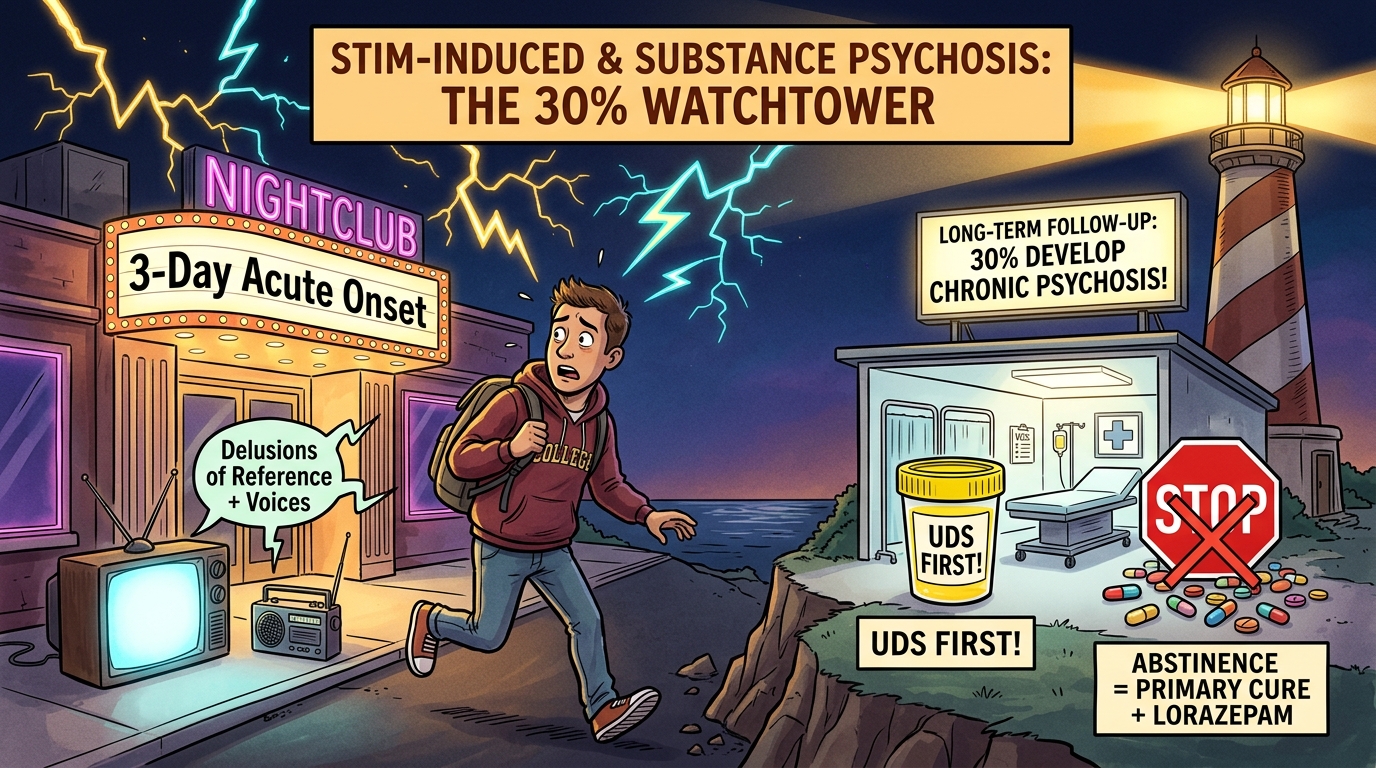
Clinical clue: Rapid 72-hour onset in a previously well-functioning nightclub regular points squarely to excessive dopamine release from cocaine, amphetamine, or methamphetamine—demand a UDS before writing a lifelong schizophrenia label!
Clinical clue: Acute symptom onset locked tightly to multi-substance use favors substance-induced psychotic disorder—yet his post-abstinence trajectory over the next weeks and months is the only true test of whether an underlying primary psychosis was unmasked.
1. Neurobiology & The “Overclocked Nightclub DJ” Mental Image
- Normal Baseline: The DJ keeps the dopamine fader smooth—background noise (radio chatter, passing footsteps) stays filtered out as irrelevant.
- The Stimulant / High-THC Surge: Cocaine blocks dopamine reuptake (DAT), while amphetamines / methamphetamine both block reuptake and force massive presynaptic vesicle release (VMAT2 reversal). Heavy THC disinhibits mesolimbic dopaminergic firing via CB1 receptors. The DJ slams the gain into the red zone: ordinary TV/radio broadcasts suddenly trigger aberrant salience—becoming delusions of reference and abusive voices.
- Pulling the Plug (Abstinence): Cut off the drug supply, and in ~70% of patients the amplifier cools down completely within days to weeks.
- The 30% Watchtower: Keep watching from the clinical watchtower even after discharge! In ~30% of cases, the substance acted as a biological stress test that unmasked an underlying primary psychotic vulnerability, causing psychosis to persist or return despite clean UDS results.
2. High-Yield Mnemonics: STIM-INDUCED & SUBSTANCE-INDUCED
Lock both clinical profiles into exam memory using Dr. Belh’s paired mnemonics—one focused on acute stimulant-induced paranoia, and one covering the broader substance-induced diagnostic and management checklist.
Mnemonic A — STIM-INDUCED PSYCHOSIS (Stimulant Profile)
Mnemonic B — SUBSTANCE-INDUCED (Diagnostic & Care Checklist)
3. Interactive Substance vs. Primary Psychosis Toxicology & Abstinence Tracker
Step through the three clinical milestones below to see how the mesolimbic dopamine surge, UDS toxicology panel, and treatment recommendation evolve from an acute 3-day club presentation to Week 2 abstinence—and learn how to spot the 30% conversion phenotype at Month 6. You can also toggle the exposure profile below to see why active relapse sabotages antipsychotic treatment.
Interactive Toxicology & Abstinence Tracker
Select a clinical milestone and exposure profile to watch dopamine dynamics, UDS status, and management shift in real time.
4. Diagnostic Differentiation: Substance-Induced vs. Primary Psychosis
In DSM-5 and ICD-11, a Substance/Medication-Induced Psychotic Disorder requires that delusions or hallucinations develop during or soon after substance intoxication or withdrawal, that the substance is pharmacologically capable of producing psychosis, and that symptoms are not better explained by an independent primary psychotic disorder (such as symptoms persisting well beyond ~1 month of verified abstinence, or preceding substance onset).
| Clinical Feature | Substance-Induced Psychosis | Primary Psychotic Disorder (e.g., Schizophrenia) |
|---|---|---|
| Onset & Time Course | Acute (Hours to Days) — e.g., 3-day club binge in a previously healthy student. | Usually insidious with months of social withdrawal and functional decline (prodrome). |
| Temporal Link to Drug | Directly tied to intoxication, heavy binge use, or acute withdrawal. | Psychosis precedes substance use OR persists > 1 month after verified abstinence. |
| Urine Drug Screen (UDS) | Positive for stimulants (cocaine/amphetamines), THC, or multiple substances. | Negative—or if positive, symptoms fail to resolve when subsequent UDS turns clean. |
| Hallucinations & Affect | Auditory voices (commenting/abusing), delusions of reference/persecution, irritability, anger, restlessness, visual/tactile cues in stimulant toxicity. | Predominantly auditory hallucinations, bizarre/fixed delusions, prominent negative symptoms (flat affect, avolition, alogia) and cognitive decline. |
| Premorbid Baseline | Often intact (“life and soul of the party,” active university student). | Often declining academic/occupational functioning prior to first frank episode. |
| Response to Abstinence | ~70% resolve completely within days to weeks of total cessation. | Symptoms persist or relapse despite sustained abstinence; requires ongoing antipsychotic therapy. |
5. Classic Culprit Drugs: Stimulants vs. Cannabis vs. Hallucinogens
Exams frequently test which substance matches a specific clinical phenotype, neurochemical mechanism, and UDS window. Notice how cocaine/methamphetamine and heavy cannabis sit at the center of Cases 5 and 11—and carry the highest risk of subsequent chronic conversion.
| Substance Class | Primary Neurochemical Mechanism | Hallmark Clinical Picture | UDS Window & Exam Pearl |
|---|---|---|---|
| Stimulants Cocaine, Amphetamine, Methamphetamine |
Massive excessive dopamine release (DAT reuptake blockade + VMAT2 vesicular release) + norepinephrine surge. | 3-day acute paranoia, speedy restlessness, anger/irritability, persecutory & reference delusions (radio/TV), commenting voices, mydriasis, tachycardia, formication (“bugs under skin”). | 2–4 days (cocaine benzoylecgonine / amphetamines). Lorazepam 1st-line for agitation. |
| Cannabis (High-Potency THC) | CB1 receptor agonism disinhibits mesolimbic dopaminergic firing + disrupts prefrontal GABA/glutamate balance. | Acute paranoia, persecutory ideation, derealization, panic, behavioral dyscontrol; strong dose-dependent link in adolescents/young adults. | 3–30+ days (fat-soluble THC-COOH in heavy daily users). Highest conversion risk to chronic schizophrenia (~30–45% in cohorts). |
| Hallucinogens & Dissociatives LSD, Psilocybin, PCP, Ketamine |
5-HT2A agonism (LSD/psilocybin) or NMDA receptor antagonism (PCP/ketamine). | Vivid visual hallucinations, synesthesia, perceptual distortion; PCP uniquely causes vertical/horizontal nystagmus, analgesia, and violent agitation. | Standard UDS often misses LSD/psilocybin (PCP usually detected 5–8 days). Reassurance in a quiet room + benzodiazepines. |
| Polysubstance Use Cannabis + Cocaine (Case 11) |
Synergistic dopaminergic excess + disrupted cortical sensory gating. | Severe acute delusions, hallucinations, paranoia, and risky/impulsive behavior with multi-positive UDS. | Rule out withdrawal (alcohol/BZD delirium tremens) & mandate structured addiction rehab. |
6. Management Protocol: Acute Stabilization vs. Long-Term Care
| Care Phase | First-Line Clinical Action | Pharmacology & Safety Rationale | Common Pitfall to Avoid |
|---|---|---|---|
| 1. Immediate Triage & Diagnostics | Urine Drug Screen (UDS), vitals, ECG (cocaine ischemia/QTc), glucose, electrolytes, safety assessment. | Confirms causative agent(s) and excludes medical/toxic emergencies (hyperthermia, rhabdomyolysis, sympathomimetic crisis). | Skipping UDS or jumping directly to a schizophrenia diagnosis on Day 1. |
| 2. Acute Agitation & Safety | Low-stimulation quiet room + Benzodiazepine (Lorazepam); brief hospitalization if high risk to self/others. | Lorazepam 1–2 mg PO/IM/IV rapidly reduces stimulant-driven agitation, tachycardia, hypertension, and seizure risk. | Using high-potency typical antipsychotics (e.g., haloperidol) alone in acute stimulant toxicity → lowers seizure threshold & risks dystonia/NMS/QTc prolongation. |
| 3. Severe / Persistent Psychosis | Short-term atypical antipsychotic (e.g., olanzapine or risperidone) at low-to-moderate dose while observing abstinence. | Provides targeted D2 blockade when frightening command/persecutory delusions persist despite benzodiazepines and safety measures. | Escalating to lifelong high-dose antipsychotics while the patient continues using drugs (poor clinical efficacy!). |
| 4. Definitive Core Therapy | Total Substance Abstinence + Motivational Interviewing, CBT, and formal Substance Rehabilitation. | Eliminates the exogenous dopamine trigger; allows ~70% of patients to recover fully and regain baseline functioning. | Treating psychosis pharmacologically without engaging addiction services or relapse prevention. |
| 5. Longitudinal Follow-Up | Structured outpatient psychiatry follow-up + serial UDS checks over 6–12+ months. | Detects the ~30% who progress to chronic primary psychosis early enough for Early Intervention in Psychosis (EIP). | Discharging the patient as “cured” once acute club paranoia clears at Day 5! |
7. The 30% Conversion Rule & Longitudinal Follow-Up Plan
Even when a student’s 3-day stimulant paranoia disappears completely after a week of abstinence, the clinical story is not over. Longitudinal cohorts consistently show that approximately 30% of patients with substance-induced psychosis convert to a chronic primary psychotic disorder (most commonly schizophrenia spectrum or bipolar disorder with psychotic features) over subsequent years. The drug did not merely create a transient toxic reaction—it acted as a neurobiological stressor that unmasked an underlying vulnerability.
| Follow-Up Milestone | Clinical Objective & Check | Reassuring Sign (70% Group) | Conversion Red Flag (30% Watchtower) |
|---|---|---|---|
| Week 1–2 Post-Discharge |
Verify early abstinence (repeat UDS), assess sleep/irritability, connect to addiction rehab. | Rapid fading of delusions/voices; returning insight (“the drugs made me paranoid”). | Persistent persecutory delusions or commenting voices despite clean UDS. |
| Month 1 DSM-5 Cutoff |
Re-evaluate psychotic symptoms after ~4 weeks of verified substance abstinence. | Full return to premorbid academic/social baseline; taper short-term antipsychotic if used. | Psychosis > 1 month drug-free → Reclassify toward primary psychotic disorder! |
| Months 3–6 Relapse & Prodrome Check |
Screen for negative symptoms, mood cycling, functional drift, and covert substance relapse. | Sustained recovery, active university/work engagement, negative UDS. | Social withdrawal, blunted affect, bizarre thought form, or recurrent psychosis with clean UDS. |
| Months 6–12+ Long-Term Surveillance |
Monitor high-risk profiles (heavy cannabis, methamphetamine, family history of schizophrenia, younger age). | Stable remission with relapse-prevention plan and psychoeducation on high-risk triggers. | Refer to Early Intervention Psychosis (EIP) + initiate long-term maintenance antipsychotic therapy. |