A quiet, emotionally flat patient sitting alone in your clinic is one of the highest-yield—and easiest-to-misdiagnose—presentations in clinical psychiatry. On the surface, social withdrawal, blunted affect, and minimal emotional reactivity can look nearly identical across three radically different entities: a lifelong, comfortable Schizoid Personality Disorder, an emerging Schizophrenia spectrum disorder masked by negative symptoms, or a primary episode of Major Depressive Disorder (MDD).
Getting this Flat-Affect Differential wrong carries major clinical stakes: medicate a stable Schizoid patient unnecessarily and you cause harm; miss subtle psychosis behind “SSRI-resistant depression” and your patient deteriorates on ineffective antidepressant monotherapy. In this guide, we pair two unforgettable clinical cases—Case 6 (The Electrical Repairman at His Mother’s Funeral) and Case 10 (The SSRI-Failure Red Flag)—with high-yield mnemonics (SCHIZOID & MISSED SCHIZOPHRENIA), an interactive 4-axis diagnostic matrix, and four exam-ready comparison tables.
Mental Status Exam (MSE): Flat/restricted affect and social detachment, NO active psychotic symptoms (no hallucinations, no delusions, no formal thought disorder), intact mechanical cognition, and completely ego-syntonic—he is genuinely comfortable being alone and feels no distress about his lifestyle.
Diagnostic Turning Point: Prominent negative symptoms (apathy, withdrawal, blunted affect) were mimicking MDD while positive psychotic symptoms quietly emerged underneath. SSRI monotherapy failure in an apathetic, withdrawn patient is a MAJOR RED FLAG for underlying psychosis!
1. The 3-Way Flat-Affect Differential: Core Clinical Framework
When a patient presents with restricted affect and social isolation, three bedside questions separate these conditions in under two minutes:
- Longitudinal Course: Has this quiet detachment been lifelong since childhood (Schizoid PD), or is it a subacute decline over months from a higher baseline (Emerging Schizophrenia or MDD)?
- Inner Emotional Experience (Ego-Syntonic vs. Ego-Dystonic): Is the patient genuinely content alone (Schizoid PD), desperately longing for friends but terrified of rejection (Avoidant PD), or experiencing pervasive painful sadness and guilt (Primary MDD)?
- Psychosis & Thought Form Screen: Are there subtle odd beliefs, formal thought disorder, strange speech patterns, or perceptual disturbances—especially after SSRI monotherapy failure (Case 10: Missed Schizophrenia)?
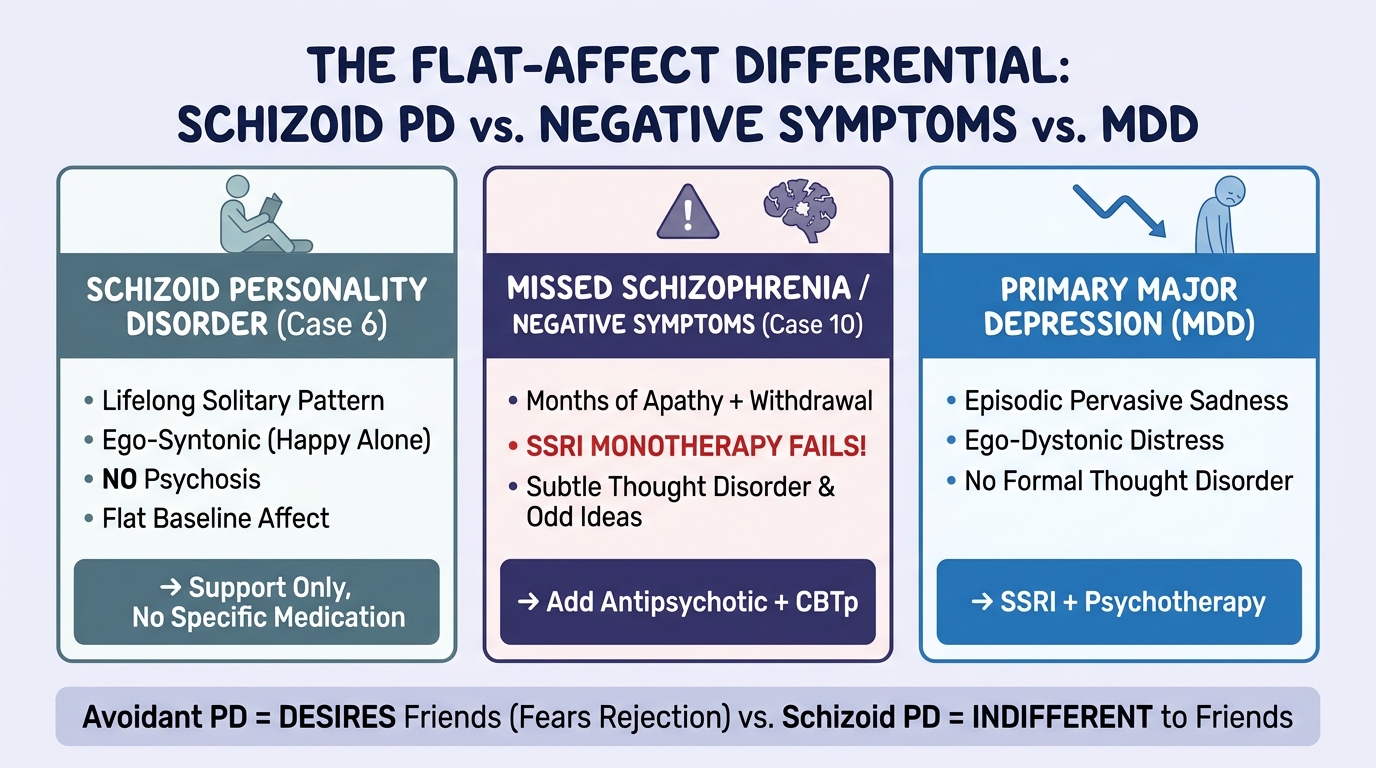
2. Memory Palace & Dual Mnemonics: “SCHIZOID” vs. “MISSED SCHIZOPHRENIA”
- Room 6 (Schizoid PD — The Calm Workbench): A solitary man in jeans and a dirty T-shirt quietly soldering a toaster after his mother’s funeral. No voices, no bizarre beliefs, no tears, and no distress—his reality testing is rock-solid, his toolbox is neat, and he simply wants to be left in peace.
- Room 10 (Missed Schizophrenia — The Red-Flag Pill Bottle): A shadowy room lined with empty SSRI bottles marked “NO EFFECT”. At first glance the patient looks flat and apathetic like depression, but a magnifying glass reveals fractured speech bubbles (formal thought disorder), subtle odd beliefs, and nighttime rumination quietly brewing behind the curtain.
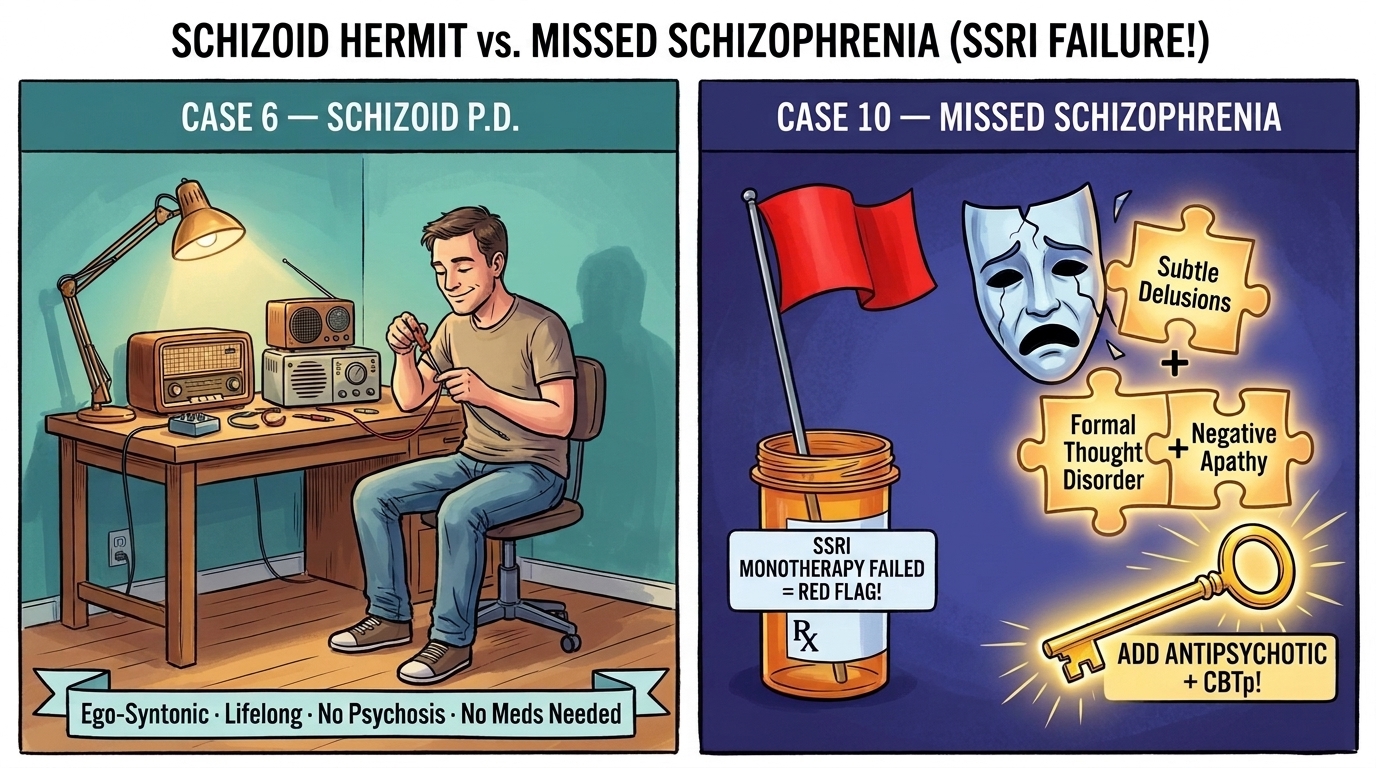
Mnemonic A (Case 6): S.C.H.I.Z.O.I.D. — Schizoid Personality Disorder
Mnemonic B (Case 10): M.I.S.S.E.D. (SCHIZOPHRENIA) — Negative Symptoms Masking Psychosis
3. Interactive 3-Way Flat-Affect & Social Withdrawal Diagnostic Matrix
Switch between the four classic exam patient profiles below to compare their live 4-Axis Diagnostic Radar (Desire for Friends, Pervasive Sadness, Lifelong Stability, and Thought Disorder / Odd Beliefs), check the First-Line Management Verdict, and click the OSCE Bedside Probe buttons to hear how each patient responds on Mental Status Exam.
Interactive Matrix: Flat-Affect & Social Withdrawal Differential
Select a clinical profile to inspect its 4-axis MSE fingerprint and first-line management verdict.
4. Four High-Yield Clinical Tables
Table 1: 4-Way Social Withdrawal Differential (Cluster A vs. Cluster C vs. Psychosis)
Examiners love testing the exact boundary between Schizoid PD, Avoidant PD, Schizotypal PD, and Prodromal / Emerging Schizophrenia:
| Clinical Feature | Schizoid PD (Case 6) | Avoidant PD (Cluster C) | Schizotypal PD (Cluster A) | Emerging Schizophrenia (Case 10) |
|---|---|---|---|---|
| Desire for Relationships | None / Indifferent Genuinely prefers solitude |
Strong Desire Avoids only due to fear of rejection |
Reduced due to extreme social anxiety & paranoid mistrust | Declining from prior baseline (secondary to avolition/asociality) |
| Ego-Syntonic vs. Dystonic | Ego-Syntonic (comfortable alone) | Ego-Dystonic (painfully lonely) | Variable (distressed by social anxiety) | Progressive functional deterioration; variable insight |
| Thought Content & Perception | Normal reality testing; NO delusions, NO magical thinking | Completely normal; preoccupied with inadequacy/criticism | Magical thinking, ideas of reference, odd beliefs, eccentric dress | Subtle delusions, formal thought disorder, strange speech, perceptual disturbances |
| Course Over Time | Lifelong, stable since quiet childhood | Lifelong, stable since adolescence | Lifelong eccentric pattern (may progress to schizophrenia) | Subacute decline over months; worsening cognition/function |
| Primary Management | Supportive; no meds; do NOT force socialization | CBT exposure, social skills, ± SSRI for anxiety | Supportive psychotherapy; low-dose antipsychotic only if transient psychosis | Antipsychotic + Antidepressant + CBTp + full psychosis workup |
Table 2: Negative Symptoms of Schizophrenia vs. Primary Clinical Depression (MDD)
In Case 10, negative symptoms masqueraded as MDD for months. Use these bedside MSE clues to tell them apart:
| MSE / History Domain | Primary Major Depression (MDD) | Negative Symptoms Masking Schizophrenia (Case 10) |
|---|---|---|
| Subjective Mood Quality | Pervasive painful sadness, emptiness, tearfulness, hopelessness | Emotional blankness/apathy rather than intense subjective misery |
| Affect & Reactivity | Depressed, tearful, constricted; often visibly anguished | Flat / blunted affect with reduced facial, vocal, and gestural range |
| Guilt & Worthlessness | Prominent excessive guilt, self-blame, suicidal ideation | Minimal classic depressive guilt; instead, detachment or odd self-referential ideas |
| Speech & Thought Form | Slowed (psychomotor retardation) but logical and linear | Alogia (poverty of speech), subtle tangentiality, echoing/unusual speech, slight formal thought disorder |
| Response to SSRI Monotherapy | Typically improves within 4–8 weeks | NO Improvement — SSRI monotherapy failure is a cardinal red flag! |
Table 3: Case 6 (Schizoid PD) vs. Case 10 (Missed Schizophrenia) — Management Plan
| Management Pillar | Case 6: Schizoid Personality Disorder | Case 10: Depressive Symptoms Masking Schizophrenia |
|---|---|---|
| Pharmacotherapy | NO Specific Medication for personality traits. Only treat comorbid MDD or stress-induced decompensation if it arises. | Add Antipsychotic to Antidepressant (do NOT continue antidepressant monotherapy alone). |
| Diagnostic Workup | Confirm lifelong baseline from collateral history; rule out autism spectrum, MDD, and active psychosis. | Full psychosis workup (medical/neurologic/toxicology screen, comprehensive longitudinal collateral, detailed MSE for positive & negative symptoms). |
| Psychotherapy | Not mandatory if stable and content; supportive individual therapy only if mood deteriorates or distress occurs. | CBT for Psychosis (CBTp) to target odd beliefs, coping strategies, and negative-symptom apathy. |
| Social & Family Approach | Reassure family about his personality style; support rather than forcing socialization or group therapy. | Family psychoeducation (reduce expressed emotion, spot relapse signs early) + structured functional rehabilitation. |
| Escalation / Safety | Routine primary care follow-up; watch for bereavement-triggered depression or isolation-related medical neglect. | Hospitalization if clinically deteriorating, unable to care for self, or developing safety risks/acute psychosis. |
Table 4: Primary Care SSRI-Failure Red-Flag Checklist (When to Screen for Psychosis)
Whenever a patient diagnosed with “depression” fails an adequate trial of SSRI monotherapy, run through this 5-point OSCE/PLAB safety checklist before switching to another antidepressant:
| Red-Flag Domain | What to Ask / Observe on MSE | Why It Points Away from Pure MDD |
|---|---|---|
| 1. Treatment Non-Response | Zero or minimal response after adequate SSRI dose & duration (6–8 weeks), with worsening apathy. | Negative symptoms of schizophrenia do NOT resolve with SSRI monotherapy alone. |
| 2. Subtle Odd Beliefs | “Have things around you felt unusually meaningful, directed at you, or hard to explain lately?” | Uncovers subtle delusions or ideas of reference hidden behind quiet withdrawal. |
| 3. Thought Form & Speech | Listen for vague, tangential answers, idiosyncratic word choices, echoing, or subtle derailment. | Formal thought disorder is NOT a feature of non-psychotic MDD or Schizoid PD. |
| 4. Perceptual Disturbances | “Do you ever hear muffled voices, murmurs, or notice strange sensations when alone at night?” | Early auditory/perceptual anomalies are frequently rationalized or concealed unless explicitly asked. |
| 5. Daytime Apathy + Nighttime Rumination | Contrast passive, flat daytime presentation with intrusive, bizarre, or distressing nocturnal thoughts. | Hallmark Case 10 pattern—prompts urgent psychiatric referral, antipsychotic addition, and CBTp. |