Two 24-year-old patients arrive in psychiatry within the same week. One sits quietly in a clinic chair, speaking in a flat monotone and insisting he “feels fine” after two years of silent isolation. The other arrives in crisis after 48 hours of hearing voices in the roof, smelling unseen intruders, and proclaiming herself a goddess chosen to rid the world of evil.
Here is the core paradox tested relentlessly on USMLE, PLAB, and OSCE exams: the dramatic, terrifying 2-day storm carries a FAR better prognosis than the quiet, slow 2-year fade. Understanding why—and separating the insidious paranoid schizophrenia prodrome from acute polymorphic (brief) psychotic disorder—will protect you from psychiatry’s five most notorious diagnostic traps.
Mental State Exam (MSE): Reduced spontaneous movements, monotonous soft speech (alogia), “prickly” defensive suspicious behavior, and flat affect. He denies depression or psychosis.
Working Diagnosis: Paranoid Schizophrenia (Insidious 2-Year Prodrome → Emerging Positive Symptoms).
Working Diagnosis: Acute Polymorphic Psychotic Disorder (ICD-11) / Brief Psychotic Disorder (DSM-5) — pending urgent medical/substance rule-out.
1. Mental Image & Memory Palace: “2-Year Bedroom Fog” vs. “2-Day City Storm”
- Case 1 — The Silent Dimming Bedroom (2-Year Fog): Picture our 24-year-old biology graduate closing his curtains while his third-class diploma collects dust. First, the lights dim slowly—negative symptoms (avolition, alogia, flat affect, asociality, neglected hygiene) precede positive symptoms by months to years. Only later do paranoid shadows (“watched and followed”) creep into the room. Because neurodevelopmental/functional erosion has already been running for 2 years, prognosis is more guarded and demands early, sustained care.
- Case 2 — The Sudden City Thunderstorm (2-Day Lightning Strike): Picture a young woman overwhelmed by a towering unfamiliar city, sleepless for days after quitting her job, suddenly struck by a violent electric storm: roof voices, phantom odors, a radiant “goddess” delusion, and swinging moods alternating between frantic pacing and frozen stillness. It looks frightening—yet storms triggered by acute stress + severe sleep deprivation with polymorphic shifting symptoms clear rapidly once safety, medication, and sleep are restored.
- PPoor performance — academic slide (third-class biology degree despite prior high achievement)
- AAnhedonia & Avolition — loss of drive; hours spent alone in bedroom
- RReduced speech (Alogia) — monotonous, soft, sparse answers
- AAsociality — gradual loss of friendships and social withdrawal
- NNeglected hygiene — deteriorating self-care and grooming
- OOdd ideas — suspicious beliefs of being watched and followed
- IIdeas of reference — neutral events misread as targeted surveillance
- DDefensive behavior — “prickly,” guarded demeanor; insists he “feels fine”
- AAgitation & Anxiety — 1 week escalating anxiety, alternating agitation & motionless catatonic-like episodes
- CConfused speech — acute perplexity and disorganized utterances
- UUnusual grandiose beliefs — “goddess chosen to rid the world of evil”
- TTactile / Auditory / Olfactory hallucinations — voices hidden in the roof + smelling them
- EEmotional lability — rapid, polymorphic mood shifts hour to hour
- FFlorid positive symptoms — abrupt onset after rural-to-city stress, job loss & severe sleep deprivation
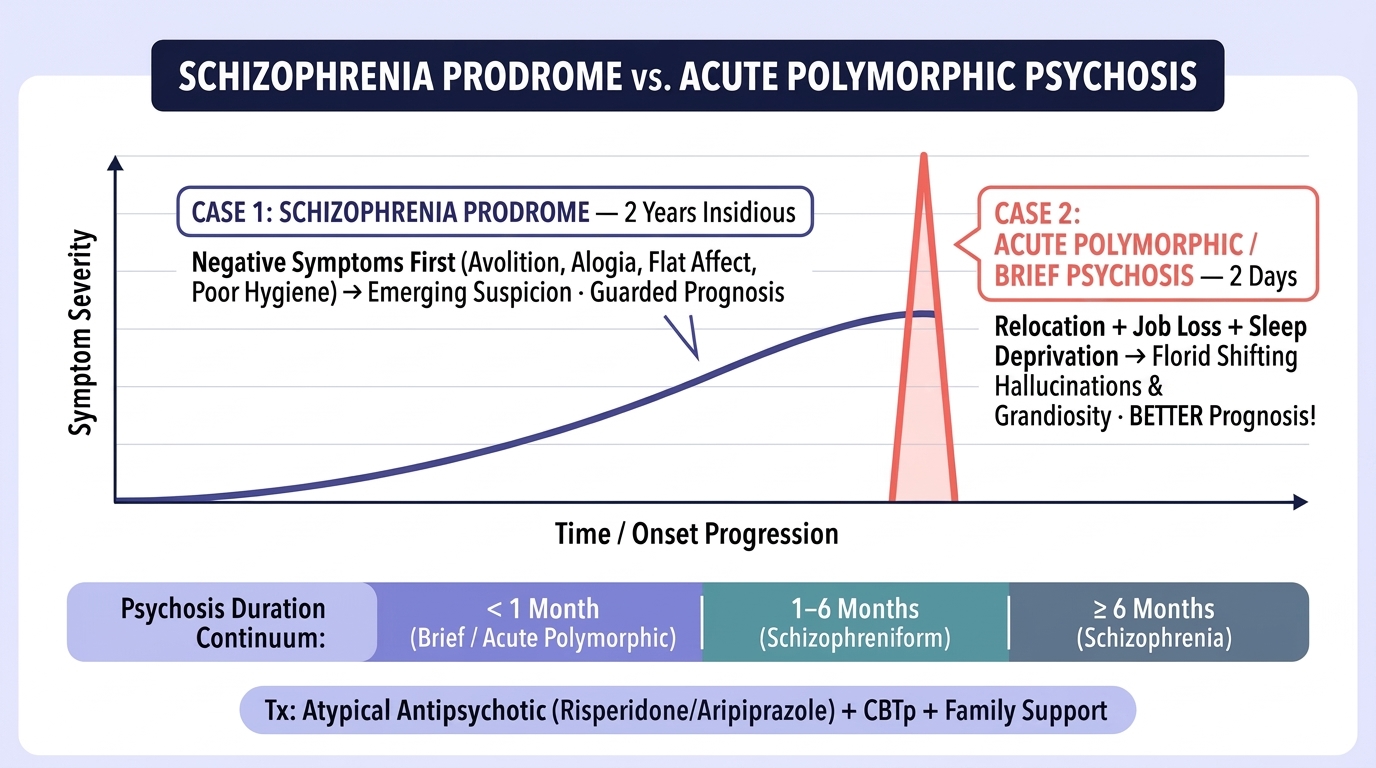
< 1 mo Brief/Acute Polymorphic vs. 1–6 mo Schizophreniform vs. ≥ 6 mo Schizophrenia).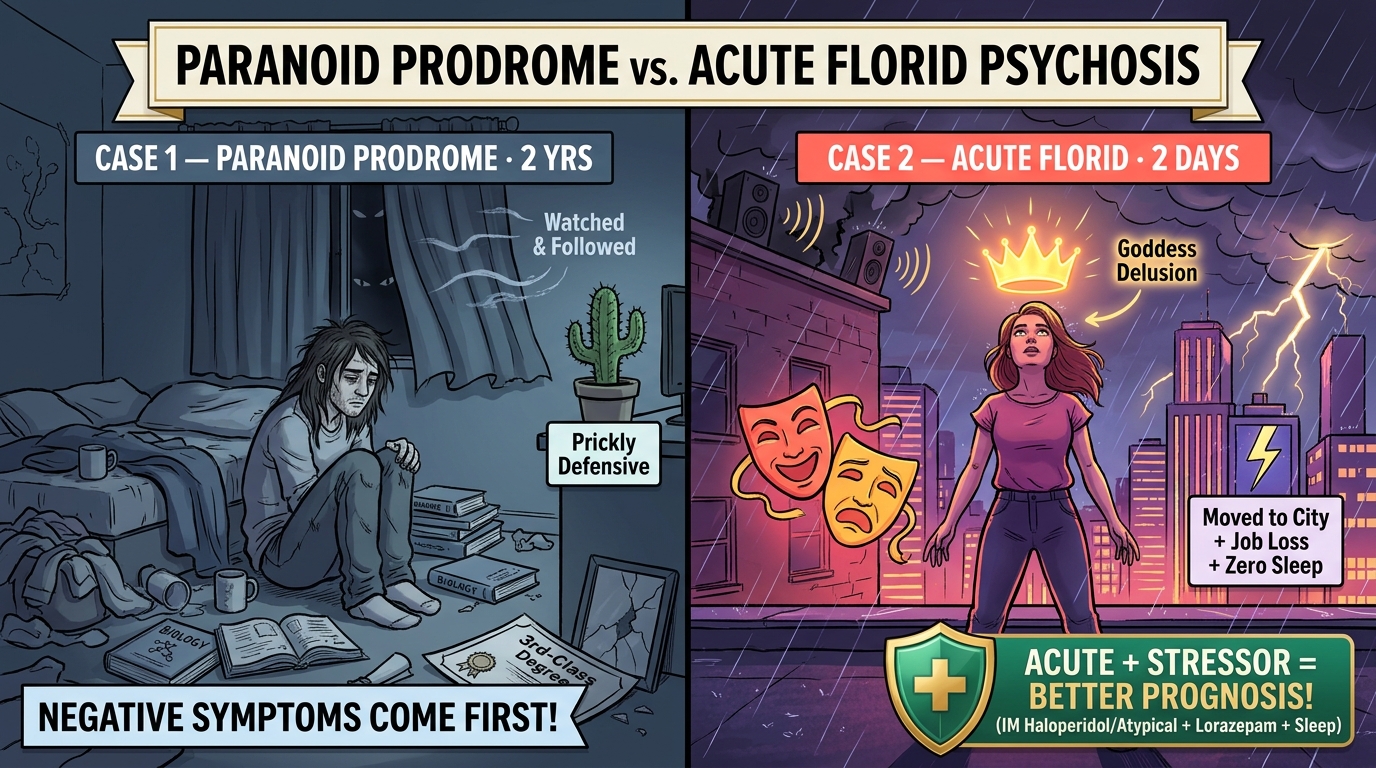
2. Interactive Psychosis Onset, Duration & Prognosis Comparator
Switch between the three clinical trajectories below to watch how Negative Symptoms and Positive Symptoms evolve across time, how the Prognosis Meter flips between acute and insidious onset, and how acute crisis stabilization differs from long-term schizophrenia care.
Interactive Psychosis Onset, Duration & Prognosis Comparator
Toggle the timeline course to compare dual symptom curves, DSM-5/ICD-11 thresholds, and management plans.
Dominant Symptom Profile
- Auditory (“voices in roof”) & olfactory hallucinations
- Grandiose delusion (“goddess ridding world of evil”)
- Confused speech, mood lability & catatonic-like stillness
Acute vs. Long-Term Management
- Acute: Urgent hospitalization + medical/substance rule-out
- Meds: IM haloperidol (or atypical) + lorazepam for agitation
- Recovery: Restore sleep, resolve stressors & follow longitudinally
3. Side-by-Side Comparison: Case 1 Prodrome vs. Case 2 Acute Polymorphic Psychosis
Both patients are 24 years old—yet nearly every feature of their onset, affect, phenomenology, and prognosis points in the opposite direction.
| Clinical Dimension | Case 1: Insidious Schizophrenia Prodrome | Case 2: Acute Polymorphic / Brief Psychosis |
|---|---|---|
| Patient Profile | 24-year-old male biology graduate; previously high-achieving; brought in by mother. | 24-year-old woman from rural community who relocated to a large city; quit job 2 weeks ago. |
| Onset & Timeline | Insidious (~2 Years) Graduated 2 years ago with a 3rd-class degree → slow functional erosion. |
Explosive (2 Days) 1 wk escalating anxiety + severe sleep loss → abrupt 48-hour crisis. |
| Leading Symptoms | Negative symptoms FIRST: avolition, asociality (hours in bedroom), neglected hygiene, alogia, flat affect. | Florid positive symptoms FIRST: roof voices, smelling unseen people, “goddess” delusion, confused speech. |
| Affect & Psychomotor State | Flat affect, reduced spontaneous movements, monotonous soft speech, “prickly” suspicious defensiveness. | Marked mood lability; rapid shifts between severe agitation and motionless catatonic-like episodes. |
| Insight & Presentation | Poor insight; denies depression or psychosis; insists he “feels fine.” | Marked acute distress/perplexity; brought urgently because behavior is dramatically unsafe/bizarre. |
| Precipitating Trigger | No single acute stressor; gradual neurodevelopmental/functional decline. | Clear psychosocial stressor (urban migration + quitting job) amplified by severe sleep deprivation. |
| Long-Term Prognosis | Guarded / Chronic Risk Long untreated duration + prominent negative symptoms worsen outcome. |
Much Better Prognosis Acute onset + clear stressor + polymorphic symptoms + female sex favor full recovery. |
4. The Psychotic Disorder Duration Continuum (DSM-5 & ICD-11)
Never assign a lifelong diagnosis of schizophrenia on Day 2 of psychosis. Examiners love testing whether you check the total duration clock—including prodromal and residual phases.
| Duration Window | Diagnosis (DSM-5 / ICD-11) | Core Diagnostic Requirements | Exam & Prognostic Pearl |
|---|---|---|---|
| < 1 Month (At least 1 day) |
Brief Psychotic Disorder (DSM-5) Acute Polymorphic / Acute & Transient Psychotic Disorder (ICD-11) |
≥ 1 positive symptom (delusions, hallucinations, disorganized speech, or grossly disorganized/catatonic behavior) with eventual full return to baseline. | Case 2 fits here! Acute polymorphic shifts (hallucinations + grandiose delusions + mood lability) after stress/sleep loss carry the best prognosis; more common in women. |
| 1 – 6 Months | Schizophreniform Disorder (DSM-5) | Same Criterion A symptoms as schizophrenia (≥ 2 symptoms, at least 1 core positive) lasting ≥ 1 month but < 6 months. Functional decline not strictly required. | Specify “with good prognostic features” (≥ 2 of: onset <4 wks, confusion/perplexity, good premorbid function, absence of blunted/flat affect). Watch closely at the 6-month mark! |
| ≥ 6 Months (incl. prodrome) |
Schizophrenia (DSM-5) (ICD-11 uses ≥ 1 month active symptoms without mandatory 6-mo total) |
≥ 6 months continuous disturbance (prodromal + active + residual), including ≥ 1 month of active-phase Criterion A symptoms + significant functional decline. | Case 1 fits this trajectory! His 2-year prodrome (3rd-class degree, bedroom isolation, hygiene neglect, flat affect) counts toward the 6-month total once active paranoid symptoms crystallize. |
5. Separating the Schizophrenia Prodrome from Depression (“Burnout Mimic”)
Why is Case 1 missed so often in primary care and exams? Because a 24-year-old graduate isolating in his room with poor hygiene looks superficially like Major Depressive Disorder. Use this 5-point bedside screen to separate them cleanly:
| Clinical Feature | Schizophrenia Prodrome (Case 1) | Major Depressive Disorder (MDD) |
|---|---|---|
| Core Emotional State | Apathy, avolition & flat/blunted affect (emotional emptiness rather than painful sadness). | Pervasive subjective sadness, tearfulness, emptiness, and emotional pain. |
| Thought Content | Emerging odd ideas, ideas of reference, suspiciousness (feeling watched and followed). | Depressive ruminations: excessive guilt, worthlessness, hopelessness, suicidal ideation. |
| Attitude & Insight | Brought by family; “prickly” defensive guardedness; denies illness and insists he “feels fine.” | Often recognizes distress and voluntarily seeks relief (unless severely psychotic depression). |
| Speech & Motor Exam | Alogia (monotonous soft sparse speech), reduced spontaneous movements, awkward social disconnect. | Psychomotor retardation (or agitation) coupled with coherent complaints of fatigue/low mood. |
| Functional Trajectory | Steep, silent 2-year downward drift (high achiever → 3rd-class degree → lost friends → neglected hygiene). | Episodic decline with preserved premorbid social relatedness between episodes. |
6. Antipsychotic & Psychosocial Management Protocols
| Management Domain | Case 1: Prodromal / Early Paranoid Schizophrenia | Case 2: Acute Polymorphic / Brief Psychosis |
|---|---|---|
| Care Setting | Outpatient / Early Intervention in Psychosis (EIP) team (hospitalize only if acute safety risk). | Hospitalization Essential Safe, low-stimulation inpatient unit to protect against impulsive/bizarre acts and catatonic complications. |
| First-Line Pharmacotherapy | Atypical (2nd-gen) antipsychotic preferred: e.g., risperidone or aripiprazole (“start low, go slow” to protect alliance and minimize EPS). | Acute antipsychotic (IM haloperidol if refusing oral/severely agitated, or oral/IM atypical) + lorazepam for severe agitation, anxiety, or catatonic-like episodes. |
| Targeted Non-Drug Priorities | Psychoeducation (gentle engagement despite low insight), Family Intervention (reduce expressed emotion), CBT for psychosis (CBTp), community/vocational rehabilitation. | Sleep restoration (critical therapeutic target!), medical/substance rule-out, gentle reorientation, practical problem-solving for urban relocation/job-loss stressors. |
| Monitoring & Follow-Up | Metabolic panel (weight, BMI, lipids, HbA1c/glucose), prolactin (especially risperidone), EPS/akathisia, suicide risk, adherence tracking. | Monitor vitals/EPS/QTc (especially with IM haloperidol), assess resolution within < 1 month, and maintain longitudinal follow-up to detect relapse or evolution into schizophrenia/bipolar disorder. |