Posttraumatic Stress Disorder (PTSD) is one of the most misunderstood conditions in psychiatry—and one of the easiest places to lose points on exams if you mistake physical injury severity for psychological trauma severity. A survivor can walk out of a burning wreck with only bruises, return to work days later, and still be blindsided weeks afterward by intrusive terror, avoidance, and crushing survivor guilt.
In this visual, exam-focused Psychiatry guide, we follow Case 3.4 (“Low Mood and Anxiety After a Very Stressful Event”) to decode the classic 1-month delayed onset, separate Acute Stress Disorder (ASD) from PTSD, anchor the PTSD TRAUMA mnemonic, and master first-line trauma-focused therapy (PE, CPT, EMDR) and FDA-approved SSRIs (sertraline and paroxetine).
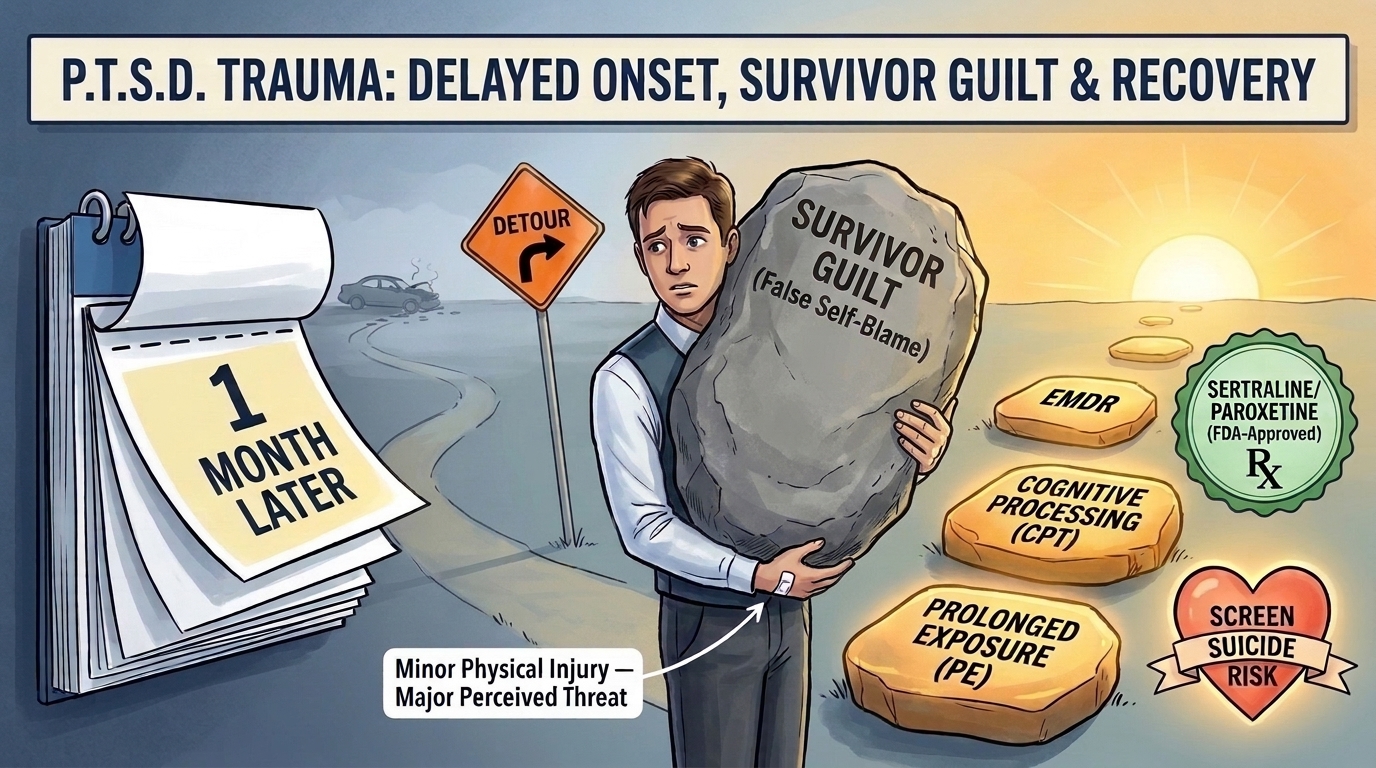
Now, 1 month post-crash, he is plagued by intrusive memories of the wreck and intense survivor guilt—convinced he “could have saved her if he had acted quicker.” He cannot drive anywhere near the accident site without overwhelming panic and feels deeply confused and ashamed that he is struggling despite barely being scratched.
Working Diagnosis: Posttraumatic Stress Disorder (PTSD), mild to moderate — driven by perceived life threat & witnessed death, NOT physical injury severity.
1. Neurobiology, Delayed Onset & The “Stuck Smoke Alarm” Mental Image
- What triggers PTSD (DSM-5 Criterion A): Exposure to actual or threatened death, serious injury, or sexual violence (direct experience or witnessing it in person). Perceived life threat—being trapped in a burning car while witnessing a fatality—drives PTSD even with minimal bodily harm!
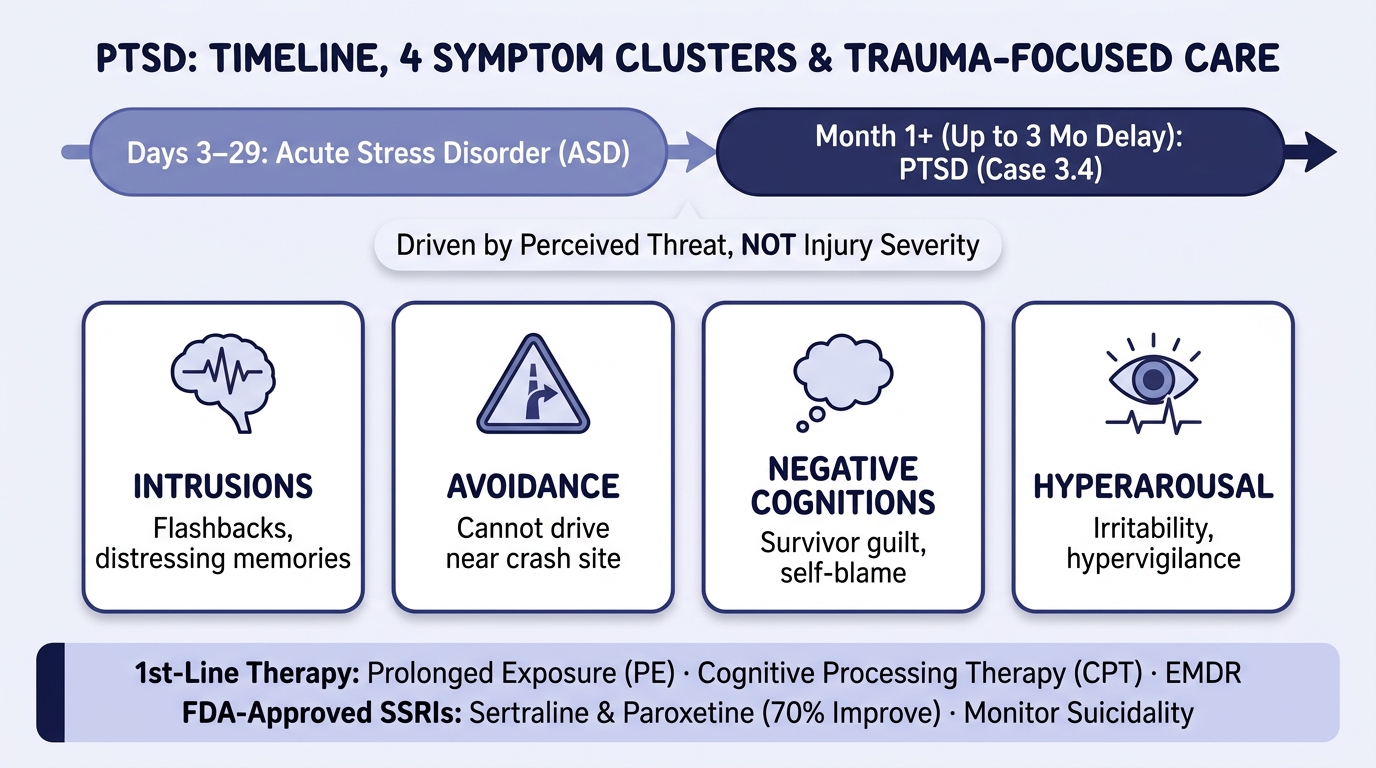
- The 1-Month Rule & Delayed Onset: Symptoms lasting 3 days to <1 month = Acute Stress Disorder (ASD). Symptoms persisting ≥1 month = PTSD. Critically, delayed onset—emerging 1 to 3 months (or even later) after an initial period of coping—is a classic presentation just like Case 3.4.
- Why Survivor Guilt Fuels Depression: In the aftermath of helpless terror, the brain invents an illusion of retrospective control (“If I had moved faster, she would have lived”). That distorted self-blame bridges PTSD directly into depressed mood and elevated suicide risk.
High-Yield Mnemonic: “PTSD TRAUMA”
Anchor Case 3.4’s exact clinical signature with the PTSD TRAUMA memory frame so you never confuse delayed PTSD with routine sadness or an adjustment reaction:
2. Interactive Post-Trauma Timeline (ASD vs. PTSD) & Trauma-Focused Therapy Simulator
Scrub across the 90-day post-crash timeline—or click the clinical milestones below—to watch the 22-year-old bank clerk’s Amygdala Alarm vs. Prefrontal Brake circuit shift from acute shock into Case 3.4 delayed-onset PTSD. Then test each treatment in the Therapy Matchmaker to see why avoidance locks PTSD in place while PE, CPT, EMDR, and sertraline/paroxetine extinguish fear and dismantle survivor guilt.
Interactive Simulator: Post-Trauma Timeline & Therapy Matchmaker
Track ASD (<1 month) → PTSD (≥1 month) neurobiology, then choose an intervention for Case 3.4.
3. Post-Trauma Differential Diagnosis: Timing & Criterion A Decide the Answer
Board exams love testing whether a distressed trauma survivor has Acute Stress Disorder, PTSD, Adjustment Disorder, or Major Depressive Disorder (MDD). Check two filters first: (1) Did the event involve actual/threatened death or severe trauma (Criterion A)? and (2) Has it lasted ≥1 month?
| Disorder | Onset & Duration Rule | Stressor Requirement & Core Features | Distinction from Case 3.4 |
|---|---|---|---|
| Acute Stress Disorder (ASD) | 3 Days to < 1 Month | Requires Criterion A trauma. ≥9 symptoms across intrusion, negative mood, dissociation, avoidance, and arousal. | Too short for Case 3.4—his symptoms emerged and persisted at Month 1, crossing the PTSD cutoff. |
| Posttraumatic Stress Disorder (PTSD) | ≥ 1 Month (Delayed onset 1–3+ mo is classic) |
Requires Criterion A trauma (perceived life threat / witnessed death) + symptoms across all 4 clusters (intrusion, avoidance, negative cognitions/guilt, hyperarousal). | EXACT MATCH Burning car + witnessed death + 1-month delayed onset + survivor guilt + driving avoidance. |
| Adjustment Disorder | Within 3 months of stressor; resolves within 6 months after stressor ends | Any psychosocial stressor (breakup, job loss, move); does not require Criterion A life threat or full PTSD intrusion/avoidance clusters. | Case 3.4 experienced life-threatening fire & witnessed death with classic trauma-cued avoidance and intrusions → PTSD, not Adjustment Disorder. |
| Major Depressive Disorder (MDD) | ≥ 2 weeks of ≥5 SIGECAPS symptoms | Pervasive depressed mood/anhedonia with neurovegetative changes; can occur without a traumatic trigger or co-occur with PTSD. | Low mood and guilt overlap heavily! Always ask about trauma cues & avoidance—and remember PTSD + depression spikes suicide risk. |
4. The 4 DSM-5 PTSD Symptom Clusters Mapped to Case 3.4
To diagnose PTSD after a Criterion A trauma lasting ≥1 month, symptoms must span all four domains (remember I-A-N-H: Intrusion, Avoidance, Negative cognitions/mood, Hyperarousal) and cause significant distress or functional impairment:
| DSM-5 Cluster | Minimum Criteria | Neurobiology | Exact Presentation in Case 3.4 (22-Year-Old Bank Clerk) |
|---|---|---|---|
| Cluster B — Intrusion / Re-Experiencing | ≥ 1 symptom (intrusive memories, nightmares, flashbacks, intense cued distress) | Hyperactive amygdala + uncontextualized hippocampal memory traces | Recurrent, distressing memories of being cut from the burning car and watching the young woman die; intense anxiety triggered by crash cues. |
| Cluster C — Avoidance | ≥ 1 symptom (avoiding internal memories/thoughts OR external reminders) | Negative reinforcement loop: escaping cue gives brief relief → prevents fear extinction | Actively avoids driving anywhere near the accident site because approaching it provokes overwhelming anxiety. |
| Cluster D — Negative Cognitions & Mood | ≥ 2 symptoms (distorted blame, persistent fear/guilt/shame, low mood, detachment) | Prefrontal-limbic dysregulation + maladaptive cognitive appraisals | Survivor guilt (false belief he could have saved her if faster), depressed mood, and shame over “not coping” despite minor injuries. |
| Cluster E — Arousal & Reactivity | ≥ 2 symptoms (irritability, hypervigilance, startle, poor sleep/concentration) | Excess noradrenergic tone (locus coeruleus) & sympathetic overdrive | Progressive irritability, constant on-edge tension, heightened anxiety, and autonomic surge near traffic reminders. |
5. First-Line Treatment: Trauma-Focused Psychotherapy (PE, CPT & EMDR)
Trauma-focused psychotherapy is the gold-standard first-line treatment for PTSD—outperforming medications alone in durability because it directly rewires conditioned fear and distorted trauma beliefs. Notice how PE and CPT precisely target Case 3.4’s two core problems: driving avoidance and survivor guilt.
| Psychotherapy | Core Therapeutic Mechanism | Primary Target in Case 3.4 | High-Yield Exam Pearl |
|---|---|---|---|
| Prolonged Exposure (PE) First-Line TF-CBT |
Repeated, safe imaginal exposure (recounting the trauma) + graded in-vivo exposure (approaching avoided reminders until distress drops). | Driving avoidance & cued panic near the accident site; extinguishes conditioned fear response. | Avoidance maintains PTSD; staying with the safe cue until anxiety habituates teaches the amygdala the threat has passed. |
| Cognitive Processing Therapy (CPT) First-Line TF-CBT |
Structured cognitive restructuring identifying and challenging maladaptive “stuck points” around safety, trust, power, and self-blame. | Survivor guilt (“I could have saved her if I acted quicker”) and shame over struggling despite minor physical injury. | Best answer when a vignette emphasizes distorted self-blame, guilt, or shame after trauma. |
| EMDR Evidence-Based Alternative |
Eye Movement Desensitization and Reprocessing: recalling trauma fragments while tracking bilateral stimulation (side-to-side eye movements/taps) to integrate memory. | Distressing visual intrusions of the fire and fatal wreck; reduces vividness and emotional charge of traumatic memories. | Recognized guideline-concordant trauma-focused alternative alongside PE and CPT; does not require extensive homework exposure. |
6. Pharmacotherapy & Mandatory Safety Monitoring
| Medication / Safety Domain | Agents & Clinical Role | Expected Response & Mechanism | Monitoring & Exam Traps |
|---|---|---|---|
| First-Line SSRIs (FDA-Approved) | Sertraline & Paroxetine | Modulate serotonergic amygdala-prefrontal pathways; reduce intrusions, anxiety, irritability & depression. ~70% of patients improve with SSRI + PE/CPT! | Allow 4–8+ weeks for full effect; monitor young adults (age 22!) closely for early activation or suicidal ideation when starting SSRIs. |
| Alternative / Adjunctive Options | Venlafaxine (SNRI, evidence-based alternative) Prazosin (α₁-blocker adjunct) |
Venlafaxine targets core PTSD clusters when SSRIs fail; prazosin specifically blunts central noradrenergic surge for trauma-related nightmares. | Check orthostatic hypotension with prazosin (first-dose syncope risk; give at bedtime); monitor BP with high-dose venlafaxine. |
| Contraindicated / Avoid | Chronic Benzodiazepines (e.g., alprazolam, lorazepam) |
Provide deceptive short-term sedation but block emotional processing and fear extinction during PE/CPT. | Classic USMLE/PLAB distractor! Linked to worse long-term PTSD severity, rebound anxiety, tolerance, and substance misuse. |
| Safety & Comorbidity Screen | Suicidality + Alcohol / Substance Screen | Early detection of suicidal thoughts and self-medication prevents fatal crises and protects therapy engagement. | Never assume “mild to moderate PTSD” means low suicide risk—survivor guilt is an independent driver of self-harm. |