Medically Written & Reviewed by Dr. Belh · ENT Surgeon & Medical Educator
Evidence-Based Educational Guide · Updated 2026
Medical StudentsPsychiatry · Perinatal EmergencyUSMLE · PLAB · OSCE High-Yield
Few moments in clinical medicine test a doctor’s triage instincts like a tearful or agitated new mother. Within days to weeks of delivery, the abrupt hormonal collapse of estrogen and progesterone collides with sleep deprivation, obstetric stress, and underlying genetic vulnerability—producing a spectrum that ranges from benign, self-limiting “Baby Blues” to debilitating Postpartum Depression (PPD) and the true psychiatric emergency of Puerperal (Postpartum) Psychosis.
On USMLE, PLAB, and OSCE exams, your score—and in real life, two lives (mother and infant)—depend on two razor-sharp distinctions: postpartum timing and insight into intrusive thoughts vs. psychotic delusions. In this guide, we pair two classic clinical vignettes (Case 2.3 and Case 7) with an interactive postpartum triage simulator, high-yield mnemonics, and breastfeeding-safe pharmacotherapy tables.
Clinical Vignette 1 (Case 2.3) — Postpartum Depression (Moderate to Severe)
A 29-year-old teacher is referred by her health visitor at ~6 weeks postpartum following the birth of her first baby. The pregnancy was unplanned, and the premature newborn required a 2-week NICU stay. She describes constant tearfulness, profound fatigue, and irritability; her partner reports she is struggling to cope at home. Tearfully and with intense guilt, she admits to fleeting intrusive thoughts of harming her infant—adding immediately that these thoughts horrify her and she would never act on them.
Clinical Key: Notice the 6-week timing, psychosocial stressors (unplanned pregnancy + NICU admission), and crucially, ego-dystonic obsessive ruminations with preserved insight—NOT command hallucinations!
Clinical Vignette 2 (Case 7) — Puerperal Psychosis (MEDICAL EMERGENCY)
A first-time mother presents acutely at 7 days postpartum (classic Day 3–10 window). Immediate delivery was uncomplicated, but on Day 3 her sleep deteriorated sharply. Over the next 4 days, she developed rapid, dramatic mood lability (swinging from crying to elation), confusion, disorganized speech, grossly erratic behavior, and perceptual disturbances (hallucinations and delusions).
Clinical Key: This is a TRUE PSYCHIATRIC EMERGENCY with acute risk of infanticide and suicide—requiring immediate inpatient admission (ideally to a specialist Mother-and-Baby Unit [MBU]), formal risk assessment, antipsychotic therapy, and evaluation for an underlying bipolar diathesis.
1. Pathophysiology & The “Postpartum Hormonal Cliff” Mental Image
Memory Palace — The Postpartum Hormonal Cliff & Dual-Track Alarm
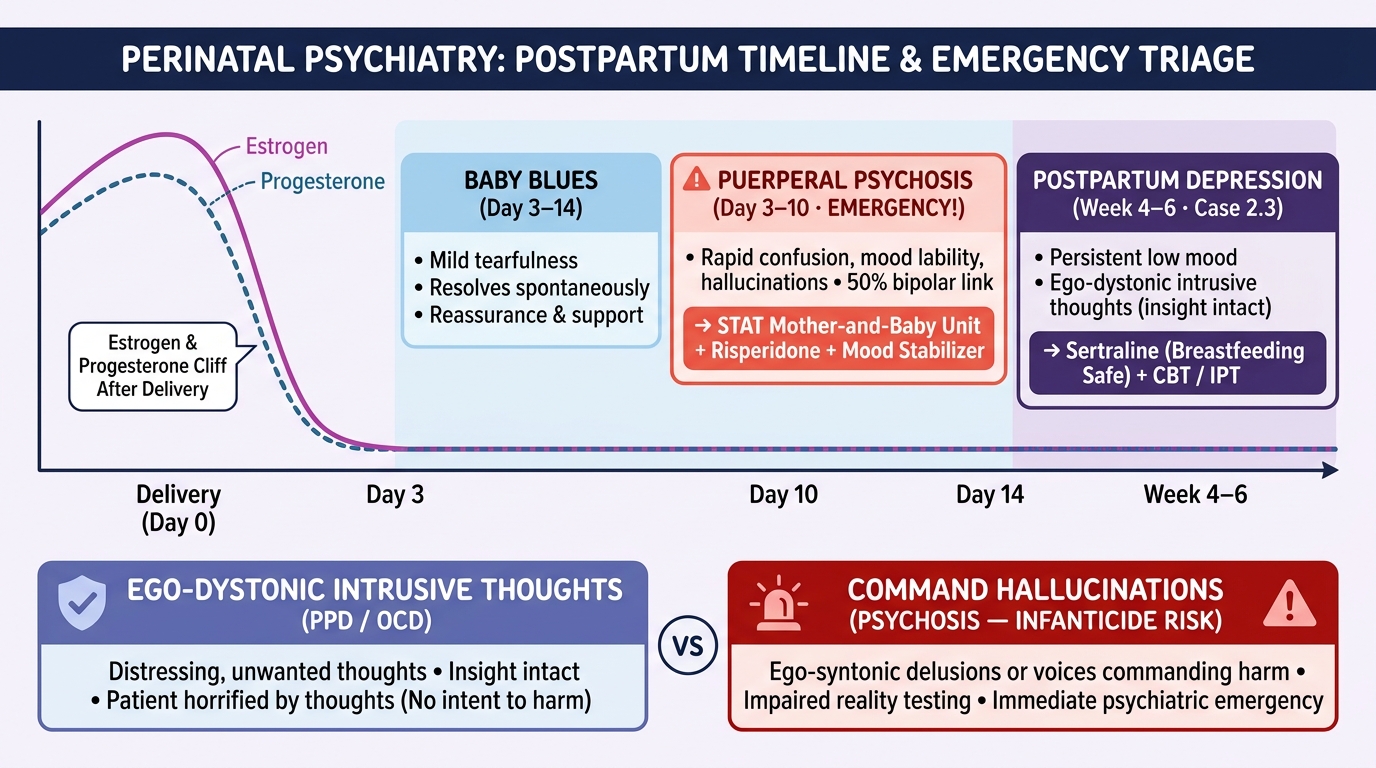
Picture childbirth as stepping off a steep Estrogen & Progesterone Cliff right after placental delivery. While every mother drops off that cliff, three separate tracks branch below:
Track 1 — Baby Blues (Day 3–5, resolves <14 days): A brief emotional wobble at the bottom of the cliff. Mild tearfulness and mood sensitivity, but functioning stays intact and it clears spontaneously by 2 weeks.
Track 2 — Puerperal Psychosis (Day 3–10 · RED SIREN): The abrupt hormonal plunge + severe sleep deprivation strikes a brain with an underlying bipolar vulnerability (50% have a bipolar history!). Reality testing shatters within hours to days—confusion, elated/tearful swings, and delusions demand STAT MBU admission.
Track 3 — Postpartum Depression (Week 4–6 · INDIGO WEIGHT): Hormonal drop + genetics + heavy psychosocial stressors (unplanned pregnancy, 2-week NICU stay, low support) sink the mother into pervasive sadness, guilt, exhaustion, and frightening ego-dystonic intrusive thoughts. Screen formally at 4–6 weeks, rule out thyroid/anemia/infection, and reach for Sertraline + CBT/IPT.
Figure 1 — Clean Clinical Diagram (Postpartum Triage Timeline & Hormonal Cliff): Contrasts the precipitous postpartum drop in estrogen and progesterone with the distinct clinical windows of Baby Blues (Day 3–5, resolves <2 wks), Puerperal Psychosis Emergency (Day 3–10, loss of insight), and Postpartum Depression (Week 4–6, preserved insight with ego-dystonic intrusions).
2. High-Yield Mnemonics: “POSTPARTUM DEPRESSION” vs. “PUERPERAL”
Lock both diagnostic syndromes into long-term memory by contrasting the two anchor mnemonics side by side:
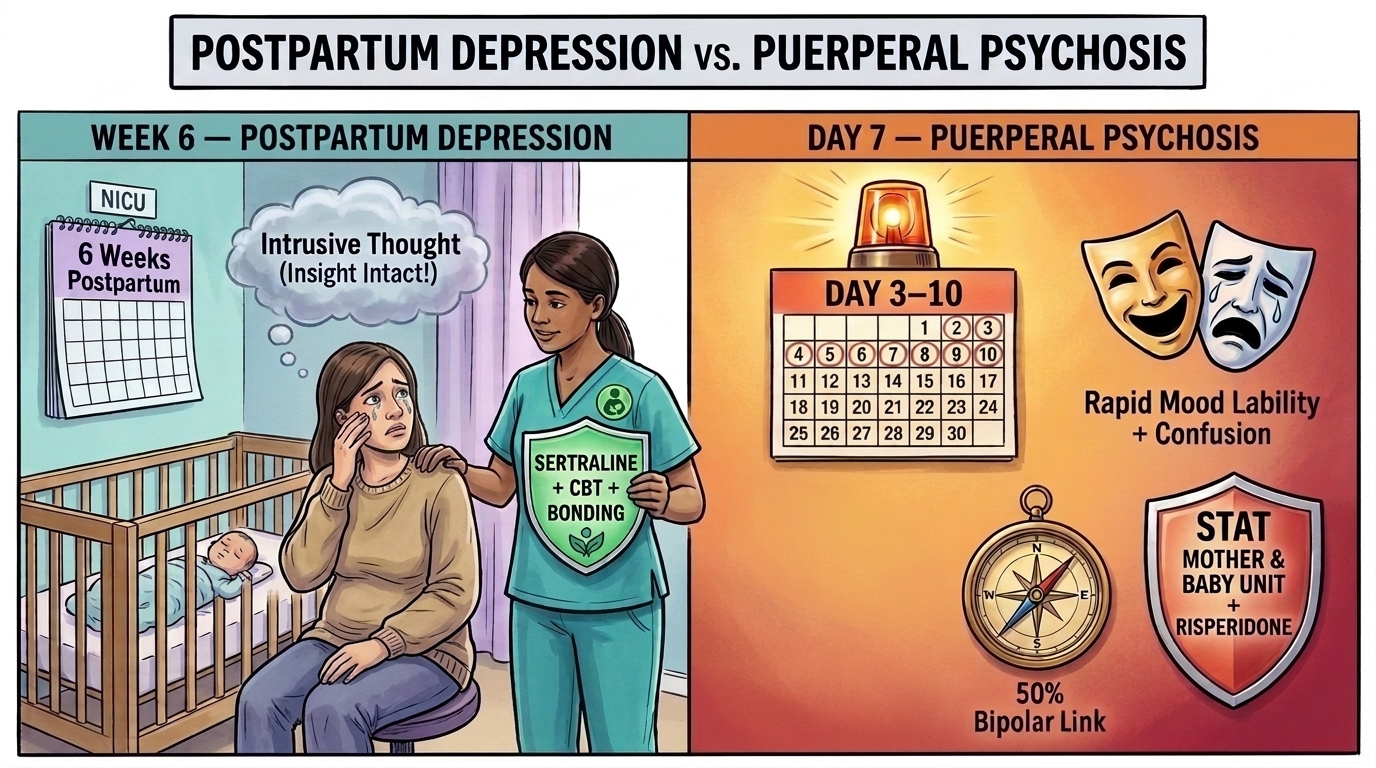
Figure 2 — Illustrated Memory Palace: Side-by-side recall scene pairing POSTPARTUM DEPRESSION (Week 6 onset, ego-dystonic obsessive fears, Sertraline breastfeeding-safe badge) against the red-alarm PUERPERAL psychosis emergency (Day 3–10 sleep collapse, rapid lability, confusion, urgent Mother-and-Baby Unit admission).
Mnemonic A — Postpartum Depression (“POSTPARTUM” Core Anchors)
P — Postnatal ~6 Weeks
Classic peak presentation and mandatory screening window at 4–6 weeks postpartum (Case 2.3 teacher).
O — Obsessive Thoughts
Fleeting ego-dystonic intrusive thoughts of harming the baby—distressing with intact insight (NOT psychotic commands).
S — Sadness Pervasive
Persistent depressed mood, anhedonia, exhaustion, and irritability lasting ≥2 weeks (unlike transient Baby Blues).
T — Tearfulness Constant
Daily crying spells combined with poor coping, guilt, and impaired bonding—often flagged by the health visitor.
P — Partner Concerned
Collateral history is gold: the partner notices she is overwhelmed, withdrawn, and unable to cope with infant care.
A — Able to Barely Cope
Clear functional decline + stressors (unplanned pregnancy, 2-week NICU stay) + 50% recurrence risk in future pregnancies.
Mnemonic B — Puerperal Psychosis Emergency (“PUERPERAL”)
P — Postpartum Timing
Explosive early onset at Day 3–10 postpartum (Case 7 presents at Day 7 after normal delivery).
U — Unwell Rapidly
Abrupt decline beginning with Day 3 sleep deterioration, escalating over just 4 days into full psychosis.
E — Emotional Lability
Rapid swings between crying and elation/mania—a hallmark reflecting the 50% bipolar diathesis.
R — Realization Impaired
Marked confusion, perplexity, and lost insight; disorganized speech and grossly erratic behavior.
P — Perceptions AbnormalHallucinations and bizarre/infanticidal delusions—often centered on the baby (e.g., baby is “evil” or must be “saved”).
E · R · A · L — Energy, Rapid, Admission, LinkEnergy dysregulated (sleeplessness) → Rapid deterioration → Admission needed STAT (MBU) → Bipolar Link (30–50% recurrence).
3. Interactive Postpartum Timeline & Ego-Dystonic vs. Psychosis Triage Explorer
Toggle between the three postpartum windows below to track the estrogen/progesterone cliff, brain insight status, live infanticide/suicide risk meter, and exact first-line management. Then test your triage instincts in the Thought Evaluator directly beneath the timeline.
Click a postpartum stage to inspect hormone dynamics, insight status, risk severity, and treatment.
Day 7 · Puerperal Psychosis [EMERGENCY]
Peak Onset
Day 3–10 (Case 7: Day 7)
Insight Status
LOST (Psychotic)
Recurrence Risk
30–50% Future Births
Key Association
50% Bipolar History
Infanticide & Suicide Risk MeterCRITICAL · STAT EMERGENCY
First-Line Management (STAT EMERGENCY): Urgent hospitalization—ideally a specialist Mother-and-Baby Unit (MBU) together if safe. Formal infanticide & suicide risk assessment, antipsychotic (risperidone) + mood stabilizer/anticonvulsant if bipolar suspected + benzodiazepine for acute agitation & sleep restoration + breastfeeding medication counseling.
Interactive Thought Evaluator: Ego-Dystonic Intrusion vs. Psychotic Command
Click either realistic patient quote below to reveal the exact diagnostic verdict and clinical action:
Verdict — Ego-Dystonic Intrusive Thought (PPD / Postpartum OCD): Insight is INTACT. Because the thought clashes violently with her values (ego-dystonic), it provokes horror, guilt, and protective avoidance—NOT delusional intent. Action: Do NOT mislabel as psychosis or reflexively separate mother and baby. Validate & normalize, complete safety screening, rule out medical mimics (TSH/Hb/infection), and start Sertraline + CBT/IPT + mother-infant bonding support.
4. Master 3-Way Comparison: Baby Blues vs. PPD vs. Puerperal Psychosis
Memorize this 3-way clinical triage table—almost every perinatal psychiatry question tests whether you can place a vignette into the exact right column.
Clinical Feature
Baby Blues
Postpartum Depression (Case 2.3)
Puerperal Psychosis (Case 7)
Typical Onset & Course
Day 3–5 postpartum; self-resolves within 10–14 days.
Peaks at 4–6 weeks postpartum (can start within first year); lasts ≥2 weeks.
Explosive onset at Day 3–10 postpartum (often triggered by Day 3 sleep collapse).
Moderate–High for suicide if severe; intrusive harm thoughts carry low impulsive risk when truly ego-dystonic (always assess safety!).
CRITICAL EMERGENCY High acute risk of both infanticide and maternal suicide.
Recurrence in Future Pregnancies
Common (~50–80% of all new mothers).
~50% recurrence risk.
30–50% recurrence risk (good long-term prognosis with prompt care).
First-Line Management
Reassurance, rest, family support, and watchful follow-up if symptoms persist >2 weeks.
Rule out TSH/Hb/infection; Sertraline (preferred breastfeeding SSRI) + IPT/CBT + bonding support + health visitor coordination; TMS/ECT if severe.
STAT Hospitalization (ideally Mother-and-Baby Unit), formal risk assessment, Risperidone + mood stabilizer (if bipolar) + benzodiazepine for sleep/agitation.
5. The #1 Exam Differentiator: Ego-Dystonic Thoughts vs. Command Hallucinations
Medical students routinely panic when a Case 2.3 mother whispers that she had a fleeting image of harming her baby. Knowing the difference between ego-dystonic obsessive ruminations and psychotic command hallucinations/delusions prevents both missed emergencies and traumatic unnecessary mother-infant separations.
Outpatient perinatal care (if no suicidal intent): psychoeducation, Sertraline + CBT/IPT, partner/health visitor support.
EMERGENCY ADMISSION Direct admission (specialist MBU if safe), continuous observation, antipsychotic + mood stabilizer + benzo.
6. Mandatory Medical Mimics Workup & Screening Window
Before attributing postpartum fatigue, tearfulness, or acute confusion solely to psychiatric illness, every exam guideline demands ruling out organic medical mimics—and conducting structured screening at the 4–6 week postnatal check.
Workup / Screen
Target Organic Mimic or Goal
Why It Matters in Perinatal Triage
TSH & Free T4
Postpartum Thyroiditis (hypo- or hyperthyroid phase)
Hypertensive encephalopathy, hyponatremia, or pituitary infarction can present with acute postpartum confusion or apathy.
EPDS Screening at 4–6 Weeks
Edinburgh Postnatal Depression Scale (EPDS)
Standardized screening window (4–6 weeks postpartum) catches hidden PPD (like Case 2.3 via the health visitor) and explicitly checks self-harm item #10.
7. Perinatal Pharmacotherapy, Mother-and-Baby Unit & Breastfeeding Safety
Clinical Pearl — Specialist Mother-and-Baby Units (MBU) & Bipolar Prophylaxis
In Puerperal Psychosis, urgent hospitalization is mandatory—but whenever safety permits, admit mother and infant together to a specialist Mother-and-Baby Unit (MBU) rather than reflexively separating them. Early MBU treatment protects infant safety while preserving maternal-infant attachment and carries a good long-term prognosis. Because 50% have an underlying bipolar diathesis and recurrence risk is 30–50%, preconception planning and immediate postpartum prophylaxis are essential for future pregnancies.
Intervention / Drug Class
Primary Perinatal Indication
Breastfeeding & Practical Clinical Notes
Sertraline (Preferred SSRI)
First-line pharmacotherapy for moderate-to-severe PPD (Case 2.3).
Breastfeeding Preferred Minimal transfer into breast milk with negligible infant serum levels; also effective for ego-dystonic intrusive ruminations.
IPT & CBT + Bonding Support
First-line for mild PPD; combined with Sertraline in moderate-to-severe PPD.
IPT targets role transition & partner conflict; CBT specifically addresses distressing ego-dystonic intrusive thoughts; coordinate with health visitor.
Risperidone (Atypical Antipsychotic)
Acute Puerperal Psychosis (Case 7) to halt hallucinations, delusions, and manic agitation.
Rapid stabilization of reality testing; provide structured breastfeeding medication counseling and monitor infant for sedation/feeding.
Crucial for affective lability and future pregnancy prophylaxis; review breastfeeding safety individually (avoid valproate in women of childbearing potential).
Benzodiazepines (Short-Term)
Acute agitation & severe sleep restoration in Puerperal Psychosis.
Breaking the Day 3 sleep-deprivation spiral rapidly lowers manic/psychotic escalation; use lowest effective short-term dose and monitor breastfed infant for lethargy.
TMS / ECT
Severe, refractory, suicidal, or slow-responding PPD (and severe/catatonic psychosis).
ECT provides rapid, lifesaving remission when mother cannot eat/drink, has severe suicidality, or fails pharmacotherapy; safe in pregnancy/postpartum.
Trap 2: “Week 6 tearfulness is just prolonged Baby Blues”
Truth: Baby Blues peaks Day 3–5 and resolves by ~2 weeks without functional collapse. Symptoms at Week 6 = Postpartum Depression until proven otherwise!
Trap 3: “Start an SSRI or antipsychotic without lab workup”
Truth: Always rule out medical mimics first—check TSH (postpartum thyroiditis), Hb/CBC (anemia), and infection/sepsis (delirium).
Trap 4: “Puerperal psychosis is a one-off freak event”
Truth: Miss the 50% bipolar link at your peril! Recurrence risk in future pregnancies is 30–50% (and 50% for PPD)—counsel early!
Trap 5: “Reflexively separate mother & baby or stop breastfeeding for SSRIs”
Truth: Admit psychosis to a specialist Mother-and-Baby Unit (MBU) together when safe, and remember Sertraline is the preferred breastfeeding-safe SSRI for PPD.
9. Quick USMLE / PLAB Self-Check Quiz
1. A 29-year-old first-time mother presents at 6 weeks postpartum after an unplanned pregnancy and a 2-week NICU stay. She is constantly tearful, exhausted, and terrified by fleeting thoughts of dropping her baby, stating she loves him and would never hurt him. TSH, CBC, and infection screen are normal. She is exclusively breastfeeding. What is the most appropriate first-line pharmacotherapy?
Correct: B! This is classic Case 2.3 (Postpartum Depression) at 6 weeks postpartum with ego-dystonic intrusive thoughts and preserved insight. Sertraline is the preferred SSRI in breastfeeding, paired with CBT/IPT and health visitor bonding support.
2. A first-time mother who had an uncomplicated delivery develops severe insomnia on Day 3 postpartum. By Day 7, she swings rapidly between weeping and elated laughter, speaks incoherently, and insists a voice told her the newborn has been replaced by an impostor. Which underlying psychiatric vulnerability is present in ~50% of patients with this emergency condition?
Correct: C! This is Case 7 (Puerperal Psychosis) presenting in the classic Day 3–10 window. Roughly 50% of affected women have an underlying bipolar diathesis, and future pregnancy recurrence risk is 30–50%.
3. What is the single most critical immediate management priority for the Day 7 postpartum patient with rapid mood lability, confusion, disorganized behavior, and auditory hallucinations?
Correct: A! Puerperal psychosis is a MEDICAL EMERGENCY carrying high acute risk of infanticide and suicide. Immediate admission (specialist MBU if safe), formal risk assessment, antipsychotic therapy (risperidone), mood stabilizer if bipolar suspected, and short-term benzodiazepine for agitation/sleep restoration are essential.
4. Before finalizing a diagnosis of Postpartum Depression at the 4–6 week postnatal screening visit, which triad of organic medical mimics must every clinician rule out?
Correct: B! Always rule out thyroid dysfunction (TSH/T4), anemia (CBC/Hb), and postpartum infection (which can mimic depression or trigger acute delirium resembling psychosis).
Need Immediate Mental Health Support? This article is for medical education. If you or someone you know is experiencing a mental health crisis or thoughts of self-harm, free confidential support is available 24/7: call or text 988 (US & Canada), dial 111 or 999 (UK), or find local emergency helplines worldwide at findahelpline.com.
Educational Medical Disclaimer & Editorial Standards
This article was authored and medically reviewed by Dr. Belh strictly for educational and informational purposes. It is not a substitute for professional medical advice, diagnosis, or individualized clinical treatment. Never ignore professional medical advice or stop prescribed medications without consulting a qualified physician. View our full Medical Disclaimer and Privacy Policy.
Written by Dr. Belh, ENT surgeon and clinical hypnotherapist. This article is for educational purposes only and does not replace a consultation with a qualified health professional. Read our medical disclaimer.