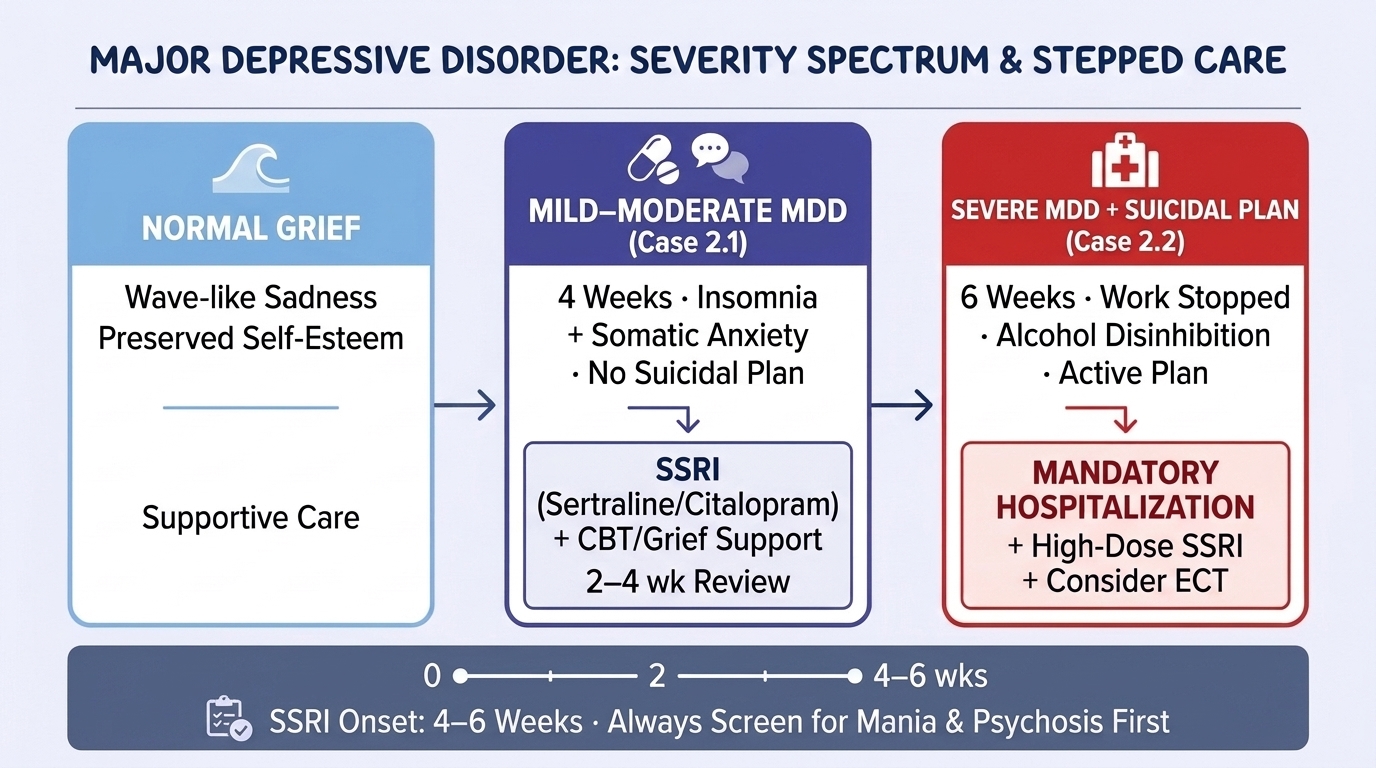
Major Depressive Disorder (MDD) is never a single textbook photograph—it is a clinical spectrum. On one end sits a grieving adult quietly struggling through everyday routines with somatic anxiety; on the opposite end sits a psychiatric emergency where profound hopelessness, alcohol disinhibition, and a lethal suicide plan demand immediate hospitalization.
In this high-yield guide, we contrast two classic clinical presentations—Case 2.1 (Mild–Moderate MDD with Anxiety) and Case 2.2 (Severe MDD with Active Suicidal Ideation)—so you can separate normal grief from MDD, master the MILD MOOD CRISIS vs. SEVERE DEPRESSION memory hooks, triage suicide risk safely, and apply evidence-based stepped care from sertraline/citalopram to inpatient admission and ECT.
Precipitant & Safety: Her mother died 3 months ago. She has no prior psychiatric history or substance use and denies self-harm or suicidal ideation.
Critical Red Flag: He admits to active suicidal ideation with a specific plan and intent, combined with severe functional collapse and alcohol disinhibition.
1. Memory Palace & Dual-Case Mnemonics
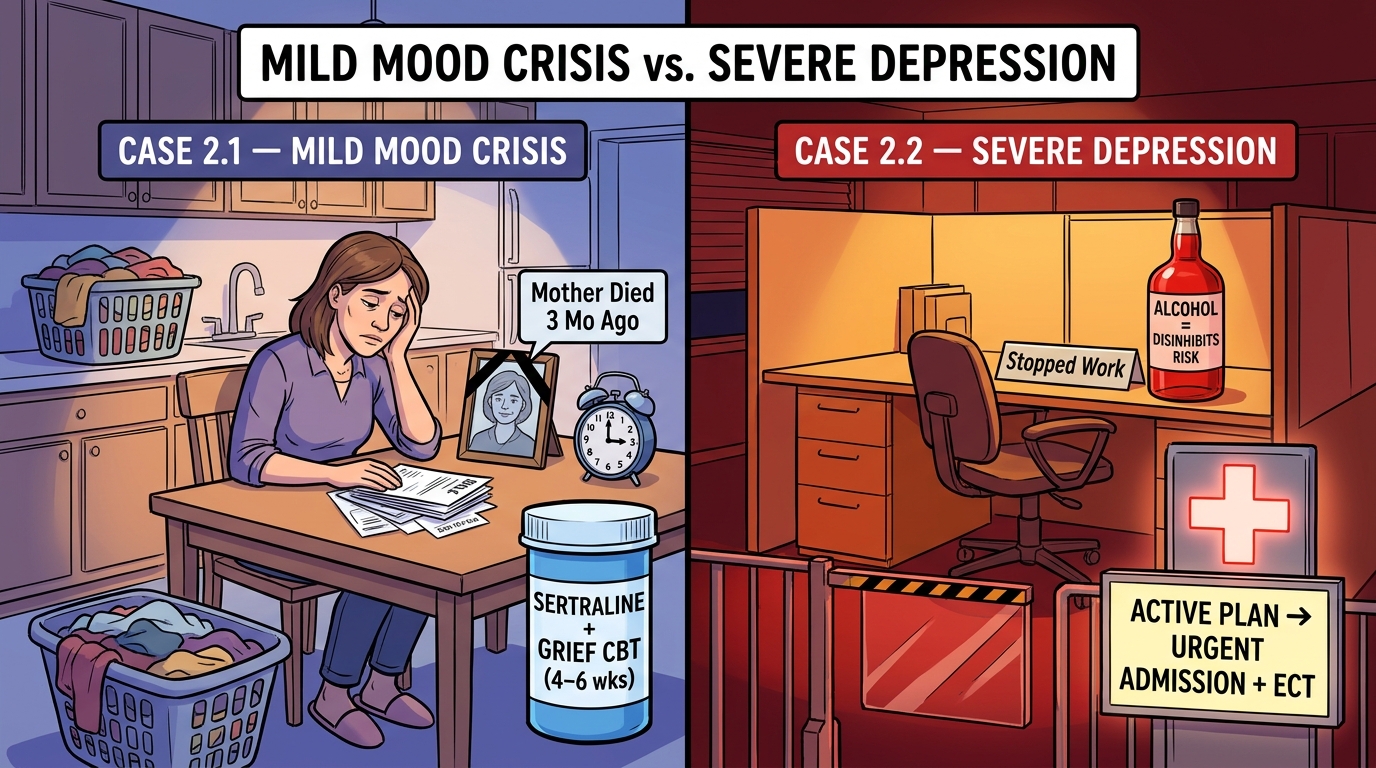
- Left Scene (Case 2.1 — Mild–Moderate MDD): A 40-year-old woman sits on a rainy porch holding a framed photo of her mother (3 months after bereavement). Her stomach churns, her mouth is dry, and laundry piles up—she is washed-out and overwhelmed, yet safely anchored indoors. She needs outpatient stepped care (psychoeducation, grief support, first-line SSRI such as sertraline or citalopram, and 2–4 week follow-up).
- Right Scene (Case 2.2 — Severe MDD Emergency): A 45-year-old man sits beside an empty liquor bottle and an untouched work badge after 6 weeks of deepening hopelessness. Alcohol has cut the brakes on his judgment while active suicidal planning has emerged. This is a STAT psychiatric emergency—stop outpatient hesitation, initiate immediate hospitalization, evaluate for psychosis/bipolarity, address alcohol cessation, and consider ECT.
High-Yield Mnemonic Cards
2. Interactive MDD Severity, Grief vs. Depression & Suicide Triage Simulator
Switch between the four clinical profiles below to see how functional impairment, somatic anxiety, alcohol disinhibition, and suicide risk transform clinical management—then test your clinical instincts with the 5-Item Bedside Red-Flag Triage Checker.
Interactive Simulator: Mood Severity, Grief vs. MDD & Suicide Triage
Select a clinical profile to inspect the live Mood & Safety Risk Gauge and stepped-care disposition.
3. Case 2.1 vs. Case 2.2 — Side-by-Side Clinical Mastery
Examiners love pairing an outpatient mild–moderate depression vignette with a severe emergency vignette to test whether you recognize the clinical inflection points: severity of dysfunction, alcohol disinhibition, and active suicidal planning.
| Clinical Domain | Case 2.1: Mild–Moderate MDD with Anxiety | Case 2.2: Severe MDD + Active Suicidal Ideation |
|---|---|---|
| Patient & Timeline | 40-year-old woman; 4-week gradual onset. | 45-year-old man; 6-week progressive deterioration. |
| Precipitant | Mother died 3 months ago (clear psychosocial trigger). | No clear precipitant (endogenous/severe trajectory). |
| Core Mood & Somatic Profile | Tired / “washed-out,” initial insomnia, daytime restlessness, occasional tearfulness, somatic anxiety (dry mouth, churning stomach). | Profound sadness, hopelessness, helplessness, emotional numbness, unprovoked crying, severe insomnia. |
| Functional Impact | Everyday tasks feel overwhelming, yet still functioning at home/outpatient level. | Severe Collapse Stopped going to work; unable to maintain daily responsibilities. |
| Alcohol & Suicide Risk | No substance use; denies self-harm or suicidal ideation. | IMMINENT RISK Increased alcohol consumption + active suicidal ideation with specific plan (driving car into local lake). |
| Key Differentials to Rule Out | Adjustment disorder / normal or complicated grief, GAD with secondary depression, medical mimics (thyroid, anemia). | Psychotic depression (delusions/hallucinations), Bipolar depression (prior mania/hypomania), primary alcohol use disorder. |
| Memory Hook | MILD MOOD CRISIS | SEVERE DEPRESSION |
| Immediate Disposition | Outpatient care: psychoeducation, grief counseling/CBT, sertraline or citalopram, review in 2–4 weeks. | MANDATORY URGENT PSYCHIATRIC ASSESSMENT & HOSPITALIZATION, daily monitoring, higher-dose SSRI/combo, alcohol cessation, consider ECT. |
4. Normal Grief (Bereavement) vs. Major Depressive Disorder
Case 2.1’s mother passed away 3 months earlier—a classic OSCE and USMLE crossroads. Bereavement does not immunize someone from MDD, nor should normal grief be prematurely medicalized. Use this high-yield bedside distinction:
| Feature | Normal Grief (Uncomplicated Bereavement) | Major Depressive Disorder (MDD) |
|---|---|---|
| Course of Sadness | Fluctuates in waves (“pangs of grief”), often triggered by reminders of the deceased; interspersed with positive memories and humor. | Pervasive, persistent depressed mood and anhedonia nearly all day, every day for ≥ 2 weeks; unable to anticipate happiness. |
| Self-Esteem | Generally preserved (guilt, if any, is limited to perceived failures toward the deceased). | Worthlessness, self-loathing, and pervasive inappropriate guilt. |
| Thoughts of Death | If present, usually focused on “joining” the deceased loved one. | Focused on ending one’s own life due to hopelessness, feeling worthless, or undeserving of life (e.g., Case 2.2’s specific plan). |
| Functional Trajectory | Gradual adaptation over weeks to months; everyday capacity remains mostly intact. | Progressive impairment—from everyday tasks feeling overwhelming (Case 2.1) to complete occupational collapse (Case 2.2). |
| First-Line Management | Supportive Care Empathetic validation, grief counseling/support groups, watchful waiting; avoid routine antidepressants. | Active Stepped Care Psychotherapy (CBT/IPT) and/or SSRI (sertraline, citalopram); escalate to inpatient care & ECT if severe/suicidal. |
5. Stepped-Care Management: SSRIs, Psychotherapy & ECT
Depression treatment follows a disciplined stepped-care ladder calibrated to severity, safety, and comorbidities. Remember the golden pharmacology clock: review early (2–4 weeks for side effects and emergent suicidality), but give an adequate SSRI trial (4–6 weeks) before declaring treatment failure.
| Severity Tier | First-Line Pharmacotherapy / Somatic Rx | Psychotherapy & Lifestyle | Setting & Monitoring Cadence |
|---|---|---|---|
| Mild MDD / Subthreshold | Watchful waiting OR first-line SSRI (sertraline or citalopram) if persistent or impairing. | Psychoeducation, guided self-help, CBT, sleep hygiene, relaxation techniques, grief support group. | Outpatient primary care; reassess in 2–4 weeks; screen suicide risk regularly. |
| Moderate MDD with Anxiety (Case 2.1) |
SSRI First-Line Sertraline or citalopram (treats both depressive and somatic anxiety symptoms). Expect 4–6 weeks to full response. | Structured CBT, grief counseling/support group, sleep hygiene & somatic relaxation exercises. | Outpatient; follow-up in 2–4 weeks (earlier if worsening), monitor adherence, side effects, and suicidal ideation. |
| Severe Non-Psychotic MDD + Active Plan (Case 2.2) |
Urgent Escalation Higher-dose SSRI or antidepressant combination (e.g., SSRI + mirtazapine/bupropion, or SNRI). Consider ECT early for high acute suicide risk. | Safety planning, concurrent alcohol cessation (monitor for withdrawal), structured inpatient milieu, family involvement. | MANDATORY URGENT PSYCHIATRIC ASSESSMENT & INPATIENT HOSPITALIZATION; daily monitoring initially. |
| Severe MDD with Psychotic Features | Combination Mandatory Antidepressant + Antipsychotic (e.g., sertraline + olanzapine/quetiapine) OR ECT (superior rapid efficacy). | Supportive inpatient care; defer intensive cognitive therapy until acute psychosis resolves. | Inpatient psychiatric unit; close observation for command hallucinations or delusional guilt driving self-harm. |
| Refractory / Life-Threatening MDD | ECT Gold Standard Electroconvulsive Therapy (ECT) — most rapid, highly effective option for medication resistance, severe malnutrition/catatonia, or imminent suicide risk. | Continuation pharmacotherapy + maintenance CBT post-ECT to prevent relapse. | Inpatient or specialized ECT unit; pre-anesthesia medical clearance & cognitive monitoring. |
6. Suicide Risk Factors, Alcohol Disinhibition & Pre-SSRI Screening
| Risk Factor / Screening Check | Clinical Mechanism & Case Anchor | Mandatory Clinical Action |
|---|---|---|
| Specific Plan & Active Intent | Case 2.2 presents with an explicit active suicidal plan plus profound hopelessness—the strongest immediate predictor of high acute self-harm risk. | Hospitalize STAT Never discharge with a “no-harm contract” alone; arrange urgent psychiatric admission and continuous observation. |
| Comorbid Alcohol Escalation | Maladaptive self-medication worsens mood, impairs judgment, and lowers the threshold from ideation to action. | Screen with AUDIT-C/CIWA; initiate concurrent alcohol cessation, thiamine/withdrawal prophylaxis if dependent, and addiction counseling. |
| Severe Functional Collapse & Isolation | Case 2.2 stopped going to work—loss of daily structure and social anchors accelerates hopelessness. | Involve family/trusted supports immediately (with safety priority) and re-establish structured inpatient care before gradual return to work. |
| Screen for Prior Mania / Hypomania | Unrecognized Bipolar Depression mimics MDD exactly during a depressive episode. | Rule Out Before SSRI Unopposed SSRI monotherapy can trigger manic switching or rapid cycling; use mood stabilizer/atypical antipsychotic instead. |
| Screen for Psychotic Features | Delusions of guilt, poverty, nihilism, or derogatory auditory hallucinations dramatically elevate suicide risk. | Ask directly about unusual beliefs/voices; treat with antidepressant + antipsychotic or ECT (SSRI alone is insufficient). |