Picture your morning routine: before stepping outside, you grab your favorite bottle of SPF 50 sunscreen, squeeze a tidy pea-sized drop onto your fingertips, and blend it smoothly across your cheeks, forehead, and nose. You feel great—your skin is protected for the day, right?
Yet by late afternoon, your cheeks still feel faintly flushed. Or over a few summers, stubborn dark spots and fine lines keep showing up even though you “always wear sunscreen.” What went wrong?
1. The Golden Dose: Meet the Two-Finger Rule
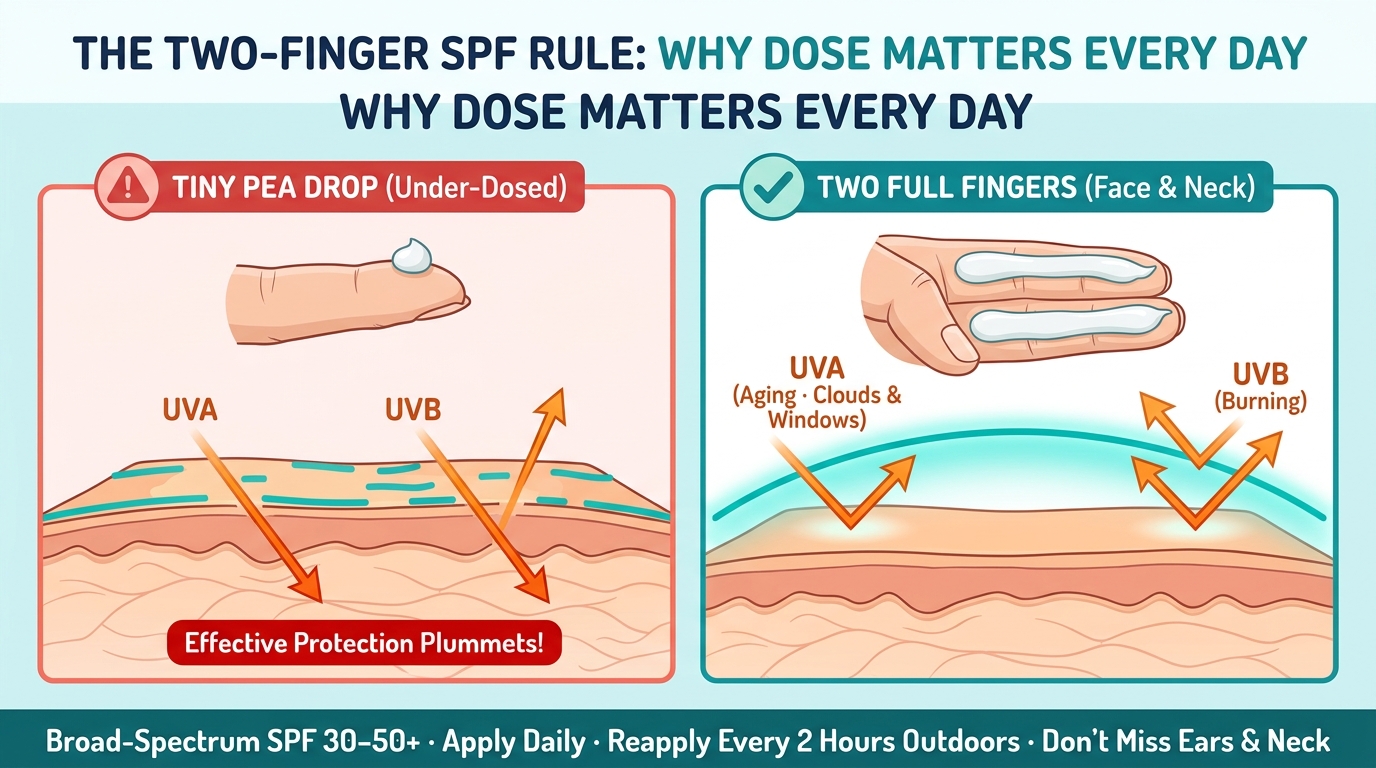
When scientists test a sunscreen in the laboratory to earn an SPF 30 or SPF 50 label, they spread a generous, even layer of 2 milligrams per square centimeter of skin—roughly ¼ to ½ teaspoon for an adult face and neck. Almost nobody measures sunscreen with a kitchen spoon in front of the bathroom mirror, which is why dermatologists share an effortless, zero-math shortcut: The Two-Finger Rule.
It could not be simpler:
- Hold up your index finger and middle finger side by side.
- Squeeze two full, uninterrupted strips of sunscreen from the base of each finger all the way to the tip.
- Spread that full dose evenly across your entire face, ears, and neck.
| Amount You Apply | If Bottle Says SPF 30 | If Bottle Says SPF 50 | Real-World Protection |
|---|---|---|---|
| Tiny Pea Drop (25%) | ~SPF 2–3 | ~SPF 3 | Barely Protected — UV rays stream through gaps |
| Half Dose (50%) | ~SPF 5–6 | ~SPF 7 | Severe Drop — Drops near the square root of the label! |
| One Finger (75%) | ~SPF 13 | ~SPF 19 | Incomplete — Still below dermatologists’ SPF 30 baseline |
| Two Full Fingers (100%) | SPF 30 | SPF 50 | Full Shield! — Blocks 97–98% of UVB + strong UVA defense |
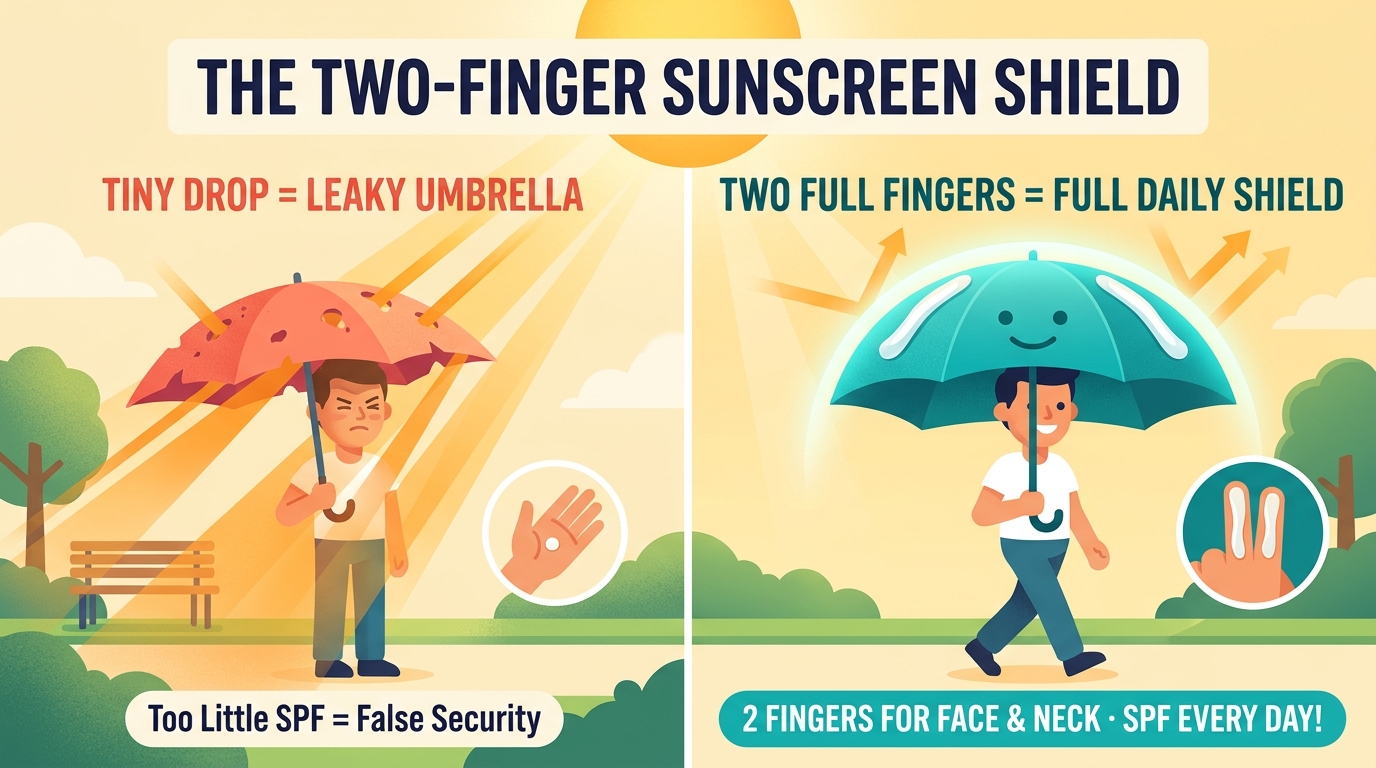
2. Mental Image: The Leaky Umbrella vs. The Two-Finger Shield
Under-applied sunscreen works the exact same way. Because human skin has microscopic hills, valleys, and pores, stretching a tiny pea-sized dab across your entire face leaves thin, leaky patches where UV rays slip straight through. Applying two full fingers seals those microscopic gaps into a smooth, continuous Two-Finger Shield.
3. Interactive Simulator: Watch Your Real-World SPF Change
Curious just how fast UV protection collapses when you use less than two fingers? Pick your bottle rating (SPF 30 or SPF 50) and slide from a Tiny Pea Drop up to the Two-Finger Rule to watch the finger dispenser, UV rays, and real-world SPF meter react live.
Interactive Two-Finger SPF Coverage & Real-World Protection Simulator
Choose your sunscreen bottle and slide the dose to see how thickness controls your UV shield.
Half Dose: Why Your SPF Crashes
Applying half the proper amount doesn’t give half the SPF—protection drops toward the square root, leaving invisible gaps across your skin.
- UVB Rays: Slip through thin patches and redden the epidermis.
- UVA Rays: Penetrate deeper into the dermis, weakening collagen.
- Quick Fix: Double up to two full fingers for your face and neck!
4. SPF Every Day: Meet UVA (“Aging”) vs. UVB (“Burning”) Rays
A second huge reason sunscreen fails people is timing: treating SPF like beachwear instead of a daily habit like brushing your teeth. Even on cool, overcast mornings—or while driving to work—sunlight delivers two distinct kinds of ultraviolet radiation:
| Ray Type | Easy Memory Trick | Where It Reaches | When You’re Exposed | How to Block It |
|---|---|---|---|---|
| UVA Rays | A = Aging (Wrinkles, dark spots, sagging & skin cancer risk) |
Deep into the dermis, where skin’s collagen and elastin live | Every single day, year-round! Passes right through clouds and standard window glass (cars & offices) | Choose “Broad-Spectrum” SPF 30–50+ (look for UVA circle or PA+++ / PA++++) |
| UVB Rays | B = Burning (Sunburn, DNA damage & skin cancer risk) |
Mainly the epidermis (surface skin layer) | Strongest midday (10 AM–4 PM), in summer, and at high altitudes—still present on bright cloudy days | Apply SPF 30 to 50+ using the full Two-Finger Rule, and reapply every 2 hours outdoors |
5. How to Make the Two-Finger Rule Effortless Every Day
Many patients tell me: “Doctor, two full fingers feels like a lot of cream all at once!” That is completely normal—especially if you are used to using a tiny drop. These simple dermatologist-approved tricks make proper sun protection feel light, comfortable, and second nature:
- Use the Two-Thin-Coats Trick: Apply one finger smoothly over your face and neck, brush your teeth or wait 60 seconds for it to settle, then layer the second finger. Same full protection, zero heaviness or pilling!
- Pick a Texture You Actually Enjoy: The best sunscreen is the one you happily wear every morning. Look for lightweight fluids, gel-creams, or sheer lotions labeled Broad-Spectrum SPF 30 to 50+.
- Treat Makeup SPF as a Bonus Only: Foundation or tinted moisturizer with SPF is almost never applied thickly enough (you would need 6–7 times your normal makeup amount to hit the bottle rating!). Always put your Two-Finger sunscreen underneath first.
- Reapply Every 2 Hours Outdoors: Sunlight, natural skin oils, sweat, and touching your face break down the protective film over time. Reapply every 2 hours when outside—and right away after swimming, heavy sweating, or towel-drying.
| Daily SPF Step or Commonly Missed Spot | Recommended Dose & Action | Practical Pro Tip |
|---|---|---|
| Face & Neck (Core Zone) | 2 full fingers (index + middle) every morning, 15 minutes before heading outside | Split into two thin coats 60 seconds apart if it feels rich at once |
| Ears & Eyelids | Gently sweep leftover product over ear tops/lobes and around the eye area | If chemical SPF stings your eyes, use a gentle mineral (zinc/titanium) SPF stick around the eyes |
| Lips | Dedicated SPF 30+ lip balm | The lower lip catches direct overhead UV all day—reapply after eating or drinking |
| Backs of Hands & Chest (V-Neck) | Add an extra finger-strip for exposed chest and rub excess onto the backs of your hands | Hands and chest show sun spots early from daily driving through car windshields and side glass |
| Outdoor Reapplication | Every 2 hours (or immediately after swimming/sweating) | Pair SPF with a wide-brimmed hat, UV-blocking sunglasses, and shade during peak midday sun |
6. Tap to Bust the 3 Biggest Sunscreen Myths
- Any mole showing the ABCDE warning signs: Asymmetry, irregular Border, multiple Colors, Diameter growing larger than 6 mm (a pencil eraser), or Evolving in size, shape, or itchiness.
- A new pearly bump, pink shiny spot, rough scaly patch, or sore that bleeds easily, crusts over, or refuses to heal after 3–4 weeks.
- Sudden severe sunburn, blistering, or unexplained sun-sensitivity rashes.
7. Frequently Asked Questions
Does the Two-Finger Rule work for watery fluid sunscreens too?
Yes—with a quick adjustment! Very runny fluid sunscreens can drip off your fingers, so instead of balancing two liquid lines, measure roughly ¼ teaspoon into your palm (about the size of a nickel/quarter-sized puddle) for your face, plus another ¼ teaspoon for your neck and ears. Apply it in two thin layers so it absorbs neatly.
What if two full fingers of sunscreen leaves a white cast or feels greasy?
That usually means the formula isn’t the right match for your skin—not that you should use less! Try a sheer chemical or hybrid broad-spectrum gel-fluid, or a tinted mineral sunscreen matched to your skin tone (iron oxides in tinted formulas eliminate white cast and even add extra protection against visible light that worsens dark spots).
Do people with deeper skin tones still need daily sunscreen?
Absolutely! While natural melanin provides some built-in baseline protection against sunburn (roughly equivalent to SPF 4–13 depending on skin tone), deeper skin is still vulnerable to UVA-driven dark spots (hyperpigmentation), uneven tone, premature aging, and skin cancer. Broad-Spectrum SPF 30–50+ (especially sheer or tinted formulas) keeps every skin tone healthier and more even.
How can I reapply sunscreen every 2 hours when I’m wearing makeup?
Always start with your full Two-Finger liquid sunscreen before makeup in the morning. For midday outdoor touch-ups over makeup, gently pat a lightweight sunscreen fluid over your cheeks and forehead with a clean damp makeup sponge, or swipe on a clear/tinted SPF stick and follow with a light dusting of translucent powder.