Medically Written & Reviewed by Dr. Belh · ENT Surgeon & Medical Educator
Evidence-Based Educational Guide · Updated 2026
Medical StudentsPsychiatry · Acute Psychosis & Mental Health LawUSMLE · PLAB · OSCE High-Yield
In emergency psychiatry and OSCE stations, two of the highest-yield challenges sit right next to each other on the acute assessment ward: (1) recognizing when severe anxiety and sleep deprivation cross the threshold into acute transient psychosis, and (2) knowing the exact legal rules of the UK Mental Health Act (MHA 1983) when a patient with relapsing psychosis refuses treatment due to loss of insight.
In this masterclass, we pair two classic clinical scenarios—Case 9 (Acute Anxiety Preceding Psychosis) and Case 8 (Clinical Management Under the Mental Health Act)—so you can master both acute clinical stabilization and forensic/legal decision-making with memorable mental images, two ironclad mnemonics (ANXIETY-PSYCHOSIS and MHA DECISION), an interactive dual-mode simulator, and exam-tested comparison tables.
Clinical Vignette — Case 9: Acute Anxiety Preceding Psychosis
A young adult experiences a severe, sudden stressful life event. Within days, acute anxiety skyrockets—feeling unsafe, constant hypervigilance, fine hand tremor, dry mouth, and racing thoughts—followed by several nights of near-total sleep loss. Abruptly, the patient develops paranoid persecutory delusions (“People are watching me and planning to hurt me”), anxiety-themed auditory hallucinations, and recurrent panic-like surges.
Core Diagnosis:Acute transient psychotic episode precipitated by severe anxiety (much better prognosis than primary schizophrenia—and benzodiazepines + sleep restoration are game-changers!).
Clinical Vignette — Case 8: Relapsing Psychosis & The Mental Health Act
A man with an established history of schizophrenia presents in acute psychotic relapse with worsening disorganization and paranoid distress. He flatly refuses voluntary admission and antipsychotic medication, exhibiting profound anosognosia (lacking insight—he genuinely does not believe he is unwell).
Core Decision: Before detaining him, you must systematically document risk, functional impairment, capacity, treatability, and least restrictive alternatives—and because he has a known illness requiring inpatient treatment, the exact statutory order is MHA Section 3!
1. Mental Images & High-Yield Mnemonics
Dual Memory Palace — “The Sleepless Pressure Cooker” & “The Three Legal Keys”
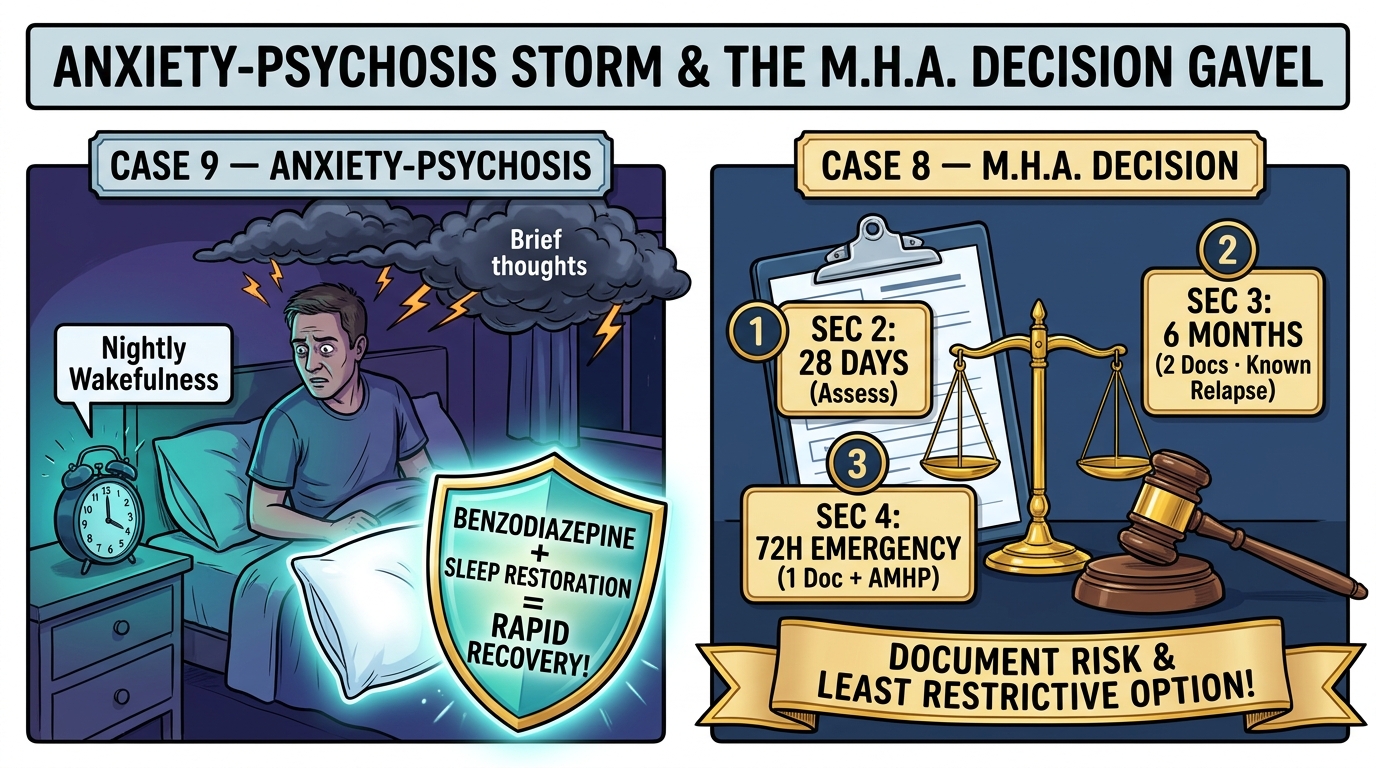
For Case 9 (Anxiety → Psychosis): Picture a pressure cooker left on high heat all night. Acute stress lights the burner (hypervigilance, tremor, dry mouth), sleep deprivation plugs the steam valve, and once pressure peaks, the lid blows into transient paranoid delusions and fear-themed voices. Turn off the heat and open the valve (benzodiazepine + restored sleep + beta-blocker), and the kitchen calms down completely!
For Case 8 (Mental Health Act Sections 2, 3 & 4): Picture a courtroom desk holding three color-coded keys beside a MHA DECISION gavel:
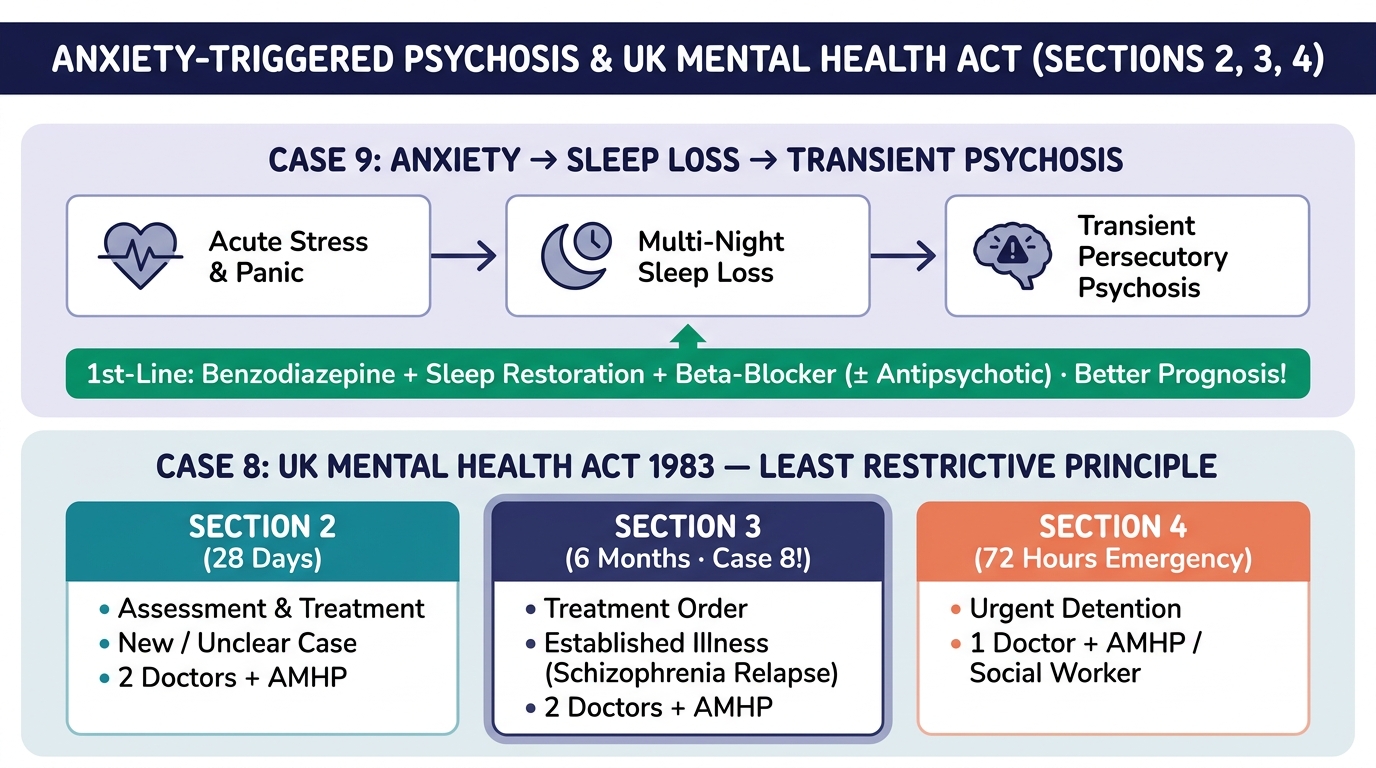
Key 2 (28 Days — “2 looks & learns”): Assessment order for new/unclear illness (2 doctors + 1 AMHP).
Key 3 (6 Months — “3 treats the known”): Treatment order for established mental illness like Case 8’s schizophrenia relapse (2 doctors + 1 AMHP).
Key 4 (72 Hours — “4 is for emergency!”): Emergency holding power when waiting for a 2nd doctor causes dangerous delay (1 doctor + 1 AMHP).
Mnemonic A (Case 9): ANXIETY-PSYCHOSIS — The Stress-to-Psychosis Escalation
A · N · X Autonomic & Sleep CollapseApprehension builds rapidly · Nightly wakefulness (severe multi-night sleep loss) · Xerophobia / dry mouth, tremor & autonomic overdrive.
I · E · T Stress CascadeIrritable, hypervigilant mood · Escalating fears & racing thoughts · Trigger event (identifiable acute psychosocial stressor).
Y · P · S Psychotic BreakthroughYou-are-unsafe persecutory delusions · Perception distortions · Sensations hallucinated (anxiety-themed auditory hallucinations & panic-like surges).
Mnemonic B (Case 8): MHA DECISION — Systematic Pre-Detention Checklist
M · H · A Threshold & Least RestrictionMental capacity assessed (decision-specific) · Hospitalization necessary (community unsafe) · Alternatives exhausted (least restrictive principle).
D · E · C Clinical & Legal CriteriaDanger to self/others or severe self-neglect · Emergent/appropriate treatment needed · Criteria of mental disorder (nature or degree) met.
I · S · O Statutory ExecutionInvoluntary care required (refusing + anosognosia) · Section chosen accurately (2 vs. 3 vs. 4) · Order signed by statutory clinicians + rights explained.
Figure 1 — Clean Clinical & Legal Diagram: Left: The neurobehavioral escalation from acute psychosocial stress and severe sleep deprivation into transient persecutory psychosis (Case 9), reversed by benzodiazepines and sleep restoration. Right: UK Mental Health Act 1983 decision matrix comparing Section 2 (28-day assessment), Section 3 (6-month treatment for established illness — Case 8), and Section 4 (72-hour emergency).Figure 2 — Illustrated Memory Palace (“ANXIETY-PSYCHOSIS” & “MHA DECISION”): Visual anchor linking the sleepless hypervigilance-to-hallucination storm (Case 9) with the statutory courtroom checklist and Section 2 / 3 / 4 duration cards (Case 8).
2. Interactive UK Mental Health Act Section Selector & Anxiety-Psychosis Escalator
Switch between the two interactive tabs below to practice both OSCE scenarios live. In Tab 1 (Case 8), toggle the four statutory criteria to see which UK MHA section applies—and why. In Tab 2 (Case 9), step through the 3-stage sleep-loss psychosis cascade and flip the Intervention Switch to watch how benzodiazepines, sleep restoration, and beta-blockade rapidly extinguish the storm.
Immediate Action (Case 9): Rule out drugs/organic causes first, then prioritize benzodiazepine therapy + sleep restoration (often primary treatment!), add a beta-blocker for tremor/palpitations, and use a short-term low-dose antipsychotic only if psychotic distress persists.
3. Deep Dive: The UK Mental Health Act 1983 (Case 8)
Under the Mental Health Act 1983 (as amended in 2007), involuntary hospital detention is strictly reserved for patients with a mental disorder of a nature or degree warranting inpatient assessment or treatment when necessary for the patient’s own health or safety, or for the protection of others—and when less restrictive community or informal care cannot safely manage the risk.
Table 1 — UK Mental Health Act Sections 2 vs. 3 vs. 4 (Exam Favorite)
Feature
Section 2 (Assessment)
Section 3 (Treatment · Case 8)
Section 4 (Emergency)
Primary Purpose
Admission for assessment (followed by initial medical treatment)
Admission for treatment of an established mental illness
Emergency detention when waiting for a 2nd doctor causes dangerous delay
Maximum Duration
28 Days (non-renewable)
6 Months (renewable 6m, then yearly)
72 Hours Max (convert to Sec 2 or discharge)
Who Signs?
2 Doctors (≥1 Section 12-approved) + 1 AMHP
2 Doctors (≥1 Section 12-approved) + 1 AMHP
1 Doctor (ideally knows patient) + 1 AMHP (Social Worker)
Compulsory Medication?
Yes (consent-to-treatment Part IV applies)
Yes (up to 3 months; SOAD needed after 3m if refusing/incapacitated)
No (does not authorize routine compulsory psychiatric treatment; emergency life-saving care only)
Classic OSCE Vignette
First-episode psychosis or unclear mood/psychotic presentation refusing care
Case 8: Man with known schizophrenia relapse refusing meds with anosognosia
Violent/acutely suicidal patient in rural A&E where 2nd doctor is hours away
Never jump straight to “section the patient” in an OSCE or PLAB station. Examiners award full marks when you document these four systematic pillars first:
Assessment Pillar
Exact Clinical Questions to Document
Case 8 Application (Schizophrenia Relapse)
1. Risk to Self & Others
Suicide/self-harm intent, command hallucinations, aggression, vulnerability, severe self-neglect, or dangerous functional impairment?
Assess whether paranoid beliefs or disorganization put him or others in danger, or impair basic food/housing/safety.
2. Insight & Decision-Specific Capacity
Can the patient understand, retain, weigh, and communicate the treatment decision? Remember: capacity is decision-specific and fluctuates!
Exhibits anosognosia (believes he is completely healthy) → unable to weigh risks of stopping antipsychotics.
3. Treatability & Appropriateness
Is appropriate inpatient medical treatment available to alleviate or prevent worsening of the disorder?
Can Crisis Resolution / Home Treatment Team, family support, or voluntary (informal) admission keep him safe?
He refuses voluntary admission and home medication, making community care unsafe → involuntary Section 3 is justified.
4. Deep Dive: Anxiety-Triggered Transient Psychosis (Case 9)
Severe acute anxiety does not always stay confined to panic attacks. When a major psychosocial stressor ignites relentless hyperarousal and destroys sleep for multiple consecutive nights, prefrontal reality-testing breaks down while stress-elevated cortisol and mesolimbic dopamine surge. The result is an acute transient psychotic episode with paranoid beliefs (“I am unsafe”) and fear-themed auditory hallucinations—yet with a far brighter prognosis than chronic schizophrenia.
Table 3 — Diagnostic Differential: Pure Anxiety vs. Anxiety-Induced Psychosis vs. Primary Schizophrenia
Clinical Feature
Pure Panic / Acute Anxiety
Anxiety-Triggered Psychosis (Case 9)
Primary Schizophrenia (Case 8)
Trigger & Onset
Abrupt panic surges; stressor often present
Acute stressor → rapid anxiety → severe sleep loss → sudden psychosis
Insidious prodrome or chronic relapsing course (≥6 months total for DSM-5 Scz)
Added if persecutory delusions or hallucinations remain severe or distressing despite anxiolysis and sleep; taper once resolved.
5. Recovery & Safety
Psychological support, CBT & hospitalization if severe
Stress-management coaching prevents relapse; admit briefly if acute safety risk or inability to sleep/self-care at home.
Clinical Red Flag — Organic & Substance Convergence Rule
Whenever acute anxiety and sudden psychosis collide in the emergency department, remember that stimulant intoxication (cocaine/amphetamines), synthetic cannabinoids, alcohol/benzodiazepine withdrawal, hyperthyroidism, and autoimmune encephalitis can look identical to Case 9. Check vitals, pupils, urine toxicology, and basic labs on every single acute presentation!
5. Five High-Yield Exam Traps to Never Fall For
Trap 1: “Put Case 8 on Section 2 or Section 4”
Truth: Case 8 has a KNOWN schizophrenia relapse needing inpatient treatment (and 2 doctors can assess) → MHA Section 3 (6 months, 2 Drs + AMHP)! Reserve Section 2 (28d) for new/unclear cases and Section 4 (72h, 1 Dr + AMHP) strictly for urgent 2nd-doctor delays.
Trap 2: “Detain immediately because the patient refused pills”
Truth: Refusal alone never justifies detention! You MUST first document systematic risk to self/others, functional impairment, treatability, and why least restrictive community/informal options are unsafe.
Trap 3: “Psychosis means zero capacity for all decisions”
Truth: Capacity is ALWAYS decision-specific and fluctuates over time. A psychotic patient may lack capacity to refuse antipsychotics (anosognosia) while retaining capacity to make everyday personal choices.
Trap 4: “Call Case 9 pure GAD/panic—or lifelong schizophrenia”
Truth: Pure panic/GAD does NOT produce true hallucinations or fixed paranoid delusions. Conversely, anxiety-triggered transient psychosis has a far better prognosis than schizophrenia—benzodiazepines + sleep restoration are cornerstones!
Trap 5: “Start antipsychotics without checking drugs or medical mimics”
Truth: Never skip organic/toxicology workup in acute anxiety-psychosis convergence. Missing stimulant toxicity, thyrotoxicosis, or delirium is an instant OSCE safety fail.
6. Quick USMLE / PLAB Self-Check Quiz
Test Your Clinical & Legal Mastery (4 High-Yield Questions)Score: 0 / 4
1. A 34-year-old man with an established 6-year history of schizophrenia stops his medication, relapses with paranoid distress, denies he is unwell (anosognosia), and refuses voluntary admission despite high risk of self-neglect. Two doctors (one Section 12-approved) and an AMHP are present. Which UK Mental Health Act section is MOST appropriate?
Correct: B (Section 3)! Because the patient has a known, established diagnosis of schizophrenia requiring inpatient treatment (not diagnostic workup) and two doctors + an AMHP are available, Section 3 (up to 6 months, compulsory treatment permitted) is the exact statutory choice.
2. In a remote emergency department at 2:00 AM, an acutely psychotic man is attempting to run into traffic and refuses admission. An AMHP and one doctor are on site, but a second doctor cannot arrive for 6 hours—creating imminent danger. Which statutory provision applies right now?
Correct: C (Section 4)! Section 4 authorizes up to 72 hours of emergency detention with 1 doctor + 1 AMHP when waiting for a second medical recommendation would cause undesirable/dangerous delay. It does not authorize routine compulsory treatment and should be converted to Section 2 once the 2nd doctor assesses.
3. A 23-year-old university student suffers a major personal crisis, develops intense hypervigilance, tremor, dry mouth, and 4 nights of near-total insomnia, and suddenly reports feeling watched with anxiety-themed voices. Urine toxicology and medical labs are normal. Which management strategy is the MOST critical cornerstone alongside supportive care?
Correct: A! In anxiety-triggered transient psychosis (Case 9), breaking the acute panic-insomnia loop with a benzodiazepine and restoring sleep is CRITICAL and may serve as primary treatment, supported by a beta-blocker for autonomic tremor/palpitations and short-term antipsychotic only if psychotic symptoms remain prominent. Prognosis is far better than chronic schizophrenia!
4. Which statement about mental capacity and the UK Mental Health Act is MOST accurate for PLAB/OSCE exams?
Correct: D! Capacity is always decision-specific and time-specific (fluctuating as psychosis resolves), and the least restrictive principle requires clinicians to explore informal admission and community crisis teams before invoking involuntary MHA detention.
Educational Medical Disclaimer & Editorial Standards
This article was authored and medically reviewed by Dr. Belh strictly for educational and informational purposes. It is not a substitute for professional medical advice, diagnosis, or individualized clinical treatment. Never ignore professional medical advice or stop prescribed medications without consulting a qualified physician. View our full Medical Disclaimer and Privacy Policy.
Written by Dr. Belh, ENT surgeon and clinical hypnotherapist. This article is for educational purposes only and does not replace a consultation with a qualified health professional. Read our medical disclaimer.