Obsessive-Compulsive Disorder (OCD) is one of the most misunderstood conditions in clinical medicine—and one of the most heavily tested in Psychiatry exams. Far from being a harmless quirk about neatness, severe contamination OCD can silently shrink a patient’s entire home, exhaust them to collapse, and hijack hours of every single day through a self-perpetuating negative reinforcement loop.
In this masterclass, we unpack Case 3.3—a young mother whose flat shrank to just 2 of 5 rooms—to master the exact mechanism of negative reinforcement, the OCD CONTAMINATION memory hook, why reassurance is a clinical trap, and how Exposure and Response Prevention (ERP) combined with high-dose SSRIs breaks the cycle.
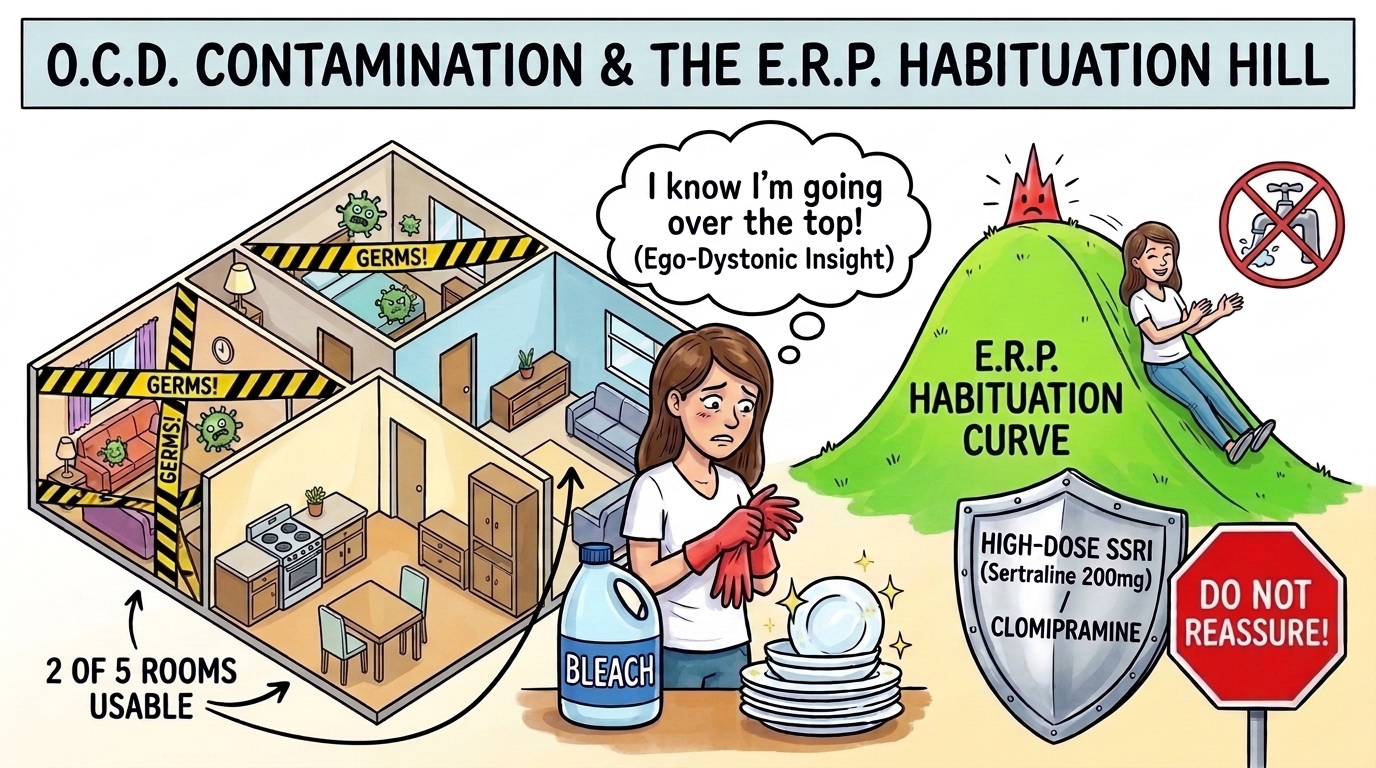
For more than 1 year, she has been plagued by intrusive fears that if her home is insufficiently clean, her young son will become ill and die. After touching almost any surface, she must disinfect it repeatedly in a specific, rigid manner for hours. She also engages in repetitive hand washing and sterilizes all crockery and cutlery before every meal. Crucially, she tearfully admits she knows she is going “over the top”—yet feels powerless to stop believing objects are covered in germs.
Exam Pearl: Notice the preserved ego-dystonic insight (“going over the top”)—this single sentence immediately separates her OCD from both delusional psychosis and OCPD!
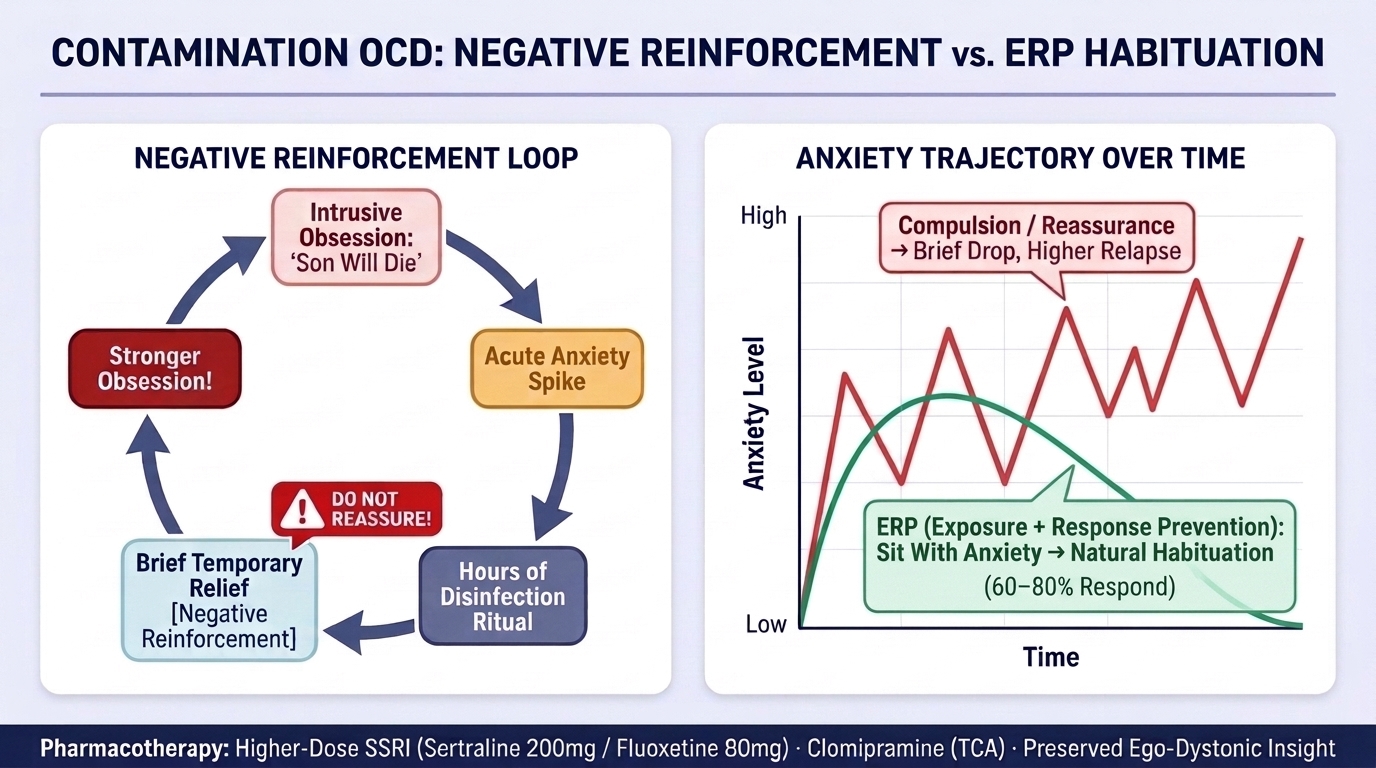
1. Mechanism: The Negative Reinforcement Trap & “The Shrinking Flat”
- Step 1 — Intrusive Obsession: An unwanted, distressing thought strikes out of nowhere (ego-dystonic).
- Step 2 — Intolerable Anxiety Spike: Sympathetic surge pushes distress toward 90–100/100.
- Step 3 — Compulsive Ritual (or Seeking Reassurance): Hours of rigid disinfection or asking someone “Is he safe?” delivers a brief, artificial drop in anxiety.
- Step 4 — Negative Reinforcement: Because removing an aversive state (anxiety) powerfully rewards the preceding behavior, the brain learns a lethal lie: “Only the ritual kept my son alive!” Tolerance builds, rituals lengthen, avoidance spreads, and her safe world collapses to 2 of 5 rooms.
Memory Palace Mnemonic: “OCD CONTAMINATION”
2. Interactive Simulator: Negative Reinforcement vs. ERP Habituation Curve
Put yourself at the bedside with Case 3.3. She has just touched a “contaminated” hallway doorknob and her anxiety surges to 90/100 SUDS. Test both clinical paths below—see why giving in to a ritual or offering reassurance backfires, watch how repeated ERP sessions unlock all 5 rooms of her flat, and compare MDD vs. OCD medication dosing.
Interactive Simulator: Negative Reinforcement Trap vs. ERP Habituation
Trigger exposure → choose a response → track live SUDS anxiety curve & flat recovery.
3. Differential Diagnosis: OCD vs. OCPD vs. Psychosis vs. GAD
Boards love testing whether you can distinguish true ego-dystonic OCD from look-alike disorders. Anchor your reasoning on two questions: Does the patient see the behavior as distressing/excessive (ego-dystonic)? and Are there true ritualized compulsions driven by intrusive obsessions?
| Disorder | Ego-Dystonic vs. Ego-Syntonic | Insight & Thought Content | Compulsions / Behavior | Exam Distinguishing Clue |
|---|---|---|---|---|
| OCD Case 3.3 |
Ego-dystonic (intrusive, unwanted, highly distressing) | Usually good/fair insight — she knows cleaning is “over the top” (can specify poor/absent insight, but not primary psychosis) | Repetitive rituals (washing, sterilizing, checking) performed to neutralize anxiety or prevent dread | Hours lost daily + severe functional impairment (only 2 of 5 rooms usable) + temporary anxiety drop after ritual |
| OCPD (Personality Disorder) |
Ego-syntonic (feels right, virtuous, and sensible to the patient) | Views strict rules, lists, perfectionism, and rigidity as the “correct” way to live | No true obsessions or neutralizing compulsions; chronic inflexible perfectionism | Patient is annoyed at others for being sloppy rather than distressed by intrusive thoughts |
| Delusional Disorder / Psychosis | Fixed belief; no sense of absurdity | Absent insight; fixed false beliefs (e.g., neighbors poisoning water supply) ± hallucinations | Protective actions match fixed delusion rather than stereotyped anxiety-neutralizing rituals | Never says “I know I’m going over the top”; fails reality testing completely |
| Generalized Anxiety Disorder (GAD) | Ego-dystonic worry | Excessive worries about real-life everyday concerns (finances, work, health) ≥ 6 months | No rigid compulsive rituals; restlessness, muscle tension, fatigue | Broad, shifting real-world worries rather than bizarre/intrusive obsessions paired with specific rituals |
4. Behavioral Mechanics: Negative Reinforcement vs. ERP Habituation
CBT with Exposure and Response Prevention (ERP) is the gold-standard psychological therapy for OCD, with 60–80% of patients responding. Understanding the exact behavioral contrast below prevents the #1 therapy error on exams.
| Phase of Cycle | Negative Reinforcement Trap (Ritual / Reassurance) | ERP: Exposure & Response Prevention (Curative) |
|---|---|---|
| 1. Trigger & Obsession | Touches doorknob → “My son will get ill and die!” | Deliberately touches graded feared trigger (doorknob / kitchen counter) |
| 2. Immediate Anxiety | Spikes sharply to ~90/100 SUDS | Spikes sharply to ~90/100 SUDS (expected & therapeutic!) |
| 3. Action Taken | Performs Ritual (disinfects for hours) or asks doctor/family for reassurance | Response Prevention — resists washing/sterilizing and sits with the distress |
| 4. Short-Term Effect | Rapid, brief temporary relief (reinforces ritual immediately) | Anxiety plateaus briefly, then naturally decays (habituation) without any ritual |
| 5. Long-Term Brain Learning | “Only disinfecting saved my son” → tolerance builds → worse future obsessions | Inhibitory learning: “Anxiety fades on its own and my son stayed safe without cleaning” |
| 6. Outcome in Case 3.3 | Exhaustion, longer rituals, trapped in 2 of 5 rooms | Progressive desensitization → reclaims all 5 of 5 rooms |
5. Pharmacotherapy Protocol: High-Dose SSRIs & Clomipramine
In moderate-to-severe OCD like Case 3.3, combining ERP with a high-dose SSRI is optimal. A classic USMLE/PLAB pitfall is prescribing standard antidepressant doses and declaring “treatment failure” too early.
| Medication | Class & Line | Standard MDD Dose | Target OCD Dose | Key Clinical & Exam Pearls |
|---|---|---|---|---|
| Sertraline | 1st-Line SSRI | 50–100 mg/day | Up to 200 mg/day | Well tolerated; titrate upward toward high OCD target; allow 8–12 weeks to assess full response |
| Fluoxetine | 1st-Line SSRI | 20–40 mg/day | Up to 80 mg/day | Long half-life (forgiving if a dose is missed); potent CYP2D6 inhibitor—check drug interactions |
| Fluvoxamine / Paroxetine | 1st-Line SSRI Alternatives | Standard lower ranges | Fluvoxamine up to 300 mg; Paroxetine up to 60 mg | Fluvoxamine is FDA-approved for OCD (watch CYP1A2/2C19); Paroxetine is more anticholinergic/sedating |
| Clomipramine | 2nd-Line TCA | — | 150–250 mg/day | FDA-approved for OCD; most serotonergic TCA. Use if SSRI trials fail. Watch anticholinergic effects, orthostasis, QTc/ECG, and lowered seizure threshold (risk increases >250 mg/day) |
6. Bedside OSCE Communication: The “DO NOT REASSURE” Rule
| Patient Statement | Trap Response — DON’T Say This | Therapeutic Response — DO Say This | Why It Works |
|---|---|---|---|
| “Tell me honestly, could my son die if I don’t bleach the cutlery twice?” | DON’T “No, I promise he will be 100% fine—the dishes are completely clean.” | DO “I can see how frightening that thought feels right now, and that urge to be 100% certain is OCD speaking. Answering that question gives brief relief but keeps OCD in charge.” | Validates the emotion without feeding the reassurance compulsion |
| “Can you check my hands to make sure there’s nothing dangerous on them?” | DON’T Inspect her hands and confirm they are germ-free. | DO “Checking with me works just like washing again—it feeds the loop. Let’s practice tolerating the uncertainty together while the anxiety settles on its own.” | Prevents turning the clinician into a proxy checking ritual |
| “During exposure my panic hit 9/10—should I wash just once to calm down?” | DON’T “Yes, wash quickly just once so you don’t get overwhelmed.” | DO “That spike means we’ve reached the exact moment ERP works. Stay with the feeling without washing—your nervous system cannot stay at 9/10 forever; watch it come down naturally.” | Protects habituation and prevents accidental negative reinforcement at peak distress |