Atrial fibrillation (AFib) is the most common sustained cardiac arrhythmia you will encounter on the wards and on licensing exams—yet students routinely lose marks by mixing up rate vs. rhythm trials, picking lethal antiarrhythmics in structural heart disease, or stopping anticoagulation the moment sinus rhythm returns.
In this two-part masterclass, we follow one high-yield patient—Mr. Kofi—from his chaotic Emergency Department arrival through morning cardiology rounds. You will lock in ECG recognition (NoPIN), underlying triggers (PIRATES), stroke prevention (CHA₂DS₂-VASc), rate control (BCD), and the modern rhythm-vs-rate matrix (AFFIRM vs. EAST-AFNET 4, SAFE-Y, FLOP vs. AMIO, and THALES).
His CHA₂DS₂-VASc score is 3 (HTN +1, T2DM +1, Age 68 +1). In the ED, he is stabilized with IV metoprolol (HR drops to 88 bpm) and started immediately on rivaroxaban. Thyroid function tests (TFTs) are normal, and echocardiography reveals a structurally normal heart with no left atrial thrombus.
Morning Rounds Decision: Because Mr. Kofi has early AF (<12 months; 6 hours) and a structurally normal heart, the cardiology team pursues Early Rhythm Control—synchronized DC cardioversion, maintenance flecainide, and lifelong rivaroxaban!
1. Pathophysiology & The “Ripples in a Pond” Mental Image
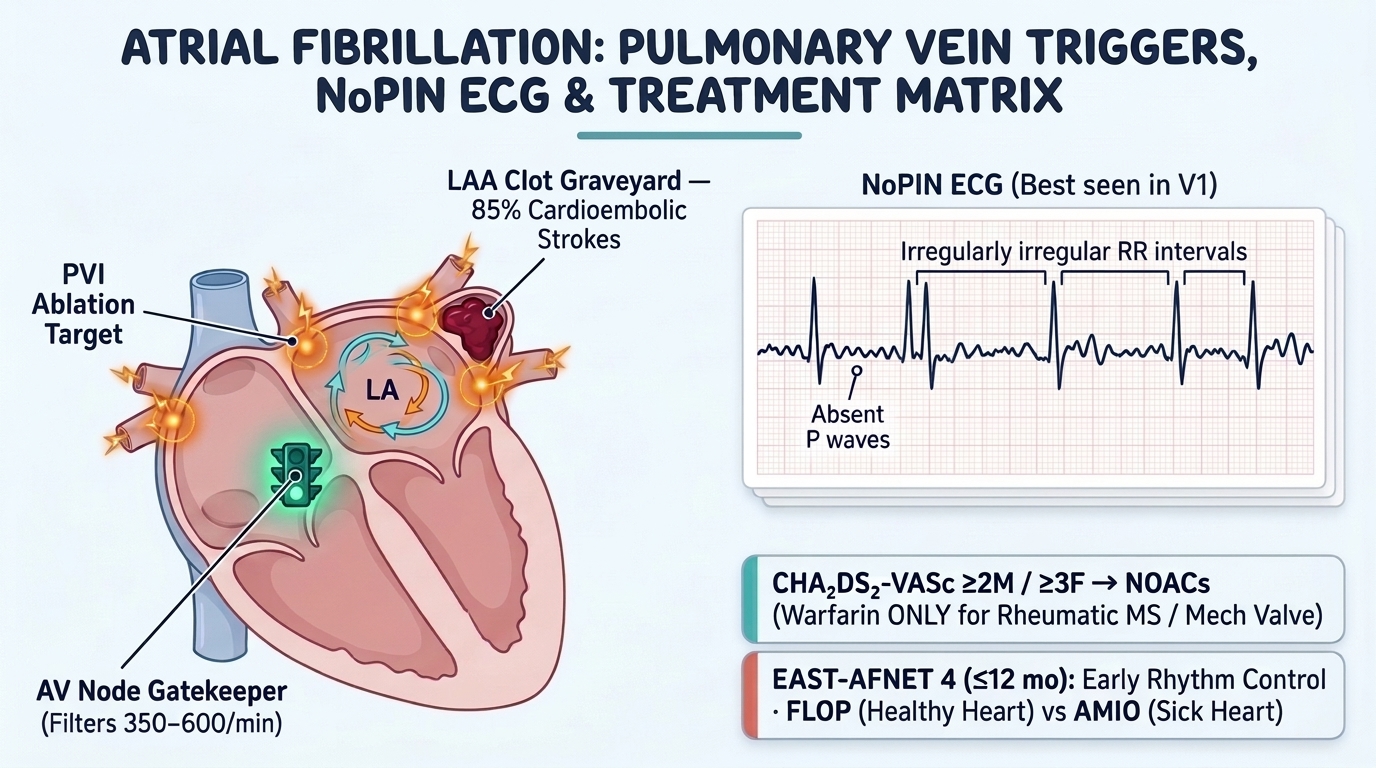
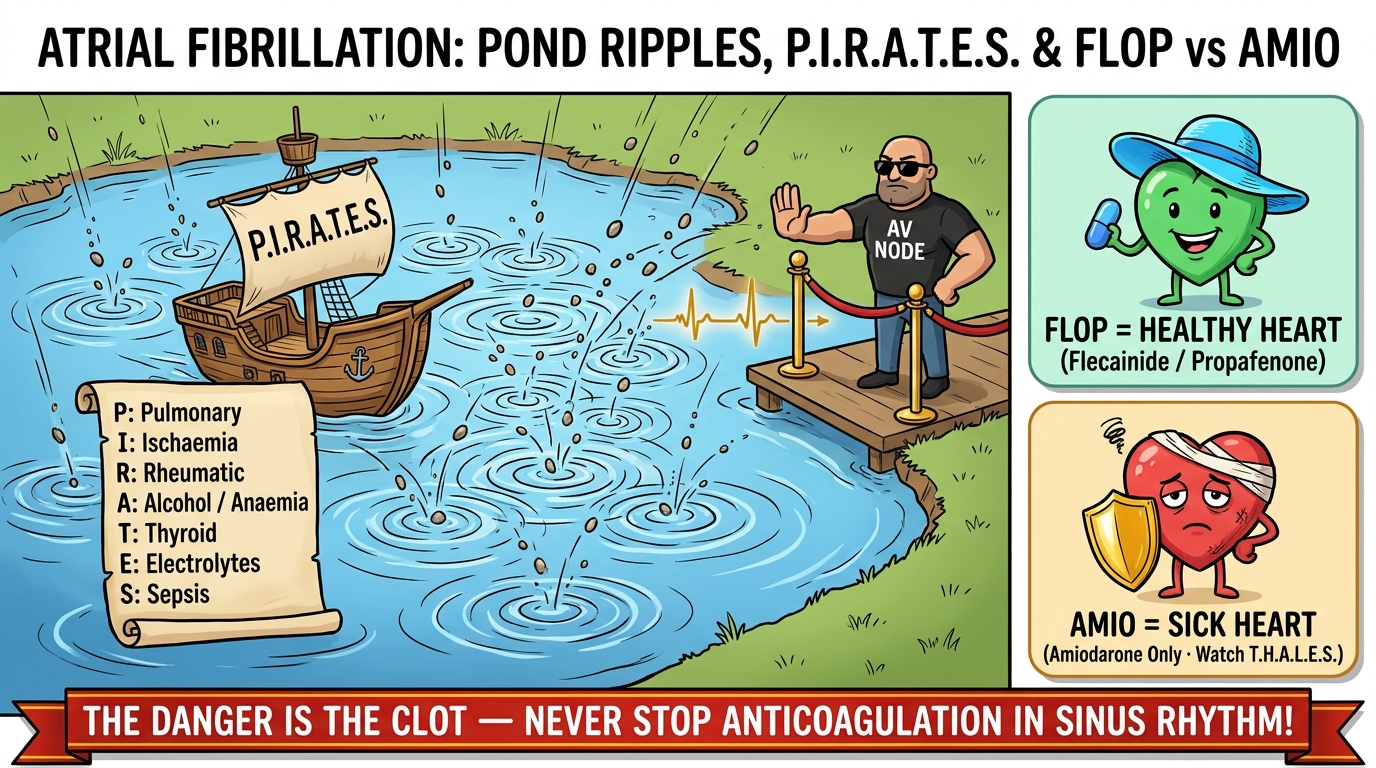
- Multiple Wavelet Theory (“Hundreds of Stones in a Pond”): Instead of one neat pacemaker wave from the SA node, ectopic foci—most commonly originating around the pulmonary vein ostia (the exact target of Pulmonary Vein Isolation [PVI] ablation)—fire chaotically at 350–600 impulses/min. Imagine hundreds of stones dropped simultaneously into a pond, creating colliding ripples and rotating wavelets across the atria.
- The AV Node Gatekeeper: If all 450 atrial impulses reached the ventricles, the patient would die immediately. The AV node acts as a refractory gatekeeper, randomly filtering impulses down to the ventricles—producing the hallmark irregularly irregular ventricular rhythm.
- The Left Atrial Appendage (LAA) — “The Graveyard Where Clots Are Born”: Because fibrillating atria merely quiver rather than contract, blood pools and stagnates inside the LAA, forming thrombi. AFib raises stroke risk 5-fold, and 85% of AF-related strokes are cardioembolic.
- Loss of the Atrial Kick: Coordinated atrial contraction contributes the final 15–20% of cardiac output. Losing this “atrial kick” precipitates dyspnea or decompensated heart failure, especially in stiff ventricles.
2. High-Yield Memory Palace & Core Mnemonics
Master AFib from ECG diagnosis to toxicity monitoring with six interconnected memory hooks:
3. Interactive CHA₂DS₂-VASc Calculator, Rhythm ECG & FLOP-vs-AMIO Treatment Matrix
Switch between the two interactive labs below: inspect animated telemetry strips comparing Mr. Kofi’s AFib against Atrial Flutter and MAT, then adjust risk factors, hemodynamic stability, structural heart disease, and AF duration to derive the exact evidence-based anticoagulation and rhythm/rate drug matrix.
Interactive Simulator: Rhythm ECG Comparator & AFib Treatment Matrix
Pre-loaded with Mr. Kofi’s ED & Morning Rounds profile (CHA₂DS₂-VASc = 3 · Early AF · Normal Heart).
1. CHA₂DS₂-VASc Risk Factors
4. AFib Classification & Narrow-Complex ECG Differentials
Always classify AFib by duration (which guides ablation and rhythm strategy) and verify it is truly AFib rather than its two classic board mimics—Atrial Flutter and Multifocal Atrial Tachycardia (MAT).
| Category / Rhythm | Key ECG or Clinical Definition | Ventricular Rate & Regularity | High-Yield Clinical Pearl |
|---|---|---|---|
| Paroxysmal AF | Self-terminates within < 7 days (usually < 48 h); recurrent episodes. | Irregularly irregular | Best responder to PVI catheter ablation (60–80% success; CABANA). |
| Persistent / Long-Standing | Lasts > 7 days (or requires cardioversion); long-standing = > 12 months. | Irregularly irregular | Early AF (≤ 12 mo) benefits from Early Rhythm Control (EAST-AFNET 4). |
| Permanent AF | Patient and clinician jointly accept AF; no further rhythm restoration attempts. | Irregularly irregular | Focus on BCD rate control + lifelong CHA₂DS₂-VASc anticoagulation. |
| AFib (NoPIN) | No P waves; irregular f-waves (350–600/min, best in V1); narrow QRS. | Irregularly Irregular (often 110–160 bpm) | Check TFTs in every new-onset case (PIRATES). |
| Atrial Flutter | Classic sawtooth F-waves at 300/min (best in II, III, aVF); macro-reentry around tricuspid annulus. | Regular 150 bpm (2:1 block; can be variable) | Same stroke risk & CHA₂DS₂-VASc anticoagulation rules as AFib! |
| MAT (COPD Classic) | ≥ 3 distinct P-wave morphologies with varying PR intervals and flat isoelectric baseline. | Irregularly Irregular (> 100 bpm) | Seen in hypoxic COPD; treat underlying lung disease/hypoxia (do NOT DC cardiovert!). |
5. Stroke Prevention: CHA₂DS₂-VASc & The Golden Anticoagulation Rule
- Hemodynamically Unstable AF (hypotension/shock, acute pulmonary edema, ongoing chest pain/ischemia, altered mental status) → Immediate Synchronized DC Cardioversion (120–200 J biphasic) STAT!
- Lifelong Anticoagulation Rule: Base anticoagulation strictly on CHA₂DS₂-VASc—NEVER stop anticoagulation just because sinus rhythm returns! Silent paroxysmal recurrences still form LAA clots.
- NOACs vs. Warfarin: Direct oral anticoagulants (NOACs/DOACs: rivaroxaban, apixaban, edoxaban, dabigatran) are first-line for non-valvular AF. Use Warfarin ONLY for moderate-to-severe rheumatic mitral stenosis, mechanical heart valves, or eGFR < 15 mL/min.
| Letter | CHA₂DS₂-VASc Risk Factor | Points | Score → Annual Stroke Risk & Action |
|---|---|---|---|
| C | Congestive Heart Failure / LV dysfunction (EF ≤ 40%) | +1 | 0 (Men) / 1 (Women, sex only): ~0% / yr → No Anticoagulation |
| H | Hypertension (Mr. Kofi +1) | +1 | 1 (Men) / 2 (Women): ~1.3% / yr → Consider Anticoagulation |
| A₂ | Age ≥ 75 years | +2 | 2: ~2.2% / yr → Anticoagulate (Men ≥2) |
| D | Diabetes Mellitus (Mr. Kofi +1) | +1 | 3 (Mr. Kofi): ~3.2% / yr → Anticoagulate (All ≥3) |
| S₂ | Prior Stroke, TIA, or Thromboembolism | +2 | 4: ~4.0% / yr · 5: ~6.7% / yr → Mandatory OAC |
| V | Vascular disease (prior MI, PAD, aortic plaque) | +1 | 6: ~9.8% / yr · 7: ~9.6% / yr → Mandatory OAC |
| A | Age 65–74 years (Mr. Kofi, 68 yrs +1) | +1 | 8: ~12.5% / yr → Mandatory OAC |
| Sc | Sex category: Female | +1 | 9: ~15.2% / yr → Mandatory OAC |
6. The Paradigm Shift: AFFIRM (2002) vs. EAST-AFNET 4 (2020)
For nearly two decades, students memorized a single rule from AFFIRM (2002): “Rate control equals rhythm control.” Then EAST-AFNET 4 (2020) revolutionized cardiology by proving that timing matters—intervening early (within 12 months of diagnosis) saves lives and prevents strokes. Know both landmark trials cold:
| Trial Feature | AFFIRM (2002, NEJM) | EAST-AFNET 4 (2020, NEJM) |
|---|---|---|
| Patient Population | Older patients with established / longer-standing AF + stroke risk factors. | Patients with early AF diagnosed ≤ 12 months + cardiovascular risk factors (like Mr. Kofi!). |
| Primary Outcome (5-Year) | 5-yr all-cause mortality: 25.9% Rate vs. 26.7% Rhythm (no survival benefit for rhythm control). | 5-yr primary CV composite (CV death, stroke, HF/ACS hosp): 17.0% Early Rhythm vs. 22.2% Usual Care (HR 0.79, p = 0.005). |
| Why Did Results Differ? | Late remodeled atria + older toxic drugs + anticoagulation was mistakenly stopped in NSR patients → lethal strokes! | Early intervention before atrial fibrosis + modern ablation/drugs + anticoagulation continued lifelong in BOTH arms. |
| Core Exam Takeaway | “The danger is the CLOT!” Rate control is completely valid in established asymptomatic AF, and OAC is never stopped. | Use Early Rhythm Control in AF ≤ 12 months (part of SAFE-Y) while keeping lifelong anticoagulation! |
Two Additional Must-Know Trials:
- CAST Trial: Proved Class Ic antiarrhythmics (flecainide, encainide) increase sudden cardiac death in patients with prior MI / structural heart disease.
- CABANA Trial: Demonstrated superior rhythm maintenance and quality of life with Pulmonary Vein Isolation (PVI) catheter ablation (60–80% success in paroxysmal AF).
7. Pharmacotherapy Matrix: BCD Rate Control, FLOP vs. AMIO & THALES
Once you decide on rate control (target HR < 110 bpm lenient per RACE II, or < 80 bpm strict if still symptomatic) or rhythm control, the heart’s structural status dictates your exact prescription:
| Strategy / Mnemonic | First-Line Agents | Mechanism & Ideal Patient | Critical Contraindications & Monitoring |
|---|---|---|---|
| Rate: B Beta-Blockers |
Metoprolol (IV/PO), Bisoprolol, Atenolol, Esmolol | 1st-line across almost all AFib; controls HR at rest AND exercise (Mr. Kofi: IV metoprolol 138 → 88 bpm). | Avoid in severe decompensated acute HF, severe asthma/bronchospasm, or high-grade AV block. |
| Rate: C Non-DHP CCBs |
Diltiazem, Verapamil | Excellent AV-nodal rate control in COPD/asthma patients with preserved EF. | AVOID in HFrEF (negative inotrope). NEVER combine with beta-blockers (severe bradycardia/AV block). |
| Rate: D Digoxin |
Digoxin | Enhances vagal tone → controls HR at rest ONLY. Useful add-on in HFrEF or sedentary elderly. | Fails during exertion; monitor renal function, K⁺ (hypokalemia worsens toxicity), and serum levels. |
| Rhythm: FLOP Healthy Heart |
Flecainide, Propafenone (Class Ic) | Structurally Normal Heart ONLY (Mr. Kofi’s maintenance drug; also “pill-in-the-pocket”). | FATAL in Structural HD (prior MI, CAD, HF, LVH — CAST trial). Co-prescribe AV-nodal blocker to prevent 1:1 flutter. |
| Rhythm: AMIO Sick Heart |
Amiodarone (Class III) | Sick Hearts ONLY / Universal Fallback (HFrEF, prior MI, LVH, severe structural HD). | Monitor THALES: Thyroid (hypo/hyper), Hepatotoxicity (LFTs), Alveolitis (pulmonary fibrosis — CXR/PFTs), Light sensitivity, Eye corneal microdeposits, Skin slate-grey. |