Imagine trimming your fingernails—or wiping off old nail polish—when you notice something unexpected: a thin, vertical dark brown or black stripe running straight from the base of your nail to the tip. It doesn’t hurt. It doesn’t itch. Your first instinct is completely human: “I must have bumped my finger without noticing—it’s probably just a harmless bruise.”
Most of the time, dark spots on nails truly are harmless. Yet there is one crucial health message every adult should know: this dark vertical line under your nail can be a melanoma. Knowing how to tell a harmless bruise apart from a warning stripe—and when to let a dermatologist look at it with a dermatoscope—can literally save a life.
1. What Is Subungual Melanoma? (In Plain English)
Deep beneath the skin at the base of every fingernail and toenail sits a hidden factory called the nail matrix. This tiny tissue produces the hard, clear nail plate that slowly grows toward your fingertip. Inside the nail matrix live pigment-producing cells called melanocytes.
When those pigment cells become abnormally active or cancerous, they release dark pigment continuously into the newly forming nail. As the nail grows outward, that pigment appears as a vertical dark brown or black stripe—a pattern doctors call longitudinal melanonychia. When caused by skin cancer in the nail root, it is called subungual melanoma.
Here are two surprising facts many people never hear:
- It is NOT just a “sunburn cancer”: Unlike melanoma on the back or shoulders, subungual melanoma is not primarily linked to heavy sun exposure—so it can occur in anyone of any skin tone, including people who never sunburn.
- It favors specific digits: It most often shows up on a single digit—especially the thumb, big toe, or index finger.
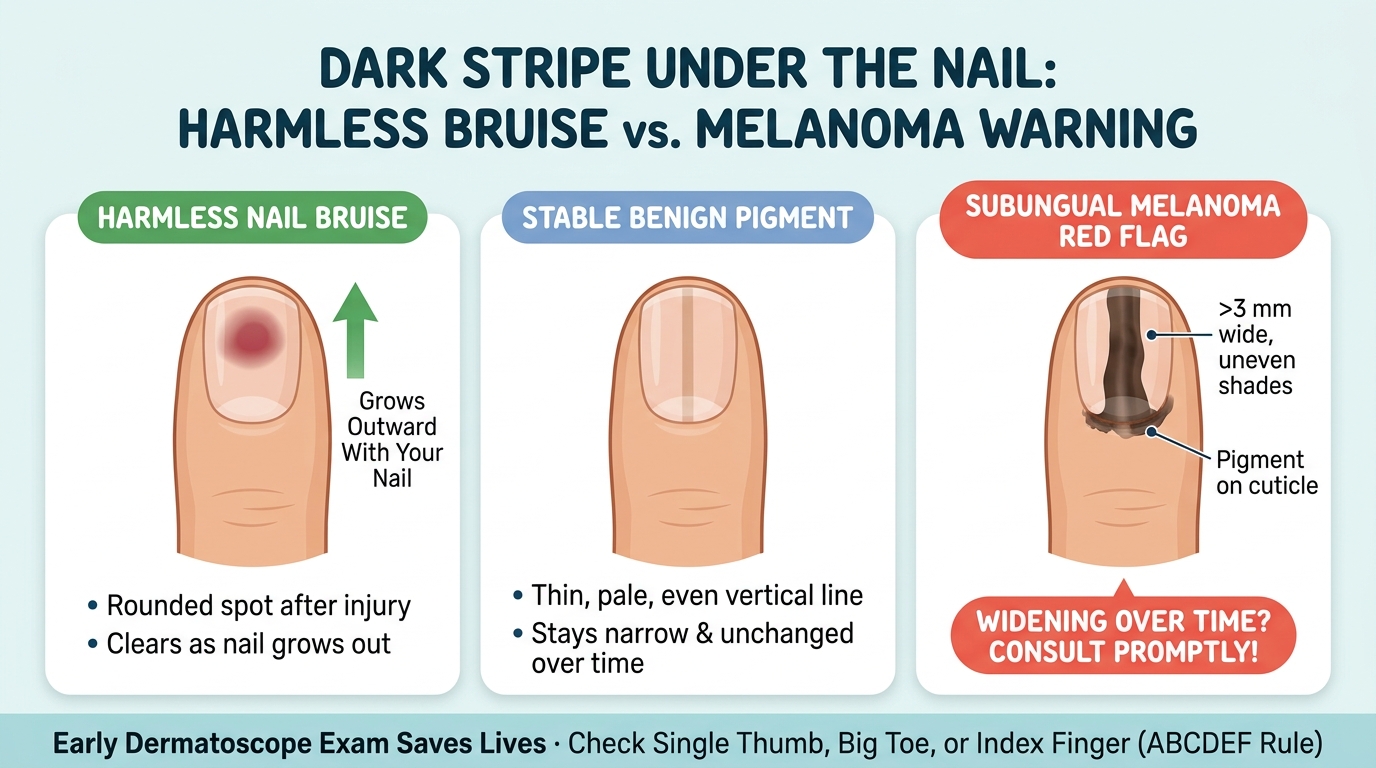
2. Mental Image: The Widening Highway Stripe Under the Nail
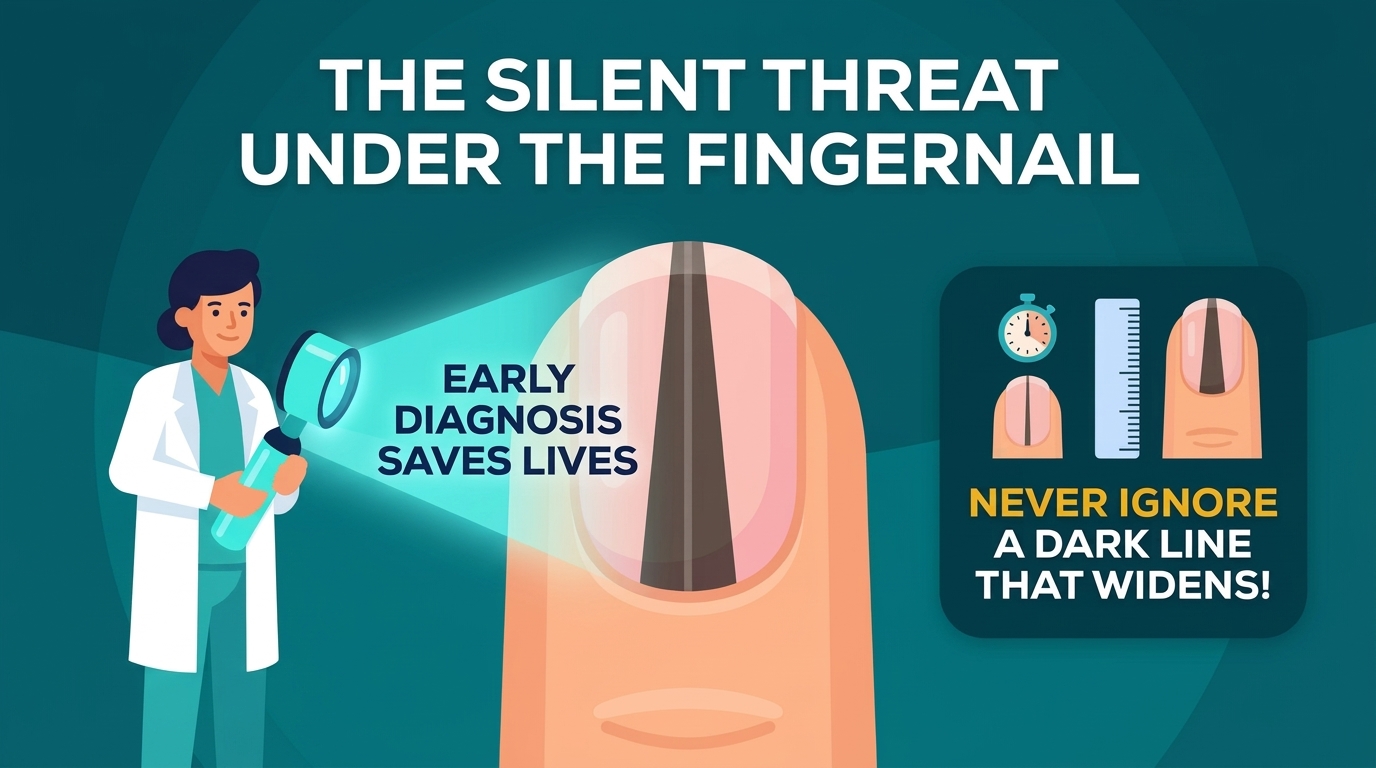
3. Interactive Checker: Watch How Nail Marks Change Over 3 Months
Because fingernails grow slowly (about 3 mm per month), time is one of your strongest clues. Choose one of the three common nail scenarios below, then tap “Fast-Forward 3 Months” to watch how a harmless bruise behaves compared to a stable pigment band and a widening melanoma warning sign.
Interactive Nail Stripe Progression & Bruise vs. Red-Flag Checker
Select a nail mark below, then fast-forward 3 months to see what happens as the nail grows.
Harmless Nail Bruise (Subungual Hematoma)
Bumping a finger or wearing tight shoes can trap a small drop of blood beneath the nail plate, forming a dark brown, purple, or black blotch.
- What to Watch For: Does a band of clear pink nail appear behind the dark spot over the next 4–8 weeks?
- Why It Matters: A true bruise moves outward with nail growth—it never stays anchored to the cuticle.
- Pro Tip: Snap a quick photo today beside a ruler so you can compare in 4–6 weeks.
4. Quick Comparison: Bruise vs. Benign Stripe vs. Warning Sign
Not every dark nail mark needs an urgent biopsy—yet knowing these side-by-side patterns helps you avoid both needless panic and dangerous delay:
| Feature | Harmless Blood Bruise Usually Benign |
Stable Benign Pigment Band Monitor |
Subungual Melanoma Red Flag See Dermatologist |
|---|---|---|---|
| How It Starts | Often after pinching a finger, dropping an object, or tight running shoes | Normal pigment cell activity (very common in medium-to-dark skin tones) | Abnormal pigment cells growing in the nail matrix (no injury required) |
| Shape & Color | Round or oval dark red, purple, brown, or black blotch | Thin (< 3 mm), uniform tan or light-brown vertical stripe with neat parallel edges | Dark brown-to-black vertical band, ≥ 3 mm wide, uneven shades, blurred borders, or wider at the base |
| How Many Nails? | Usually 1 injured nail (or both big toes in runners) | Often multiple fingernails or toenails at the same time | Almost always a single digit (especially thumb, big toe, or index finger) |
| Over 2–3 Months | Moves smoothly outward toward the tip with clear pink nail growing behind it | Stays completely stable in width and shade over time | Widens, darkens, or changes—and fails to grow out cleanly |
| Cuticle / Skin Fold | Normal skin color | Normal skin color | Dark pigment may spread onto the cuticle skin (Hutchinson’s sign) |
5. The ABCDEF Rule: A 60-Second Self-Check for Dark Nail Stripes
Dermatologists use an easy-to-remember checklist called the ABCDEF Rule of Subungual Melanoma. You do not need to have all six letters to seek advice—even one strong warning sign (especially C: Change or Widening) is reason enough for a quick check.
| Letter | What It Stands For | What to Look For on Your Nail |
|---|---|---|
| AAge | Adult onset (peaks ages 50–70) | Subungual melanoma is most common between ages 50 and 70, though any adult with a new or changing dark nail stripe should have it evaluated. |
| BBand | Brown-to-black pigment, width ≥ 3 mm | A dark brown or black band measuring 3 millimeters or wider (roughly the thickness of two stacked nickels), especially with irregular, blurred borders or multiple shades. |
| CChange | Widening or changing over time | #1 Red Flag: A stripe that grows wider, turns darker, develops uneven streaks, splits the nail, or fails to grow out like a bruise over 2–3 months. |
| DDigit | Single high-risk finger or toe | Involvement of a single digit—most frequently the thumb, big toe, or index finger—carries higher concern than faint stripes on several nails at once. |
| EExtension | Hutchinson’s sign | Dark brown or black pigment extending beyond the nail onto the surrounding cuticle or side skin folds. |
| FFamily | Family or personal history | A personal history of melanoma or a close relative (parent, sibling, child) who has had melanoma. |
- A new dark vertical stripe appearing in adulthood on a single finger or toe (especially thumb, big toe, or index finger).
- Any dark nail band that widens, darkens, or changes shape over time, or measures 3 mm or wider.
- Dark pigment creeping onto the cuticle or skin around the nail (Hutchinson’s sign).
- A “bruise” that does not move outward with clear nail behind it after 6–8 weeks—or occurs with no memory of injury.
- Unexplained splitting, crumbling, bleeding, or a raised nodule beneath the nail plate.
6. Tap to Bust the 3 Biggest Nail-Stripe Myths
7. What to Expect at the Dermatologist (Why Dermoscopy Is Painless)
Many people put off checking a nail stripe because they picture an immediate, painful procedure. In reality, your first visit is quick, gentle, and completely painless:
| Clinic Step | What Happens | What It Means for You |
|---|---|---|
| 1. Dermoscopy (Onychoscopy) | Your dermatologist places a handheld illuminated magnifier called a dermatoscope gently onto the bare nail (often with a drop of clear gel). | Zero pain, 2 minutes. It reveals microscopic pigment lines and blood droplets invisible to the naked eye—often ruling out cancer on the spot! |
| 2. Baseline Photo & Measurement | If the band looks reassuringly benign, your doctor records its exact millimeter width and takes a magnified photo. | Gives you peace of mind and a clear baseline for simple follow-up checks every 3–6 months. |
| 3. Targeted Biopsy (Only If Needed) | If dermoscopy shows irregular lines, widening, or Hutchinson’s sign, the dermatologist numbs the finger with local anesthesia and samples a tiny piece of the nail matrix. | Provides a definitive lab answer. Catching melanoma early—when it is still thin or confined to the top layer—leads to dramatically higher cure rates. |
8. Frequently Asked Questions
How can I tell at home if a dark mark is just a blood bruise?
Take a well-lit smartphone photo of the bare nail next to a ruler today, then take another photo in 4 to 6 weeks. A harmless bruise (subungual hematoma) moves smoothly forward toward the tip as your nail grows, leaving a clear gap of healthy pink nail between the cuticle and the dark spot. If the mark stays anchored to the base, widens, or never grows out, schedule a dermatology check.
Does checking a dark nail stripe hurt? Will the doctor pull off my whole nail?
No! The first exam uses a dermatoscope—a painless magnifying light that simply rests gently on the nail surface. Many patients leave with immediate reassurance that their spot is a bruise or benign pigment. Only if suspicious features are found will a dermatologist discuss a targeted biopsy performed comfortably under local numbing medication.
Are vertical brown stripes under the nails ever completely normal?
Yes. Benign vertical pigment bands (melanonychia) are very common, especially in adults with medium-to-dark skin tones. Benign stripes tend to appear on multiple fingernails or toenails, stay narrow (< 3 mm), have uniform light-to-medium brown color, and remain unchanged over years. Even so, a brand-new, solitary, dark, or widening stripe on one digit deserves a quick dermatoscope check.
Should I remove nail polish, gel, or acrylics before my dermatology appointment?
Yes—please remove all nail polish, gel, and artificial extensions completely before your appointment. A bare nail allows the dermatologist to inspect the full nail plate, cuticle, and subtle pigment lines clearly through the dermatoscope.