Imagine glancing in the bathroom mirror one morning and noticing a tiny pink bump on the side of your nose, your cheek, or your ear. You wash your face—and it bleeds a little on your towel. You shrug and think, “Just a stubborn pimple or a shaving nick. It’ll clear up in a few days.”
A week passes, and a light crust forms. You think it’s finally gone—until next Tuesday, when it starts oozing and bleeding in the exact same spot all over again. Two months later, that harmless-looking little bump is still right there.
1. What Is Basal Cell Carcinoma—In Plain English?
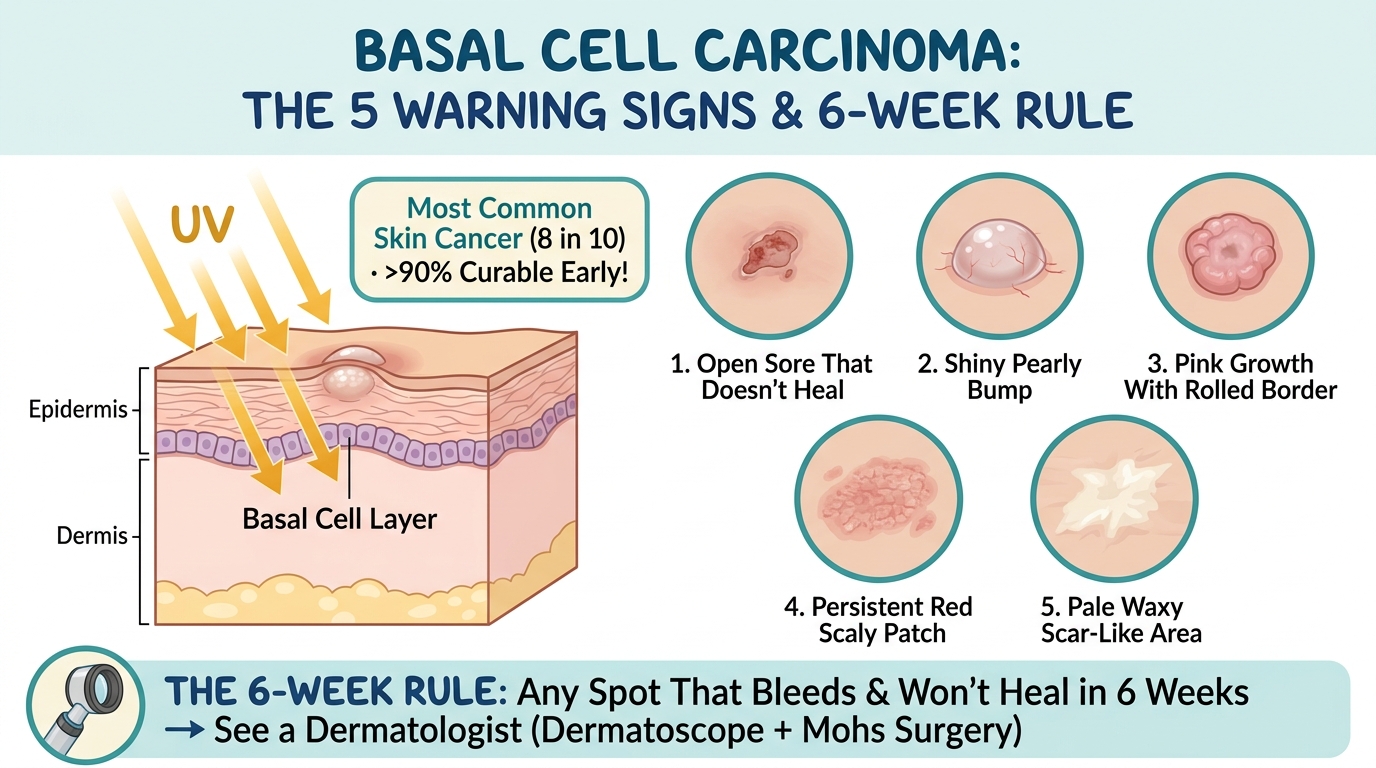
Your skin is constantly renewing itself. At the very bottom of your skin’s outer layer (the epidermis) sits a row of hardworking cells called basal cells. Think of them as the skin’s factory floor: they steadily produce fresh skin cells to replace older ones shed from the surface.
Over the years, ultraviolet (UV) radiation from sunlight—or from indoor tanning beds—gradually scratches the DNA instructions inside those basal cells. Eventually, a damaged basal cell forgets how to stop dividing and begins forming a slow-growing little cluster. That is Basal Cell Carcinoma.
- Remarkably common: BCC accounts for roughly 8 out of every 10 skin cancers (around 3 million cases diagnosed each year in the United States alone).
- Where it loves to appear: Sun-exposed areas—especially the nose, forehead, cheeks, ears, neck, scalp, shoulders, and back.
- Why early action matters: Even though BCC rarely travels through the bloodstream to other organs, leaving it alone lets it quietly grow deeper and wider, risking damage to delicate facial structures like the nose, eyelids, or lips.
2. Mental Image: “The Bleeding Button” & The 6-Week Rule
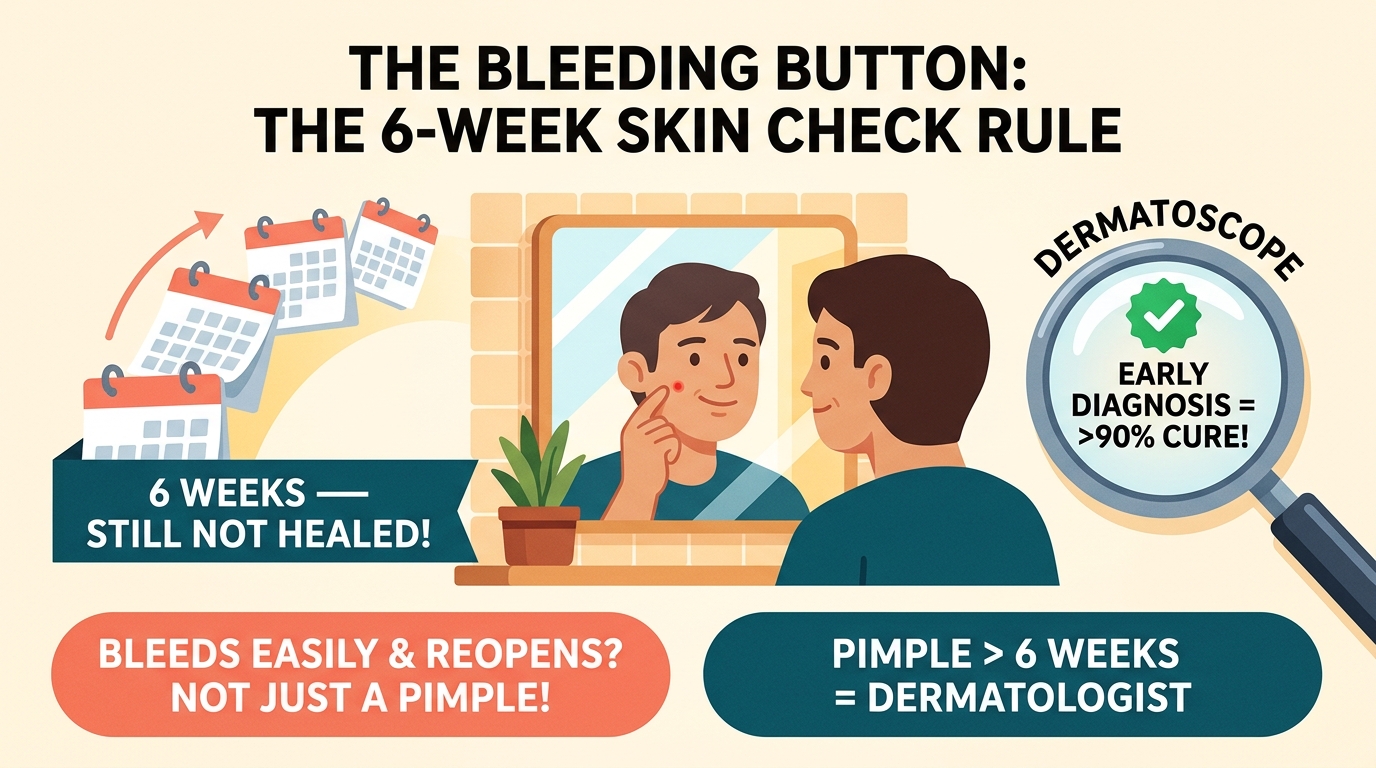
Imagine a tiny, innocent-looking shirt button—or a small pimple—that starts bleeding at the slightest brush of a towel, razor, or fingernail. It tries to scab over, tricks you into thinking it healed, and then reopens again and again. Unlike a true acne pimple that finishes its job and vanishes in 1 to 2 weeks, The Bleeding Button refuses to leave.
3. Interactive Tool: 6-Week Spot Checker & BCC 5-Warning-Signs Explorer
Not every Basal Cell Carcinoma looks like a bleeding sore—it can wear five different disguises. Use the interactive explorer below to compare a normal healing pimple with each of the 5 BCC warning signs, and slide the Week Tracker from Week 1 to Week 8 to see how the 6-Week Rule works in real time.
Interactive 6-Week Spot Checker & BCC 5-Warning-Signs Explorer
Step 1: Choose a spot appearance below. Step 2: Drag the week slider to see what happens beneath the skin.
Normal Healing Pimple (7–14 Days)
An ordinary acne pimple or razor bump sits in a shallow surface pore. Your immune system clears it, and the skin closes smoothly within one to two weeks.
- Depth: Superficial pore only—never invades the basal layer.
- Bleeding: Rare unless picked; heals cleanly without reopening.
- Key Clue: Gone within 1–2 weeks.
4. Normal Pimple vs. Basal Cell Carcinoma: How to Tell the Difference
Because BCC hides in plain sight, knowing how a real pimple behaves compared to a “Bleeding Button” can save you months of unnecessary waiting:
| Feature | Ordinary Pimple or Shaving Nick | Possible Basal Cell Carcinoma (BCC) |
|---|---|---|
| Healing Time | Clears up reliably within 7 to 14 days. | Still present, crusty, or recurring past 6 weeks. |
| Bleeding Pattern | Rarely bleeds unless squeezed; once scabbed, it heals for good. | Bleeds easily after washing your face, drying with a towel, or shaving—then crusts over and reopens. |
| Pain or Tenderness | Often slightly sore, warm, or tender to the touch. | Usually completely painless—which is why people ignore it! |
| Appearance Over Time | Shrinks day by day until skin returns to normal. | Stays the same or slowly enlarges, develops pearly borders, or leaves a pale waxy flat mark. |
| Best Next Step | Gentle cleansing, hands off, daily sunscreen. | Book a dermatologist visit for a painless dermatoscope check. |
5. The 5 Classic Faces of Basal Cell Carcinoma
Dermatologists and the Skin Cancer Foundation highlight five major warning signs. Even a single one that lasts beyond 6 weeks deserves a quick check:
| BCC Warning Sign | What You See in the Mirror | What People Often Mistake It For |
|---|---|---|
| 1. Open Sore That Won’t Heal | A small sore that bleeds, oozes, or crusts over for weeks—seems to heal, then breaks open again. | A stubborn pimple, cold sore, or shaving nick. |
| 2. Reddish, Irritated Patch | A flat red or pink scaly patch on the face, chest, shoulders, or arms that may itch or crust slightly. | A patch of dry skin, eczema, or mild sun irritation. |
| 3. Shiny, Pearly Bump | A smooth, translucent, pearly pink, white, or flesh-colored dome (sometimes brown/black in darker skin tones) with tiny surface blood vessels. | A harmless mole, clogged pore, or small skin tag. |
| 4. Rolled-Border Pink Growth | A pink bump with slightly raised, “rolled” outer edges and a tiny crusted dent in the center. | An ingrown hair or healing insect bite. |
| 5. Pale, Flat, Waxy Scar-Like Area | A white, yellowish, or waxy flat patch with blurred borders where the skin looks tight—with no memory of an injury there. | An old forgotten scratch or faint acne scar. |
6. Tap to Bust the 3 Biggest Skin Cancer Myths
Don’t let common misconceptions delay a simple, life-protecting checkup. Tap each card below to reveal the medical truth:
7. Good News: How Dermatologists Diagnose & Cure BCC
Walking into a dermatologist’s office for a suspicious spot is far easier and gentler than most people expect. There are no intimidating machines—just a bright magnifying lens and straightforward, highly effective treatments:
| Step / Option | How It Works (In Plain English) | Why Patients Feel Reassured |
|---|---|---|
| 1. Dermatoscope Exam | Your dermatologist looks closely at the spot with a handheld lighted magnifier (a dermatoscope) that sees just beneath the surface. | 100% painless, takes under a minute, and immediately spots telltale pearly patterns or tiny vessels. |
| 2. Quick Skin Biopsy | If a spot looks suspicious, the skin is numbed locally and a tiny sample is sent to a lab for a definitive answer. | Quick outpatient step with minimal discomfort—removes all guesswork. |
| 3. Mohs Micrographic Surgery | The gold-standard treatment for the face: thin layers are removed and checked immediately under a microscope until zero cancer cells remain. | Offers the highest cure rate (up to ~99% for new BCCs) while preserving the maximum healthy skin around the nose, eyelids, ears, and lips. |
| 4. Standard Excision & Local Care | For small or lower-risk spots on the trunk, arms, or legs, simple numbed removal (or dermatologist-prescribed topical treatments for very superficial BCCs) works beautifully. | Simple in-office procedure with fast healing and cure rates above 90%. |
| 5. Targeted Oral Therapy (Vismodegib) | For rare, deeply advanced cases where surgery isn’t possible, modern targeted pills (Hedgehog pathway inhibitors like vismodegib) switch off the BCC growth signal. | Even complex, long-neglected cases now have effective medical options guided by specialists. |
- Any pimple, crusted sore, or bump lasting longer than 6 weeks.
- A spot that bleeds repeatedly with normal washing, shaving, or toweling.
- A new pearly bump, rolled-edge pink growth, persistent red scaly patch, or waxy “scar” with no past injury.
- A spot growing near sensitive areas like the eyelids, nose, lips, or ears.
Medical safety note: If a doctor has already prescribed a skin cream or medication for a lesion, never stop or change your prescribed treatment without consulting your physician first.
8. Simple Daily Habits to Protect Your Skin for Life
Because UV exposure adds up quietly over decades, small daily habits make a huge difference—even if you already had sunburns years ago:
9. Frequently Asked Questions
Does a dermatologist check hurt? What happens during the visit?
The skin check itself is completely painless. Your dermatologist examines the spot with a handheld lighted magnifier called a dermatoscope, which takes less than a minute. Only if a spot truly looks suspicious will they numb the tiny area with local anesthesia to take a small biopsy sample.
Why do doctors often recommend Mohs surgery for spots on the face?
Mohs micrographic surgery removes Basal Cell Carcinoma one ultra-thin layer at a time and checks 100% of the tissue edges under a microscope right away. That gives both the highest cure rate and the smallest possible footprint—helping preserve your natural appearance around delicate areas like the nose, eyelids, ears, and lips.
I hardly sunbathe anymore—can I still get Basal Cell Carcinoma?
Yes. UV damage is cumulative, meaning sun exposure or sunburns from childhood, teenage summers, outdoor work, or past tanning beds can show up decades later as a small BCC. Starting daily sun protection today still lowers your future risk significantly!
Should I put over-the-counter acne cream or stop my prescription ointment on a bleeding bump?
Avoid picking, scrubbing, or trying harsh home remedies on a spot that won’t heal—it only irritates the tissue and delays diagnosis. And if a doctor has already prescribed a topical medication for a skin condition, never stop your prescribed treatment on your own; instead, let your dermatologist inspect any spot that bleeds or persists past 6 weeks.