Catatonia with psychotic features is one of the most dramatic—and most frequently mismanaged—emergencies in psychiatry. A patient arrives frozen like a living statue, silent and staring, yet may suddenly erupt into purposeless agitation while experiencing vivid hallucinations or persecutory delusions. Reach for the wrong drug first (especially a high-potency antipsychotic), and you can precipitate fatal Neuroleptic Malignant Syndrome (NMS) or malignant catatonia.
In this high-yield clinical masterclass based on Case 12, you will decode the basal ganglia–frontal motor circuit, lock in every bedside sign with the CATATONIA PSYCHOTIC mnemonic, rehearse the lifesaving IV/IM Lorazepam Challenge → ECT protocol in our interactive ward simulator, and master the lethal pitfalls tested on USMLE, PLAB, and OSCE exams.
On bedside exam, the patient is afebrile (36.8°C) with stable vital signs, does not answer questions (mutism), actively resists attempts to close their eyes (negativism), and when you gently lift their right arm above their head, it remains suspended in mid-air like soft candle wax (waxy flexibility / catalepsy). Occasionally, they echo your exact hand movement (echopraxia).
Critical Ward Decision: The intern asks, “Since the patient has hallucinations and delusions, should we inject IM haloperidol right now?” — Keep reading to see why the answer is a resounding NO!
1. Neurobiology & The “Living Wax Statue” Mental Image
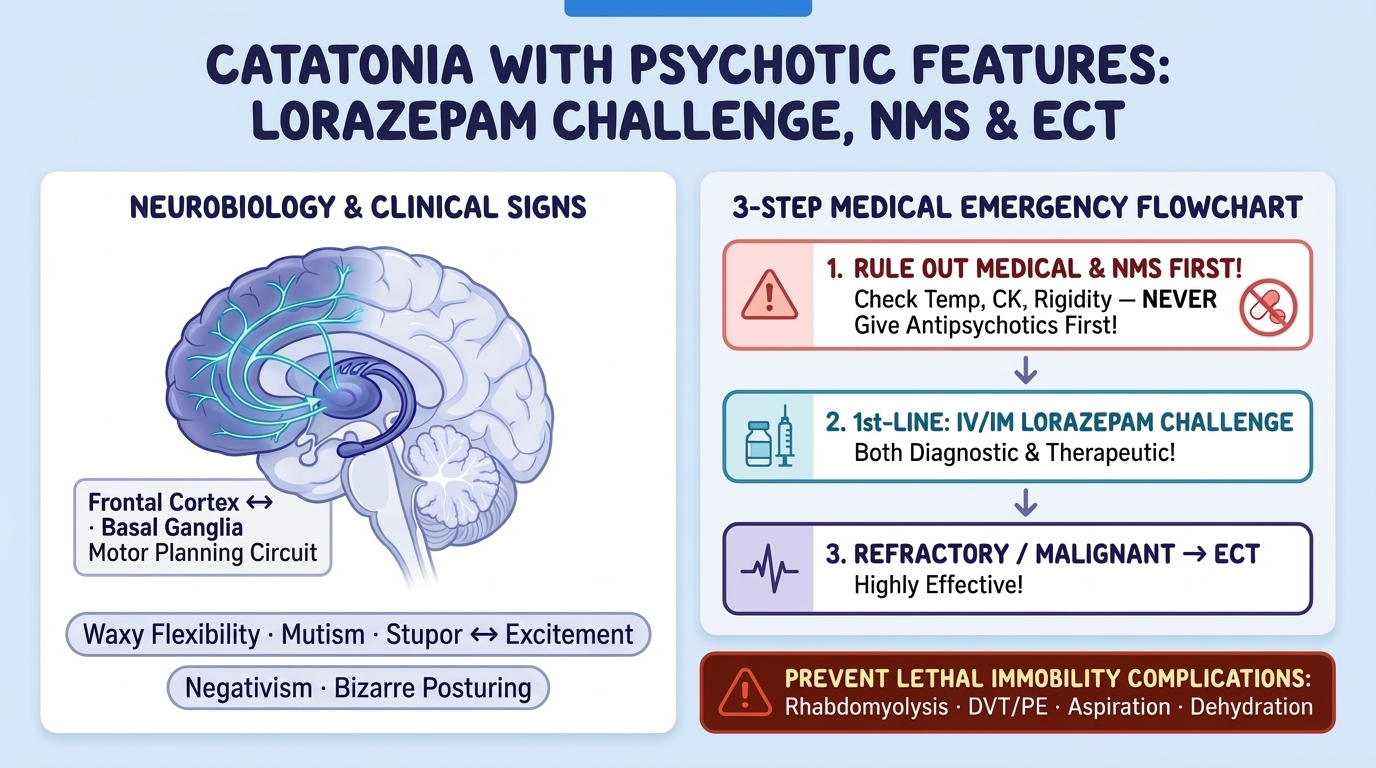
- Basal Ganglia–Frontal Cortex Circuit Lock-Up: Catatonia is a severe psychomotor syndrome driven by dysfunction in the frontal lobe–basal ganglia–thalamic motor planning loop—specifically impaired GABA-A inhibitory modulation and disrupted dopamine/glutamate balance. The brain’s motor “gearbox” jams in neutral (stupor/catalepsy) or violently lurches into overdrive (sudden catatonic excitement).
- Not Only Schizophrenia! Although catatonia can co-occur with psychosis, it is just as common—or even more common—in severe mood disorders (bipolar mania/depression, psychotic MDD) and general medical/neurologic illnesses (autoimmune/anti-NMDA receptor encephalitis, metabolic encephalopathy, toxic states, or medication-induced reactions).
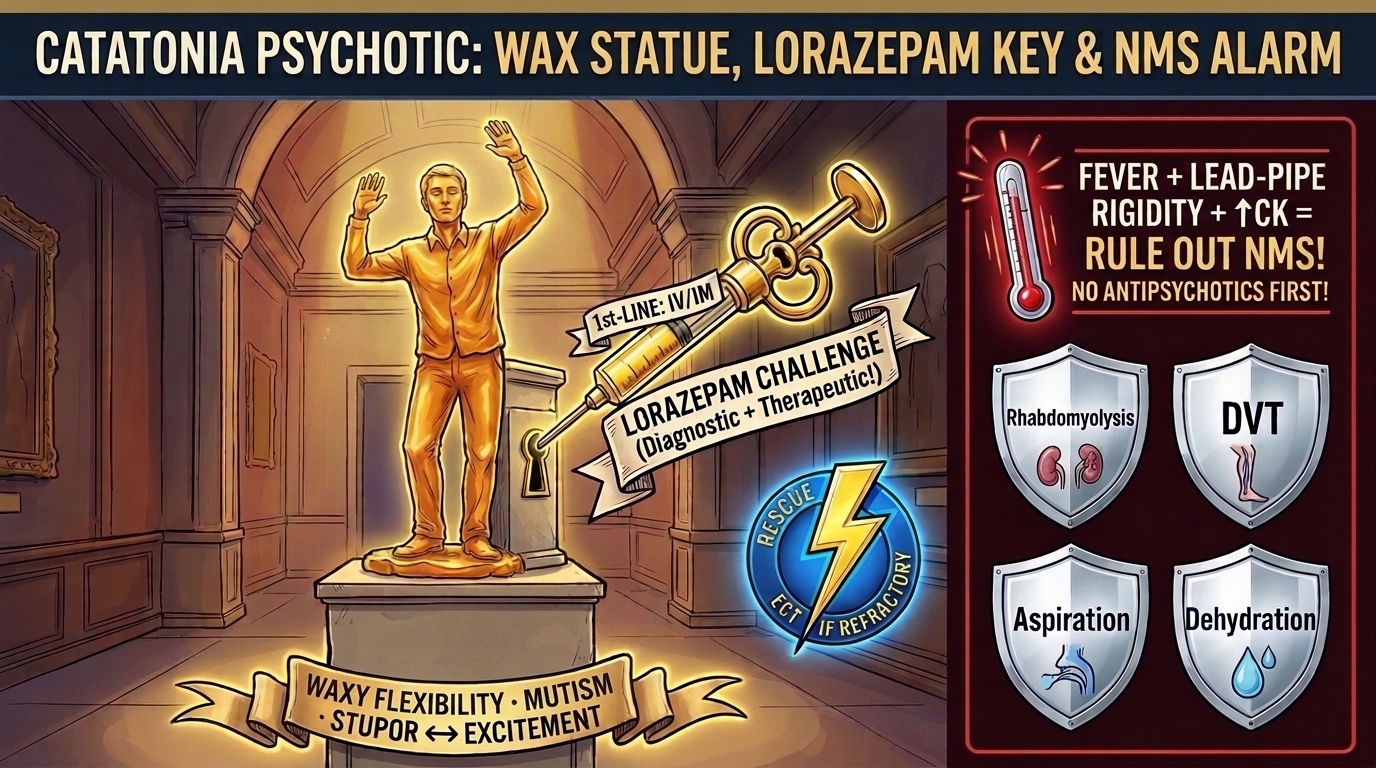
- The Magic Key: Boosting GABA-A tone with an IV/IM Lorazepam challenge turns the key in the rusted motor lock—often melting away hours of stupor and mutism within 15–30 minutes!
2. Memorize Every Sign: The “CATATONIA PSYCHOTIC” Mnemonic
Under DSM-5, diagnosing catatonia requires ≥ 3 of 12 psychomotor features. Anchor the clinical presentation—and the first-line bedside action—with the CATATONIA PSYCHOTIC framework:
+ PSYCHOTIC Overlay: Concurrent delusions, auditory/visual hallucinations, or disorganized thought—confirming Catatonia with Psychotic Features (yet you must resolve catatonia and rule out NMS FIRST before cautious antipsychotic therapy!).
3. Interactive Catatonia Lorazepam Challenge & NMS Safety Simulator
Explore both halves of this bedside console: first inspect how each psychomotor sign alters the Frontal–Basal Ganglia motor circuit and patient posture; then test your emergency ward decisions across two high-stakes clinical profiles (Afebrile Catatonia + Psychosis vs. Haloperidol-Induced NMS).
Interactive Catatonia Lorazepam Challenge & NMS Safety Simulator
Inspect psychomotor signs on the motor circuit, then test emergency interventions safely.
4. Core Catatonic Signs & Bedside Definitions
Know the exact definitions of each psychomotor sign—examiners frequently describe the bedside behavior without naming it directly:
| Psychomotor Sign | Bedside Clinical Definition | How to Test / Spot on OSCE | High-Yield Distinction |
|---|---|---|---|
| Waxy Flexibility & Catalepsy | Slight, even resistance to passive positioning by the examiner (waxy flexibility), followed by holding that imposed posture against gravity (catalepsy). | Gently lift the patient’s arm to 90°–135°; observe initial wax-like resistance and sustained mid-air hold. | Distinct from uniform severe lead-pipe rigidity seen in NMS! |
| Stupor & Immobility | No psychomotor activity; awake yet totally unresponsive to the surrounding environment. | Eyes open and tracking minimally or fixed, yet no spontaneous movement or interaction. | High risk of rhabdomyolysis, DVT/PE, dehydration, and aspiration. |
| Mutism | No, or minimal, verbal response (excluding known aphasia). | Patient remains silent even to direct, repeated simple questions despite intact hearing. | Often rapidly reverses within minutes after an IV/IM lorazepam trial. |
| Negativism | Opposition or no response to instructions or external stimuli (passive or active resistance). | Ask patient to open eyes or relax arm—they tightly clench shut or pull in the exact opposite direction. | Not deliberate “stubbornness”—it is involuntary motor-circuit pathology. |
| Posturing | Spontaneous and active maintenance of a bizarre posture against gravity (e.g., head hovering above the bed: “psychological pillow”). | Observe spontaneous odd stances held for minutes to hours without examiner placement. | Posturing is spontaneous; catalepsy is passively induced by the examiner. |
| Excitement / Agitation | Sudden, severe, purposeless motor agitation not triggered by external stimuli. | Frozen stuporous patient abruptly erupts into frantic pacing, shouting, or thrashing. | TRAP Do NOT reflexively inject high-potency haloperidol! |
| Echolalia & Echopraxia | Pathological mimicking of another person’s speech (echolalia) or movements (echopraxia / echokinesis). | Scratch your head or say a phrase; the patient automatically mirrors the gesture or repeats your words. | Often accompanied by odd mannerisms, stereotypies, or grimacing. |
5. Critical Differential Diagnosis: ALWAYS Rule Out NMS!
| Clinical Feature | Catatonia (Simple vs. Malignant) | Neuroleptic Malignant Syndrome (NMS) | Serotonin Syndrome | Conversion (Functional) Disorder |
|---|---|---|---|---|
| Key Trigger | Mood disorder, schizophrenia, encephalitis/medical illness, or abrupt benzo withdrawal | Dopamine antagonist (haloperidol, fluphenazine, atypicals, metoclopramide) | Serotonergic excess (SSRIs + MAOI, linezolid, tramadol, triptans) | Acute psychological stressor; no organic motor-circuit lesion |
| Onset & Vitals | Acute/subacute; normal vitals in simple catatonia (fever/autonomic storm in malignant catatonia) | Days to weeks; high fever (>38.5–40°C), labile BP, tachycardia, diaphoresis | Rapid (<24 hrs); fever, tachycardia, hypertension, diaphoresis, dilated pupils | Abrupt; normal vital signs, afebrile, no autonomic instability |
| Muscle Tone & Reflexes | Waxy flexibility, catalepsy, posturing, negativism; normal reflexes | Severe “lead-pipe” rigidity, hyporeflexia / bradyreflexia | Hyperreflexia, inducible clonus (especially ankles), ocular clonus, tremor | Inconsistent weakness / normal tone; positive Hoover sign or distractibility |
| Serum CK & Labs | Normal or mildly elevated (markedly ↑ if prolonged stupor/rhabdo or malignant) | Markedly elevated CK (often >1,000–10,000+ U/L), leukocytosis, myoglobinuria | Normal or mildly elevated CK (unless severe agitation) | Completely normal labs and CK |
| First-Line Management | IV/IM Lorazepam → ECT if refractory or malignant | STOP Antipsychotic! Aggressive IV fluids/cooling; Dantrolene or Bromocriptine (+ lorazepam/ECT) | Stop serotonergic agents; IV fluids, benzodiazepines, Cyproheptadine (5-HT2A blocker) | Reassurance, validation, physical therapy & psychotherapy (CBT) |
6. Step-by-Step Emergency Management Protocol (Lorazepam → ECT)
Treat every acute catatonic presentation as a hospital-level medical emergency. Follow this exact 5-step sequence on ward rounds and exams:
| Step | Action & Protocol | Clinical Purpose & Exam Pearl |
|---|---|---|
| Step 1 Stabilize |
Immediate Hospitalization & Medical Support: Continuous vitals, airway/aspiration precautions, IV fluids, electrolyte repletion, and DVT prophylaxis. | Prevents death from dehydration, rhabdomyolysis/AKI, pulmonary embolism, and aspiration pneumonia. |
| Step 2 Rule Out |
Exclude NMS & Medical/Organic Causes: Check temperature, CK, CMP/electrolytes, CBC/infection markers, toxicology, neuroimaging/LP/EEG if encephalitis suspected. HOLD antipsychotics! | Never miss NMS (fever + lead-pipe rigidity + ↑↑CK) or anti-NMDA receptor encephalitis presenting as catatonia + psychosis. |
| Step 3 First-Line |
IV / IM Lorazepam Challenge (1–2 mg): Reassess catatonic signs (Bush-Francis scale) at 5–15 minutes (IV) or 15–30 minutes (IM); repeat if partial response, then schedule standing high-dose lorazepam. | Dual Role: Dramatic rapid reversal both confirms the diagnosis of catatonia AND serves as first-line treatment (70–80% response rate). |
| Step 4 Escalation |
Electroconvulsive Therapy (ECT): Initiate urgently if lorazepam fails, or IMMEDIATELY first-line alongside supportive care in malignant catatonia (fever, autonomic instability, life-threatening refusal of intake). | Highly effective (>85–90% response) and lifesaving! Do NOT delay ECT when autonomic instability appears. |
| Step 5 Underlying |
Treat the Primary Cause Cautiously: Once catatonia has resolved and NMS is definitively excluded, treat the underlying mood disorder, schizophrenia, or medical illness (if antipsychotic is needed, prefer cautious low-potency/second-generation agent while maintaining lorazepam cover). | Prevents relapse of psychosis or mood episodes without re-triggering catatonia or NMS. |
7. Preventing Lethal Immobility Complications
Even afebrile catatonia can become fatal if the medical team overlooks the systemic consequences of prolonged frozen stillness:
| Lethal Complication | Mechanism in Prolonged Catatonia | Warning Signs / Labs | Mandatory Ward Prophylaxis |
|---|---|---|---|
| Rhabdomyolysis & Acute Kidney Injury | Sustained isometric muscle rigidity/posturing + dehydration causes skeletal muscle breakdown and myoglobin tubular toxicity. | ↑↑ Serum CK, dark tea-colored urine, hyperkalemia, rising creatinine. | Serial CK & renal panel monitoring, aggressive IV crystalloid hydration, rapid catatonia reversal. |
| DVT & Pulmonary Embolism (PE) | Prolonged immobility causes severe venous stasis (Virchow’s triad) compounded by hemoconcentration. | Unilateral calf swelling/warmth, sudden tachycardia, hypoxia, chest pain. | Low-molecular-weight heparin (LMWH) / UFH + sequential compression devices (SCDs) + early mobilization. |
| Aspiration Pneumonia | Stupor, mutism, blunted airway reflexes, and unsafe attempts at forced oral feeding. | Fever, tachypnea, crackles, new infiltrate on CXR, ↓ SpO₂. | Keep NPO while stuporous, elevate head of bed 30°–45°, suction readiness, swallow evaluation before resuming PO. |
| Dehydration, Malnutrition & Pressure Ulcers | Refusal of oral food/water (negativism/stupor) + unrelieved bony pressure during hours of immobility. | Hypernatremia, elevated BUN/Cr ratio, orthostasis, skin erythema/breakdown. | Maintenance IV fluids + electrolyte/thiamine replacement, enteral tube if prolonged, q2h turning & pressure-relieving mattress. |