On psychiatry exams and in primary care clinics, Panic Disorder with Agoraphobia and Social Anxiety Disorder (Social Phobia) are two of the most frequently confused—and most treatable—conditions you will encounter. Both can trap bright, capable adults inside shrinking worlds, yet they run on two distinct psychological engines.
In this high-yield masterclass, we pair two unforgettable clinical vignettes—a 36-year-old teacher fleeing a supermarket and a 29-year-old woman cleaning offices at night—to decode the exact physiological and cognitive loops driving each disorder, master cycle-breaking CBT and first-line SSRI pharmacotherapy, and avoid the classic benzodiazepine and differential-diagnosis traps.
1. Two Distinct Engines: “Fear of the Fear” vs. “Fear of Scrutiny”
Although both patients avoid crowds, workplaces, and social spaces, ask WHY they are avoiding—that single question unlocks the diagnosis every time:
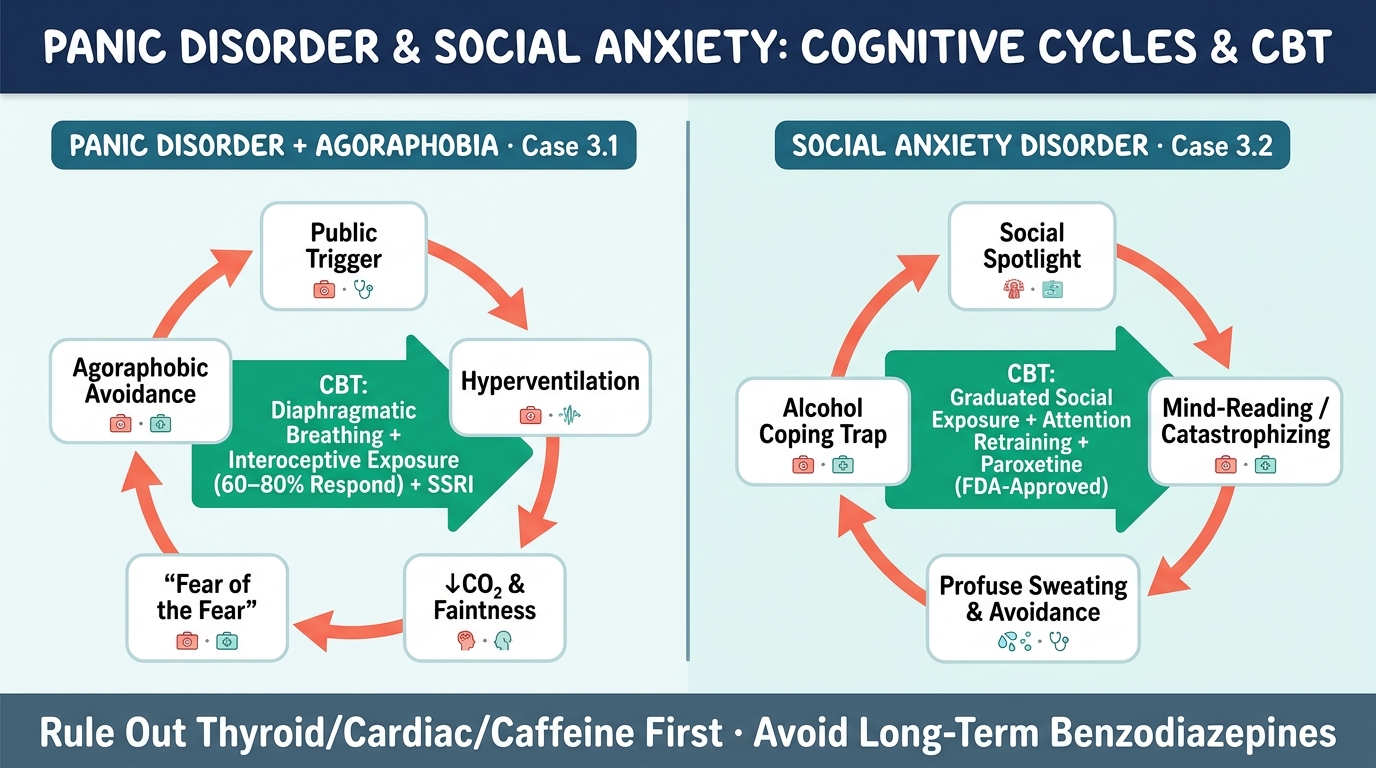
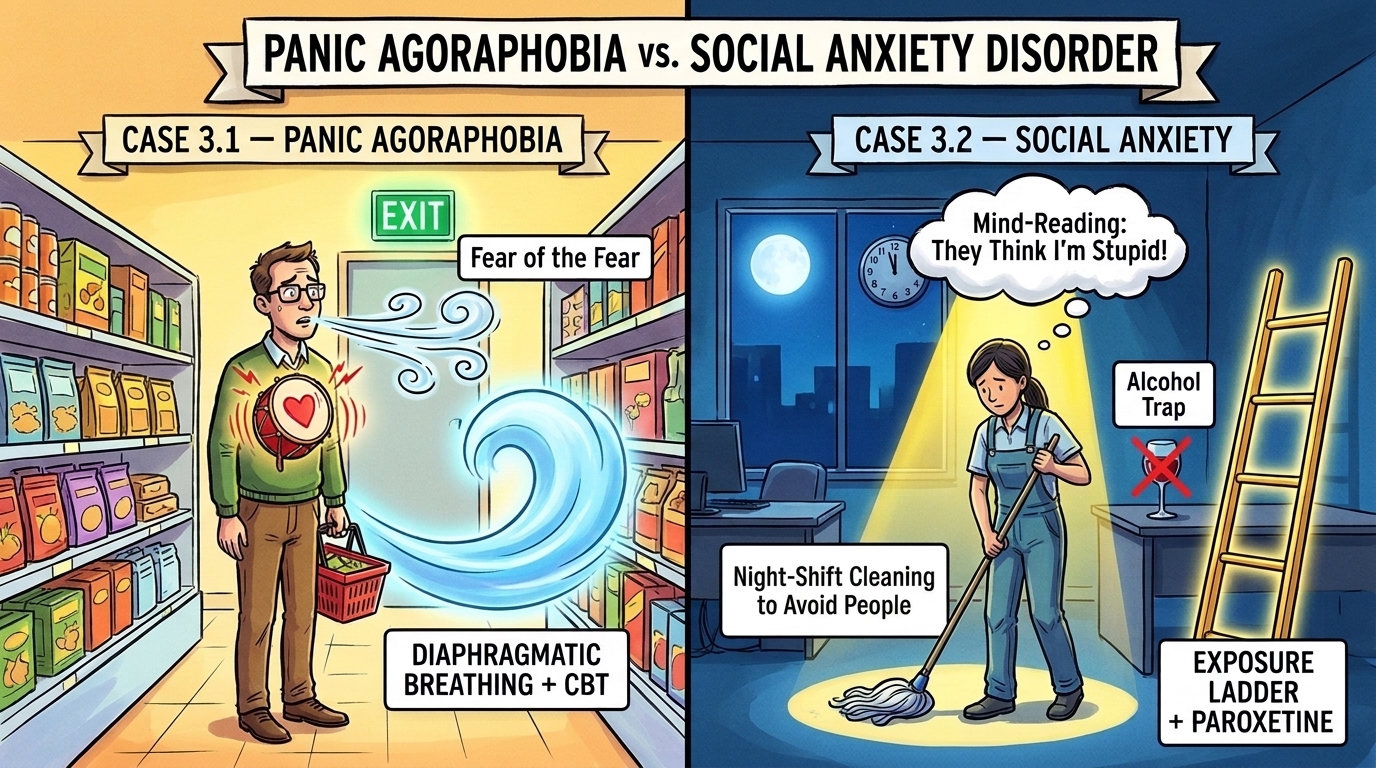
- Panic Disorder & Agoraphobia (Case 3.1): The core fear is internal catastrophe (“My heart is going to stop / I will faint and die”) and being trapped in a place where escape or help feels impossible if a panic attack strikes.
- Social Anxiety Disorder (Case 3.2): The core fear is external social humiliation—shame-based fear of negative evaluation (“They will see me sweating and think I’m stupid”).
- Case 3.1 Mental Image (Hyperventilation Loop): Picture our 36-year-old teacher in a bright supermarket aisle. A benign flutter triggers hyperventilation → rapid blow-off of CO₂ (hypocapnia) → cerebral vasoconstriction → dizziness, tingling, and faintness → catastrophic misinterpretation (“I’m having a heart attack!”) → massive adrenaline surge → fleeing the store. Escaping brings instant relief, which negatively reinforces avoidance and snowballs into early agoraphobia.
- Case 3.2 Mental Image (Spotlight & Alcohol Trap): Picture our 29-year-old woman vacuuming an empty office at midnight—safe only when every coworker has gone home. In daylight, two cognitive distortions hijack her mind: mind-reading (“Everyone thinks I’m incompetent”) and catastrophizing (“If I sweat or stumble, I’ll be humiliated forever”). Reaching for alcohol offers brief disinhibition, but backfires into embarrassment, worsening shame, and covert alcohol misuse.
- Palpitations in public (staff meeting, supermarket)
- Apprehensive always (anticipatory anxiety)
- No real cardiac disease (normal GP workup)
- Intensifying “fear of the fear”
- Crowds & enclosed spaces avoided
- Avoidance increasing rapidly
- Going out becomes difficult → housebound risk
- Sweating fear & fear of “looking stupid”
- Occupation unstable (longest job: night office cleaner)
- Catastrophize negative evaluation & mind-reading
- Isolation pattern long (avoids cars, parties)
- Avoidance extensive + Alcohol self-medication
- Lifetime course starting from adolescence
2. Interactive Panic Loop vs. Social Anxiety Exposure Ladder Simulator
Switch between both patient cases below. In Tab 1, watch how hyperventilation drops CO₂ to fuel the teacher’s supermarket panic—then click Break the Loop to deploy diaphragmatic breathing and interoceptive CBT. In Tab 2, guide our 29-year-old patient up her 4-rung exposure ladder and contrast the Alcohol Coping Trap against CBT + Attention Retraining + Paroxetine.
Interactive Simulator: Panic Loop & Social Exposure Ladder
Explore live respiratory physiology, cognitive distortions, and evidence-based CBT cycle-breaking.
3. Differential Diagnosis: Four Commonly Confused Conditions
Boards love testing whether you can separate Panic/Agoraphobia, Social Anxiety Disorder, Generalized Anxiety Disorder (GAD), and Avoidant Personality Disorder. Compare the core fear, onset, and ego-syntonicity below:
| Disorder | Core Fear & Trigger | Typical Course & Duration | Insight & Key Exam Clues |
|---|---|---|---|
| Panic Disorder + Agoraphobia Case 3.1 |
Recurrent unexpected surges of intense somatic fear + “fear of the fear”; avoids places where escape or help feels hard (supermarkets, crowds, meetings). | Abrupt peak within minutes; ≥ 1 month of anticipatory anxiety or maladaptive avoidance (Agoraphobia ≥ 6 months in DSM-5). | Ego-dystonic. Patients often visit ED/GP repeatedly fearing MI or stroke despite normal workup. |
| Social Anxiety Disorder Case 3.2 |
Shame-based fear of negative evaluation, sweating, trembling, or “looking stupid” during social interaction or performance. | Typically lifelong since adolescence; persists ≥ 6 months; impairs career & relationships (e.g., quitting day jobs for night cleaning). | Ego-dystonic. High risk of alcohol self-medication and comorbid Major Depressive Disorder. |
| Generalized Anxiety Disorder (GAD) | Chronic, free-floating excessive worry across multiple everyday domains (finances, health, family, work) rather than one cue. | Persists ≥ 6 months; accompanied by restlessness, fatigue, muscle tension, irritability, poor sleep/concentration. | Ego-dystonic. Worry is pervasive and hard to control, without discrete unexpected panic attacks as the primary driver. |
| Avoidant Personality Disorder | Pervasive feelings of inadequacy, hypersensitivity to criticism, and viewing oneself as socially inept or unappealing. | Enduring, inflexible trait pattern beginning by early adulthood across virtually all life contexts. | Ego-Syntonic — the patient believes their inadequacy is fundamentally true, rather than an irrational anxiety disorder. |
4. Step One Before Psychiatry: Rule Out Medical Mimics
Never label recurrent palpitations, heat flashes, and faintness as a panic attack until you exclude life-threatening or reversible organic causes—just like our teacher’s GP did in Case 3.1!
| Medical Mimic | Overlapping Symptoms | Red-Flag Clues | Targeted Initial Workup |
|---|---|---|---|
| Cardiac Arrhythmia (SVT, AFib, VT) | Sudden pounding heart, lightheadedness, chest tightness, fear of dying. | Abrupt “light-switch” onset/offset, syncope, family history of sudden cardiac death, abnormal pulse. | 12-lead ECG, ambulatory Holter / event monitor, electrolytes. |
| Hyperthyroidism | Palpitations, heat intolerance, profuse sweating, tremor, restlessness. | Unexplained weight loss, exophthalmos, lid lag, goiter, warm moist skin, baseline tachycardia. | Serum TSH (and free T4 if suppressed). |
| Excess Caffeine / Stimulants / Withdrawal | Tachycardia, jitteriness, sweating, racing thoughts, acute panic surges. | High energy-drink/coffee intake, decongestants, ADHD stimulants, cocaine, or alcohol/benzo withdrawal. | Detailed substance/caffeine history; urine toxicology if clinically indicated. |
| Pheochromocytoma / Asthma / Hypoglycemia | Episodic diaphoresis, palpitations, dyspnea, impending doom. | Paroxysmal severe hypertension + headache (pheo); wheezing (asthma); relief with glucose (hypoglycemia). | BP check, fingerstick glucose, pulse oximetry; plasma free metanephrines only if paroxysmal HTN present. |
5. Cycle-Breaking CBT: First-Line & Curative
In both Panic Disorder (60–80% response) and Social Anxiety Disorder (60–70% improvement), Cognitive Behavioral Therapy (CBT) is first-line—and in Social Anxiety Disorder, structured CBT is superior to medications alone for durable long-term remission because it extinguishes avoidance rather than merely masking it.
| CBT Technique | Primary Target | How It Breaks the Cycle in Clinic |
|---|---|---|
| Interoceptive Conditioning / Exposure | Panic Disorder | Deliberately reproduces harmless body sensations in session (e.g., spinning in a chair for dizziness, breathing through a straw, jogging in place) so the brain unlearns “fast heart = dying.” |
| Diaphragmatic Breathing Retraining | Panic Disorder | Replaces rapid upper-chest hyperventilation with slow abdominal breathing—preventing the CO₂ drop (hypocapnia) that triggers dizziness and faintness. |
| Graduated In-Vivo Exposure Ladder | Agoraphobia & Social Anxiety | Systematic step-by-step approach from low-fear to high-fear cues (e.g., brief supermarket visit → full shopping; daytime greeting → team chat → speaking in meetings) without escaping until anxiety naturally habituates. Curative! |
| Cognitive Restructuring | Both Disorders | Identifies and tests core distortions: catastrophic misinterpretation of bodily signs in Panic, and mind-reading (“they think I’m stupid”) / catastrophizing in Social Anxiety. |
| Attention Retraining | Social Anxiety | Shifts spotlight from hyper-vigilant internal self-monitoring (checking sweat, heartbeat, blush) outward to external task focus (listening to the other person’s words). |
6. Pharmacotherapy, Benzodiazepine Rules & Comorbidity Care
| Agent / Modality | Indication & Role | Clinical Pearls & Monitoring |
|---|---|---|
| SSRIs (First-Line Meds) Sertraline, Paroxetine |
Panic + Agoraphobia & Social Anxiety Paroxetine is FDA-approved for Social Anxiety. |
Start low, go slow (especially in Panic Disorder to avoid transient activation/jitteriness). Therapeutic onset takes 2–4 weeks (full effect 6–12 weeks). Continue ≥ 6–12 months after remission. |
| SNRIs Venlafaxine ER |
First-line alternative if SSRI fails or is poorly tolerated. | Effective across Panic Disorder, Social Anxiety, and GAD; monitor blood pressure at higher doses and taper slowly to prevent discontinuation symptoms. |
| Benzodiazepines e.g., Lorazepam, Clonazepam |
Short-Term Bridge ONLY (severe disabling acute panic). | Strictly time-limited (days to a few weeks) while awaiting SSRI onset; contraindicated/high-risk in patients with alcohol misuse (Case 3.2!) due to cross-tolerance & respiratory depression. |
| Beta-Blockers Propranolol (PRN) |
Performance-only Social Anxiety (e.g., isolated public speaking). | Blunts peripheral tremor, palpitations, and sweating 30–60 min pre-event; not effective for generalized Social Anxiety Disorder (Case 3.2). Avoid in asthma/bradycardia. |
| Lifestyle & Comorbidity Care | Essential adjunct in every patient. | Cut caffeine (major panic trigger), prescribe regular aerobic exercise & sleep hygiene. In Social Anxiety, actively address alcohol misuse and screen for comorbid depression (MDD). |