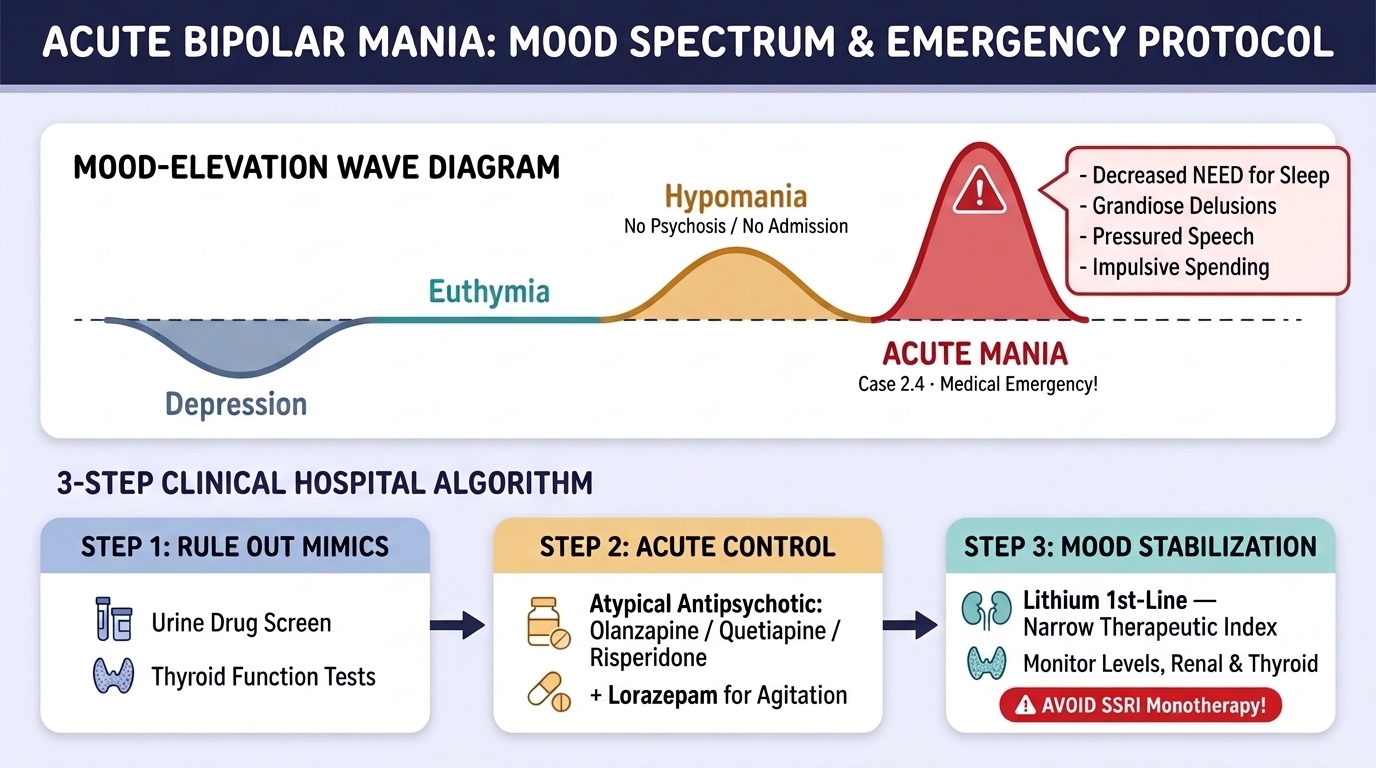
Acute bipolar mania is not a “harmless happy mood”—it is a psychiatric emergency. Within days, an untreated manic episode can dismantle a career, wipe out life savings through reckless spending, sever family relationships, and spiral into exhaustion, psychosis, or physical danger.
In this high-yield visual guide, we unpack Case 2.4 (a 27-year-old woman pacing in A&E convinced she was just offered a CEO role), lock in the BIPOLAR MANIC & DIGFAST frameworks, run an interactive High-RPM Mania & A&E Order Simulator, and master emergency workup, rapid tranquilization, lithium monitoring, and safe prescribing in women of childbearing potential.
On assessment, her speech is rapid, tangential, and pressured (flight of ideas). She firmly claims she has just been offered a CEO position at a major company (grandiose delusion) and angrily refuses to stay in A&E because she is “too important to be messed around.”
Primary Diagnosis: Bipolar I Disorder, Current Episode Manic (Moderate to Severe, with Psychotic Features)—pending urgent exclusion of substance-induced mania and hyperthyroidism.
1. Core Concept & The “High-RPM Engine” Mental Image
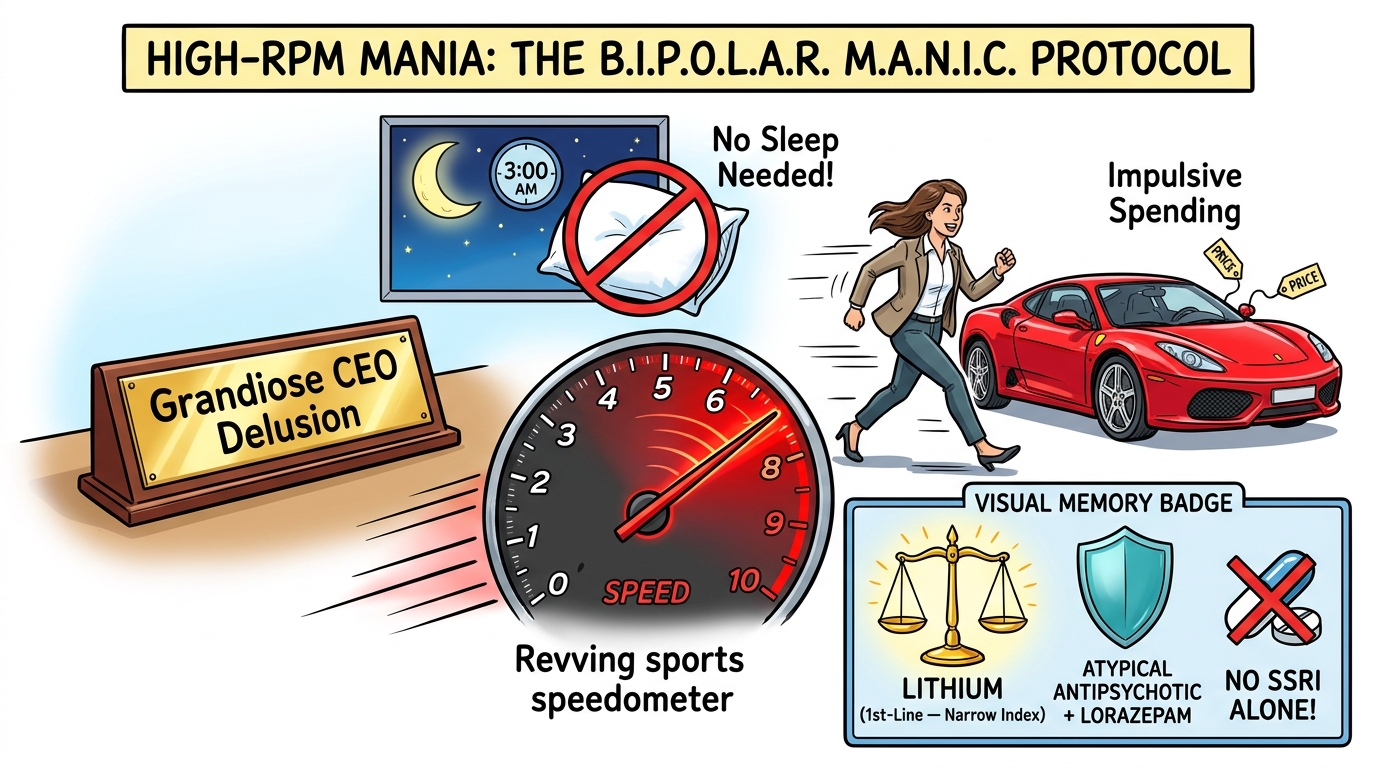
- No Fuel Gauge Warning (Decreased Need for Sleep): Unlike a depressed patient with insomnia who lies awake exhausted, a manic brain runs at full throttle on 0–2 hours of sleep and feels supercharged.
- Pressured Speech & Flight of Ideas: Thoughts race so fast that words spill out non-stop, leaping rapidly from topic to topic by loose associations or puns.
- Broken Brakes (Lost Insight & Impulsivity): Grandiose delusions (“I am a major-company CEO”) and impulsive luxury spending (buying an expensive car) occur because frontal inhibitory brakes have failed.
- One Manic Episode = Bipolar I: You do not need a prior depressive episode to diagnose Bipolar I disorder—a single confirmed manic episode seals the diagnosis once drugs and thyroid disease are ruled out!
2. Mnemonic Palace: “BIPOLAR MANIC” & Classic “DIGFAST”
Dr. Belh’s clinical bedside mnemonic BIPOLAR MANIC captures the exact A&E presentation of Case 2.4, while mapping effortlessly onto the classic USMLE/DSM-5 DIGFAST checklist:
3. Interactive High-RPM Bipolar Mania & A&E Management Simulator
Shift the Mood RPM Tachometer below across the bipolar spectrum to inspect how sleep need, insight, and hospitalization thresholds change—then complete the A&E First-30-Minutes Order Picker for our 27-year-old patient without falling for classic exam traps.
Interactive Simulator: High-RPM Mood Tachometer & A&E Order Picker
Toggle mood states to compare Mania vs. Hypomania vs. Depression, then safely manage Case 2.4 in A&E.
A&E First-30-Minutes Order Picker — Stabilize Case 2.4 (27yo Woman)
4. Differential Diagnosis: Mania vs. Hypomania vs. Medical/Drug Mimics
In every USMLE, PLAB, or OSCE station featuring an elated, overactive patient, you must answer two diagnostic questions in order: (1) Is it primary or secondary (drugs/thyroid)? and (2) Is it Mania (Bipolar I) or Hypomania (Bipolar II)?
| Feature | Acute Mania (Bipolar I) | Hypomania (Bipolar II*) | Substance / Hyperthyroid Mimic |
|---|---|---|---|
| Minimum Duration | ≥ 7 days (or any duration if hospitalization or psychosis is present) | ≥ 4 consecutive days | Acute onset linked to intoxication/withdrawal or thyrotoxic state |
| Functional Impairment | Severe — job loss, reckless car spending, social/financial ruin | Mild / Noticeable — observable change in functioning, NOT marked impairment | Variable; often abrupt autonomic instability or erratic behavior |
| Psychosis & Hospitalization | May be present (e.g. Case 2.4 CEO delusion); hospitalization often required | STRICTLY ABSENT (either one upgrades the diagnosis to Mania!) | Stimulants (cocaine, amphetamines) can trigger acute paranoid/grandiose psychosis |
| Key Diagnostic Clues | Decreased need for sleep, flight of ideas, grandiosity, episodic course | Elevated energy/talkativeness; must also have ≥ 1 Major Depressive Episode for Bipolar II* | UDS positive (cocaine/amphetamines), dilated pupils, tachycardia; or suppressed TSH / high free T4, heat intolerance, tremor, weight loss |
| Other Differentials | Bipolar I Mixed Episode (concurrent manic + depressive symptoms, high suicide risk) · ADHD (chronic childhood onset <12 yrs, not episodic adult mania) · Schizophreniform / Schizophrenia (psychosis persists ≥2 weeks without prominent mood elevation). | ||
5. Case 2.4 Mental State Examination (MSE) Mapped to BIPOLAR MANIC
Structure your OSCE psychiatric presentation cleanly by mapping each observation from Case 2.4 to its precise Mental State Examination domain and mnemonic anchor:
| MSE Domain | Case 2.4 Clinical Finding (27yo Woman) | BIPOLAR MANIC / DIGFAST Link |
|---|---|---|
| Appearance & Behavior | Visibly restless, pacing the A&E waiting room, irritable when asked to stay. | Overactivity · Agitation visible · Irritable if challenged |
| Speech | Rapid, loud, tangential, difficult to interrupt (pressured speech). | Pressured speech (DIGFAST: Talkativeness) |
| Mood & Affect | Elated/expansive baseline mood flipping rapidly to labile irritability when challenged. | Irritable if challenged · Elevated/expansive affect |
| Thought Form | Subjective racing thoughts with tangential leaps from idea to idea (flight of ideas). | Racing thoughts (DIGFAST: Flight of ideas) |
| Thought Content | Fixed false belief that she was offered a CEO position at a major company (grandiose delusion). | Being productive excessively / Grandiosity (DIGFAST: Grandiosity) |
| Biological & Risk | No sleep for several nights yet feels NOT tired; fired from job; bought an expensive car. | Less sleep (decreased need!) · Monetary spending excessive (Indiscretion) |
| Insight & Judgment | Severely impaired insight; refuses to remain in A&E (“too important to be messed around”). | High Risk — requires urgent psychiatric assessment & possible involuntary admission for safety |
6. Emergency Management & Acute vs. Maintenance Pharmacotherapy
- Ensure Safety & Hospitalization: Arrange urgent psychiatric assessment. If the patient lacks capacity/insight and refuses admission despite severe risk of financial, occupational, or physical harm, assess for involuntary detention under mental health legislation.
- Mandatory Organic Rule-Out: Order Thyroid Function Tests (TFTs) and a Urine Drug Screen (UDS) plus baseline renal function, electrolytes, ECG, and a pregnancy test (β-hCG) before prescribing mood stabilizers.
- Rapid Acute Control: Combine an atypical antipsychotic (rapid onset within hours–days) + short-term lorazepam (calms agitation & restores sleep) while initiating a mood stabilizer (first-line Lithium, which takes 1–2 weeks for full effect).
| Drug Class / Agent | Role in Bipolar Disorder | Speed & Key Clinical Pearls | Critical Exam Caveat |
|---|---|---|---|
| Atypical Antipsychotics Olanzapine, Quetiapine, Risperidone |
Acute Mania (1st-Line Rapid) + Psychosis | Fastest control of manic overactivity, grandiosity, and psychotic delusions; also used in maintenance. | Monitor metabolic profile (weight, glucose, lipids), QTc, and extrapyramidal symptoms (risperidone). |
| Benzodiazepines Lorazepam (PO/IM) |
Acute Adjunct | Rapidly reduces severe A&E agitation and restores critical sleep cycle. | Short-term bridge only (risk of sedation, dependence, respiratory depression). |
| Lithium Carbonate | Gold-Standard Mood Stabilizer (Acute + Maintenance) | Proven to prevent manic & depressive relapses AND uniquely reduces suicide risk. Takes 1–2 weeks for full antimanic onset. | Narrow therapeutic index! Requires strict serum level, renal, and thyroid monitoring. |
| Valproate (Semisodium / Sodium) | Mood Stabilizer (Effective in Acute Mania & Mixed Episodes) | Rapid antimanic loading option in men or non-childbearing patients. | AVOID in women of childbearing potential (like our 27yo!)—severe teratogenicity (neural tube defects, IQ decline). |
| Lamotrigine | Bipolar Depression & Maintenance | Strong protection against depressive relapse; well tolerated metabolically. | NOT for acute mania! Slow multi-week titration required to prevent Stevens-Johnson Syndrome (SJS). |
| SSRI Monotherapy e.g., Sertraline, Fluoxetine |
CONTRAINDICATED ALONE | Never give an unopposed antidepressant in Bipolar I disorder. | Triggers acute manic switch, rapid cycling, and heightened agitation/suicidality! |
7. Lithium Monitoring Protocol & Safety in a 27-Year-Old Woman
Because our patient is a 27-year-old woman of childbearing potential, examiners love testing both Lithium’s narrow therapeutic window and reproductive/teratogenicity safety:
| Monitoring Domain | Protocol & Target Values | High-Yield Clinical & Exam Alerts |
|---|---|---|
| Mandatory Baseline Workup | U&Es / eGFR / Creatinine, TFTs, Calcium, ECG (if cardiac risk/age), BMI, and Pregnancy Test (β-hCG). | Lithium is renally cleared (competes with Na⁺ in the proximal tubule) and directly inhibits thyroid hormone release. |
| Serum Lithium Levels (12-Hour Trough) | Check 5–7 days after starting or dose change, drawn 12 hours post-dose. Acute Mania: 0.8–1.2 mEq/L Maintenance: 0.6–0.8 (up to 1.0) mEq/L Toxicity: > 1.5 mEq/L (severe > 2.0) |
Once stable, check lithium level every 3 months, and renal + thyroid function + calcium every 6 months. |
| Toxicity Signs & Drug Interactions | Early: Coarse tremor (vs fine benign tremor), nausea/diarrhea, ataxia, dysarthria. Severe: Confusion, hyperreflexia, seizures, renal failure, coma (dialysis if severe). |
Drugs that SPIKE lithium levels: NSAIDs (ibuprofen), Thiazide diuretics, ACE inhibitors / ARBs, and dehydration / low-salt intake! |
| Side Effects (LMNOP) | Leukocytosis · Movement (fine tremor) · Nephrogenic diabetes insipidus (polyuria/polydipsia) · Oedema/weight gain & hypOthyroidism · Pregnancy risk. | Treat nephrogenic DI carefully (hydration; specialist amiloride if persistent). Monitor for hyperparathyroidism/hypercalcemia. |
| Women of Childbearing Potential (Case 2.4) | Avoid Valproate (~10% major malformation + ~30–40% neurodevelopmental risk). Lithium: Small absolute risk of Ebstein anomaly (tricuspid valve defect) in 1st trimester; requires dedicated preconception & contraception counseling. |
Provide contraception, folic acid, genetic counseling, strict sleep hygiene (sleep loss triggers relapse!), and family education on early prodromal warning signs. |