Invalidation in family systems is rarely malicious; it is a structural communication failure that amplifies emotional dysregulation. To resolve high-conflict dynamics, we must redefine validation not as agreement, but as a precise psychophysiological intervention. This analysis outlines the six levels of validation and the “Core Dialectic” required for effective treatment.
Clinical Navigation
Defining the Construct: Validation vs. Legitimatization
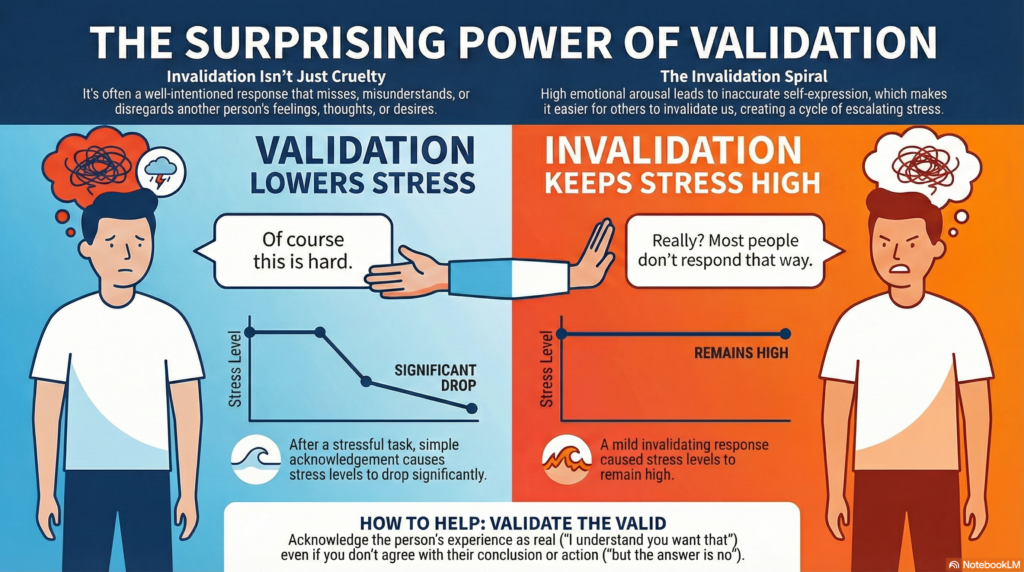
In clinical practice, validation is the act of communicating that a patient’s internal experience (emotions, thoughts, sensations) is understandable and grounded in their current context or history. It functions as a “safety signal” to the amygdala, reducing physiological arousal.
Conversely, invalidation is the transactional rejection of this private experience. Crucially, validation must be distinguished from agreement or legitimatization of behavior. A therapist can validate the impulse (the anger) while simultaneously invalidating the behavior (the violence). This distinction is the bedrock of the “Core Dialectic”: Validate the valid (the emotion), Invalidate the invalid (the dysfunction).
Mechanistic Analysis: The Transactional Model of Dysregulation
Emotional dysregulation is not solely an intrapsychic phenomenon; it is maintained by a feedback loop between the subject and their environment. Research, including the “Math Problems” stress study, demonstrates that validating responses lower heart rate and skin conductance, while invalidating responses—even subtle ones—sustain high arousal.
The Dysregulation Feedback Loop
External Stimulus
Vulnerability Factors
Acting Out / Shutting Down
“Calm down” / “You’re overreacting”
Applied Clinical Approach: The Dr. Belh Framework
To intervene in the cycle described above, the clinician must adopt a tripartite stance. This framework moves validation from a passive “listening” activity to an active restructuring intervention.
1. Observation & Context
Identify the valid internal kernel within the chaotic behavior. Even “manipulative” threats of self-harm contain a valid seed of desperation or fear. Locate the “why” before addressing the “what.”
2. The Core Dialectic
Simultaneously validate the valid (emotion) and invalidate the invalid (dysfunctional behavior). Example: “I understand you are in pain (valid), but I cannot let you hurt yourself (invalid behavior).”
3. Radical Genuineness
Treat the patient as an equal. Avoid the “clinical distance” or fragile handling that implies the patient is incompetent. Use “Level 5” validation: acknowledge shared human experience.
Therapeutic Progression and Levels of Intervention
The workshop outlines a six-module progression for training families. Below is the temporal efficacy timeline, mapping the acquisition of these skills from basic attention to functional behavioral change.
Phase 1
Foundational Principles
Phase 2
Advanced Toolkit
Phase 3
Application
Outcome
Efficacy
Synthesis: The Six Levels of Validation
The following table synthesizes the “Practitioner’s Toolkit” (Module 2). Mastery of these levels distinguishes a layperson’s empathy from clinical validation.
| Level | Definition | Clinical Impact |
|---|---|---|
| 1. Active Listening | Focus, eye contact, no multi-tasking. | FOUNDATIONAL |
| 2. Accurate Reflection | Mirroring the exact emotional state without interpretation. | Builds Trust |
| 3. Mind Reading | Articulating the unspoken emotions based on cues. | Increases Insight |
| 4. Normalizing | Framing reaction as a logical biological response. | Reduces Shame |
| 5. Radical Genuineness | Sharing the human experience (“Me too”). | HIGH IMPACT |
| 6. Functional Action | Taking physical steps to resolve the distress. | Solves Problem |
Clinical FAQ
Does validation mean I agree with the behavior?
No. Validation acknowledges the internal emotion or desire. You can validate the anger while condemning the aggression.
What if the patient’s perception is factually wrong?
Validate the *feeling* that results from their perception. The emotion is real to them, even if the trigger is misunderstood.
Can validation stop a panic attack?
Yes. Physiological evidence shows validation reduces heart rate and skin conductance response during high arousal.
What is “Radical Genuineness”?
It is interacting as a human equal rather than a distant expert, confirming the patient’s experience is safe and shared.
Why is invalidation so harmful?
It creates a secondary layer of distress (shame about the emotion), fueling the feedback loop of dysregulation.
Références
[Article PubMed]
Author(s). Title of the article. Journal Name. Year;Volume(Issue):Pages.
Available from: https://pubmed.ncbi.nlm.nih.gov/29113614/
[Article PMC – texte intégral]
Author(s). Title of the article. Journal Name. Year;Volume(Issue):Pages.
Available from: https://pmc.ncbi.nlm.nih.gov/articles/PMC11675095/
Branje S.
Development of parent–adolescent relationships: Conflict interactions as a mechanism of change.
Child Development Perspectives. 2018;12:171–176.
doi:10.1111/cdep.12278
Branje SJ, van Doorn M, van der Valk I, Meeus W.
Parent–adolescent conflicts, conflict resolution types, and adolescent adjustment.
Journal of Applied Developmental Psychology. 2009;30:195–204.
doi:10.1016/j.appdev.2008.12.004
Koerner AF, Fitzpatrick MA.
Family conflict communication.
In: Oetzel JG, Ting-Toomey S, editors. The SAGE Handbook of Conflict Communication: Integrating Theory, Research, and Practice.
Thousand Oaks (CA): Sage Publications; 2006. p.159–183.
Mastrotheodoros S, Van der Graaff J, Deković M, Meeus WH, Branje S.
Parent–adolescent conflict across adolescence: Trajectories of informant discrepancies and associations with personality types.
Journal of Youth and Adolescence. 2020;49:119–135.
doi:10.1007/s10964-019-01054-7