Chronic tinnitus is less an auditory pathology and more a failure of the brain’s limbic gating mechanisms to filter internal stimuli. Traditional suppression methods often fail because they ignore the autonomic nervous system’s “threat response” which sustains the condition. This article outlines a rehabilitation framework based on Cognitive Behavioral Therapy (CBT) to leverage neuroplasticity for permanent habituation.
By Dr. Belh | Medical Review
The Pathology: The Tinnitus-Threat Response Loop
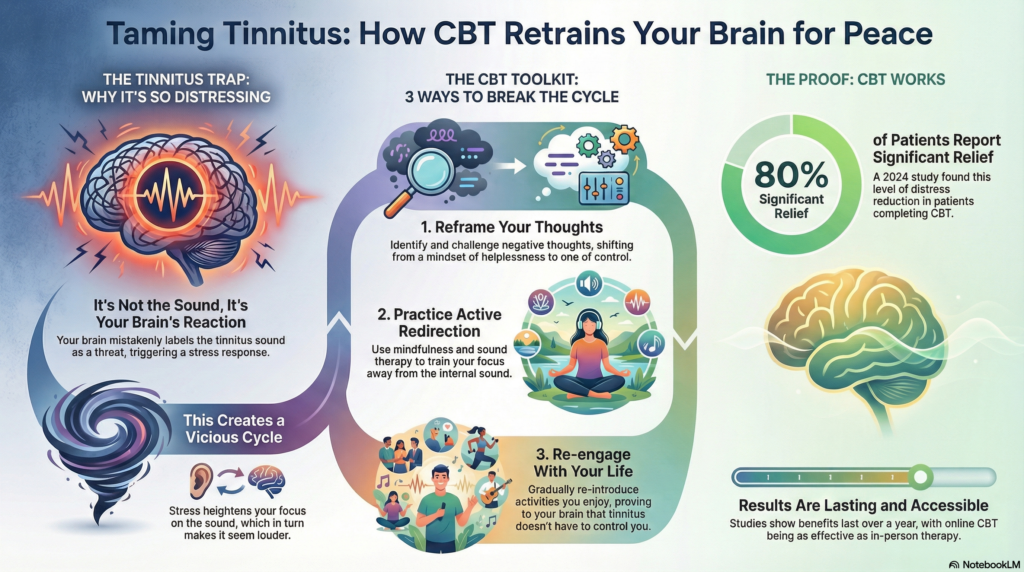
In clinical neuro-audiology, tinnitus transitions from a symptom to a chronic condition when the auditory signal becomes entangled with the limbic system. This creates a feedback loop where the auditory cortex perceives the sound, the amygdala classifies it as a biological threat, and the autonomic nervous system triggers a “fight-or-flight” response. This physiological arousal reinforces the brain’s prioritization of the sound, preventing natural habituation.
Mechanistic Analysis: The Failure of Gating
The persistence of tinnitus is a result of a breakdown in thalamic gating. Just as the brain filters out the sensation of clothing on the skin, it should filter out internal auditory signals. The following flowchart illustrates the pathological cycle that CBT aims to interrupt:
The Limbic Reinforcement Cycle
(Trigger)
(Fear/Threat)
(Fight or Flight)
(Reinforcement)
The goal of therapy is to sever the link between “Auditory Signal” and “Limbic Reaction.”
Applied Approach: The Neuroplastic Protocol
Rehabilitation utilizes the brain’s inherent plasticity to re-categorize the tinnitus signal from “dangerous” to “neutral.” This follows a tripartite framework:
1. Observation (Somatic)
The Principle: Shift from avoiding the sound to observing it neutrally. By removing the emotional “wince” reaction, we deprive the limbic system of the feedback it needs to maintain high alert levels.
2. Context (Cognitive)
The Principle: Reframe catastrophic thoughts (“This will never end”) into evidence-based statements (“My brain is learning to filter this”). This cognitive layer reduces cortical gain.
3. Solution (Environmental)
The Principle: Utilize Sound Enrichment (not masking). A low-level background auditory stream reduces the signal-to-noise ratio, facilitating natural habituation.
Chronology of Habituation
Neuroplastic change is non-linear but generally follows a predictable biphasic pattern of initial resistance followed by gradual integration.
De-mystification
Education & identifying triggers.
Active CBT
Cognitive reframing practice.
Desensitization
Reduced autonomic arousal.
Habituation
Passive filtering established.
Core Principles of Rehabilitation
- Volume Control is Emotional Control: The perceived loudness of tinnitus correlates directly with autonomic distress, not cochlear damage.
- Sound Enrichment vs. Masking: The goal is not to cover the sound (which maintains fear), but to mix it with neutral sound to reduce contrast.
- The Paradox of Silence: “Absolute silence” is an unnatural state. Pursuing it causes the brain to amplify internal neural noise (gain).
- Action over Avoidance: Engaging in meaningful activities despite the sound is the primary driver of fear extinction.
Comparative Efficacy: CBT vs. Traditional Models
Recent meta-analyses (2018–2024) position CBT as the superior intervention for distress reduction compared to purely acoustical treatments.
| Intervention Protocol | Mechanism | Long-term Efficacy |
|---|---|---|
| CBT (Cognitive Behavioral Therapy) | Re-wires limbic interpretation of sound | High / Sustained |
| Masking (White Noise) | Suppresses auditory perception temporarily | Low / Dependency Risk |
| Notch Therapy | Targets specific frequency inhibition | Moderate / Variable |
Clinical FAQ
Will CBT make the sound go away completely?
CBT does not silence the ear, but it silences the reaction. Most patients reach a state where they hear the sound only when specifically listening for it, effectively removing it from conscious awareness.
How long does neuroplastic habituation take?
While immediate anxiety relief can occur within weeks, full neurological habituation (automating the filter) typically requires 6 to 18 months of consistent protocol application.
Is masking recommended during sleep?
Avoid total masking (covering the sound). Use sound enrichment (nature sounds, fan noise) at a volume just below the tinnitus to help the brain classify the tinnitus as part of the background noise floor.
Does stress make tinnitus physically louder?
Technically, no. Stress acts as an amplifier for the brain’s attention. It lowers the gating threshold, making the existing signal perceived as louder and more intrusive.
Can I do this without a therapist?
Yes. Evidence from 2024 suggests that self-guided internet-based CBT (iCBT) can be highly effective, provided the patient adheres strictly to the cognitive exercises and sound enrichment protocols.