The Neuroscience of Personal Reality: Breaking the Habit of Being Yourself
The brain functions not as a predictor of the future, but as a biological artifact of the past. When internal cognitive states align perfectly with external environmental cues, neurological evolution halts, trapping the subject in a recursive loop of “sameness.” This analysis details the mechanics of this stagnation and the protocol for architectural neurological change.
1. Defining the Personal Reality
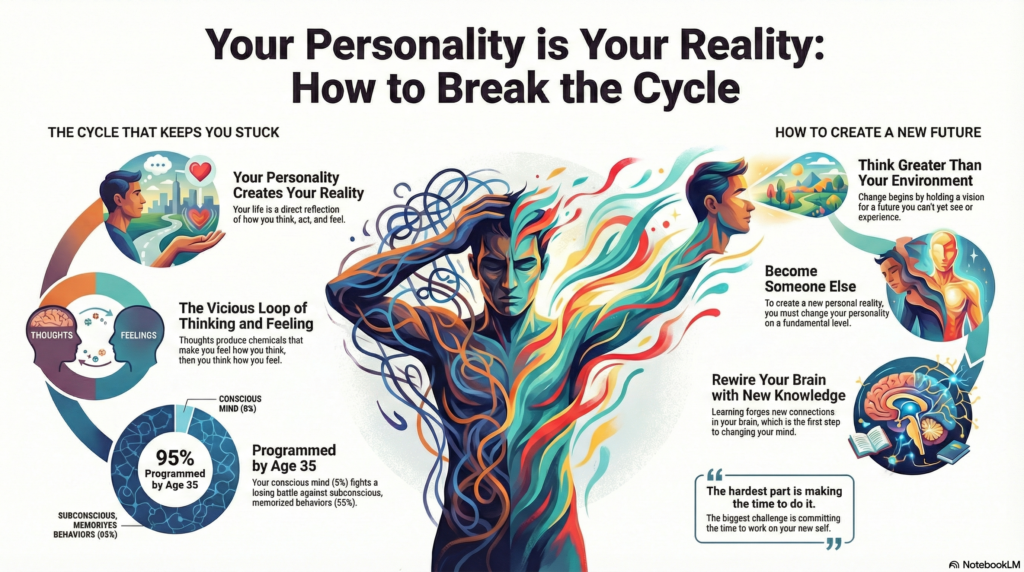
In clinical terms, “Personality” is not an abstract trait but a physiological engine comprising three distinct vectors: Thought (Neural firing), Action (Behavioral output), and Feeling (Chemical feedback). The summation of these vectors creates “Personal Reality.”
When the brain is an exact reflection of the environment, the subject operates in a closed system. The external world dictates the internal state. This creates a feedback loop where the identity is anchored to past experiences, preventing the genesis of new neural pathways.
2. Analysis of the Environmental Control Mechanism
The core mechanism of stagnation is the “Loop of Sameness.” This occurs when environmental triggers (Relationship, Location, Object) initiate a pre-programmed neurological sequence, bypassing the conscious mind.
The Automated Neurological Loop
Environmental Cue
Redundant Firing
Chemical Confirmation
Result: The body becomes the mind. The subject thinks equal to their environment.
This process adheres to Hebbian Theory: “Nerve cells that fire together, wire together.” Daily repetition of this loop results in a hard-wired “Finite Signature” of personality by age 35.
3. The Dr. Belh Framework: Breaking the Loop
To disrupt the 95% automated program, one must introduce three clinical interventions:
01. Observation
Metacognition. The subject must become conscious of unconscious habits. Observing the “self” separates the observer from the program, halting the automatic firing sequence.
02. Inhibition
Chemical Withdrawal. When the body demands the familiar chemical state (emotion), the subject must deny the stimulus. This creates necessary cognitive dissonance.
03. Re-Wiring
New Inputs. Introducing new knowledge forces the brain to forge new synaptic connections. Learning is the biological catalyst for personality change.
Temporal Progression of Change
The 5% Conscious
Initiation of new thought. High mental effort required.
Chemical Alignment
Body begins to feel the new thought. New State of Being.
The 95% New Self
The new pattern becomes the automatic habit.
4. Clinical Extraction Zone
- The 95% Rule: By age 35, 95% of identity is a memorized set of behaviors, creating a “computer program” state of existence.
- Environmental Subservience: If you are not creating a new future, you are biologically reinforcing the past via environmental triggers.
- State of Being: Achieved only when the brain’s electricity (Thought) aligns with the body’s chemistry (Feeling).
- Neuroplasticity: The brain is physically modified by learning. To change the mind is to physically dismantle old synaptic connections.
5. Synthesis: Survival vs. Creation Mode
| Parameter | Survival Mode (The Past) | Creation Mode (The Future) |
|---|---|---|
| Neurology | Redundant, fixed circuits | New synaptic connections |
| Chemistry | Addicted to familiar emotions | Elevated emotional states |
| Relationship to Environment | Victim (Effect) | Creator (Cause) |
| Outcome | Predictable known reality | Unknown new possibilities |
📸 Personality Creates Reality: Break Cycle.
6. Clinical FAQ
Why is change physically uncomfortable?
Because the body is chemically addicted to the previous emotional state. Breaking a habit is a biological withdrawal process, not just a mental choice.
What does “Thinking greater than your environment” mean?
It means holding a vision of the future internally that is more real and emotionally potent than the external sensory reality you currently experience.
How long does it take to rewire the brain?
While individual plasticity varies, research suggests significant synaptic restructuring requires sustained conscious effort (metacognition) over 4 to 8 weeks to move from conscious effort to automaticity.
Can I change if I am over 35?
Yes. While the “identity” is 95% fixed by 35, neuroplasticity exists until death. It simply requires higher energy expenditure to break the established calcified networks.
What is the first step to breaking a habit?
Observation. You cannot change what you do not notice. You must become the witness of your own automatic program.