Imagine standing safely in your own living room—and without warning, the entire room starts spinning like a merry-go-round. Your stomach flips, your legs give way, and you grab the nearest wall just to keep from falling.
Because an episode like this looks sudden and frightening, families sometimes panic and reach for the wrong explanations: “Is something wrong with the brain? Is it stress—or even something supernatural?”
1. Meet Your Body’s Hidden “Balance GPS”
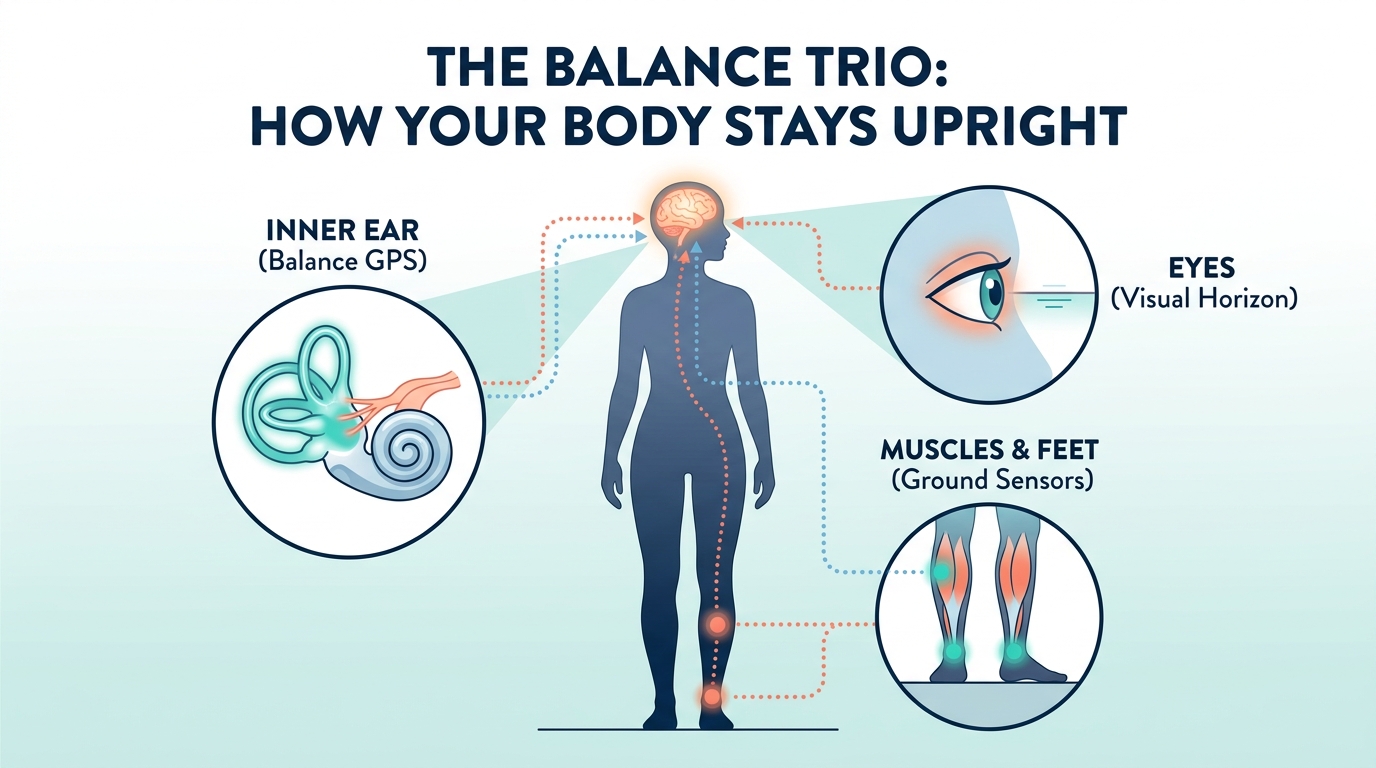
Deep inside each ear—far beyond the eardrum—sits a tiny, delicate structure called the vestibular apparatus. Think of it as your body’s built-in Balance GPS.
Every second of the day, this miniature GPS quietly tells your brain which way is up, which way is down, whether you are walking forward, or when you turn your head.
To keep you standing comfortably upright, your brain actually relies on a team of three systems—The Balance Trio:
- Your Inner Ear (Balance GPS): Detects head movement and rotation.
- Your Eyes: See the room and confirm the horizon is level.
- Your Muscles & Feet: Feel the solid floor beneath you.
2. Mental Image: What Happens During a Vertigo Crisis?
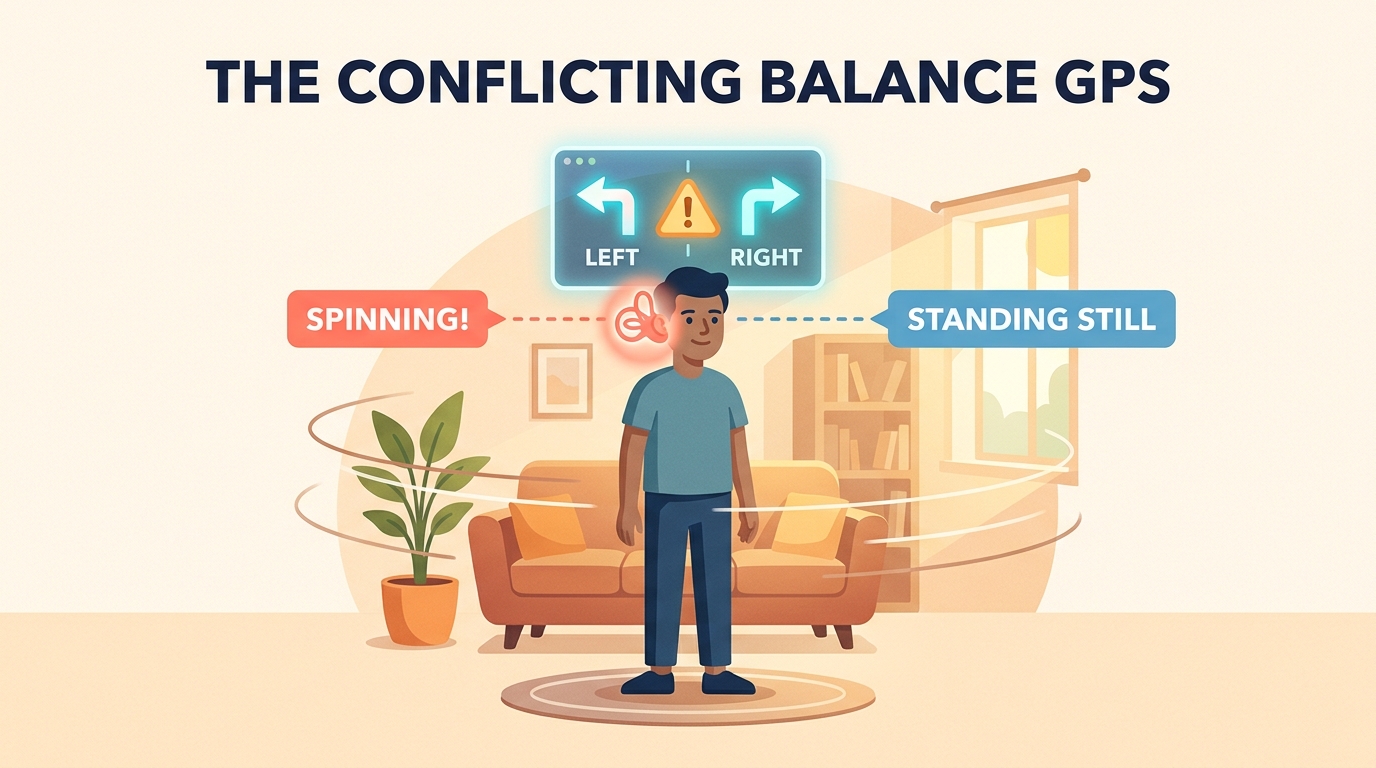
That exact sensory traffic jam happens inside your head during a vertigo episode:
- Your inner ear glitches and shouts to the brain: “WE ARE SPINNING!!”
- Your eyes look at the couch and reply: “No we aren’t—we’re completely still!”
- Your feet agree with your eyes: “The floor isn’t moving!”
3. Interactive Animation: Explore Your Balance GPS & How It’s Fixed
Switch between the three interactive modes below to see normal balance, watch what triggers rapid eye movements (nystagmus) during a vertigo attack, and walk step-by-step through the painless Epley maneuver that resets your inner ear.
Interactive Explainer: The Balance GPS & Epley Recovery
Click a mode below to watch how the inner ear, eyes, and brain communicate.
Normal Balance: All Three Systems Agree
When your inner ear, eyes, and feet all send matching information, your brain keeps your posture effortless and your vision steady.
- Inner Ear: Reports calm, neutral head position.
- Eyes: Remain steady on the room around you.
- Result: Effortless balance, zero dizziness.
4. Why Do Your Symptoms Feel So Intense?
Once you understand the Conflicting Balance GPS, every frightening symptom of benign vestibular vertigo suddenly makes logical sense:
| Symptom | Why It Happens (In Plain English) |
|---|---|
| The Room Spins | Your inner ear sends a false spinning signal, so your brain interprets the stationary room as rotating around you. |
| Eyes Moving on Their Own (Nystagmus) | Your eyes are directly wired to your inner ear so you can stay focused when you turn your head. When the ear shouts “We’re turning!”, your eyes automatically flick back and forth to compensate—making the room look like it’s whirling. |
| Sudden Falls & Walking Crooked | Because the brain believes you are tipping over, it fires automatic protective muscle reflexes to “catch” you—ironically throwing you off balance or making you hug the hallway wall. |
| Nausea & Vomiting | Just like severe motion sickness on a boat, conflicting signals between your inner ear and eyes trigger the brain’s nausea center. |
5. Tap to Bust the 3 Biggest Vertigo Myths
6. Good News: How Doctors Cure It (Simple Maneuvers)
You do not have to live in fear of the next spinning spell. After examining your eyes and confirming benign peripheral vertigo, an ENT specialist or doctor can often resolve the problem using simple, gentle head-and-body positioning maneuvers—most famously the Epley maneuver.
Think of it as gently guiding your inner ear’s Balance GPS back to its neutral resting spot. Many patients walk into the clinic holding onto the walls and stand up feeling remarkably steadier within days—sometimes even immediately.
| Typical Benign Inner Ear Vertigo | Emergency Red Flags (Go to ER Immediately) |
|---|---|
| Brief spinning triggered by rolling in bed, looking up, or turning the head | Sudden slurred speech, trouble speaking, or facial droop |
| No arm/leg weakness or numbness | New weakness or numbness in the face, arm, or leg |
| Normal vision between spinning episodes | Double vision, sudden vision loss, or severe sudden “worst-ever” headache |
| Unsteady during the spin, improves once the episode passes | Complete inability to stand/walk even after spinning stops, fainting, or chest pain |
7. Frequently Asked Questions
Can I perform the Epley maneuver on myself at home?
It is always best to see a doctor or ENT specialist first so they can confirm which ear is affected and rule out other causes of dizziness. Once diagnosed, your doctor can teach you safe home exercises if symptoms ever return.
Why does vertigo feel worse when I roll over in bed?
Changing head position relative to gravity stimulates the inner ear’s balance sensors—triggering that sudden false spinning signal if the inner ear system is irritated.
What should I do right away if a vertigo episode strikes?
Sit or lie down immediately to prevent a fall, keep your head still, focus your eyes on one steady object in front of you, breathe slowly, and wait for the spinning sensation to pass before standing up slowly.