The entry into healthcare administration is often obstructed by a fundamental misunderstanding of the distinct cognitive requirements between clinical translation (coding) and financial negotiation (billing). This confusion leads to poor credential selection, creating a workforce prepared for “learning” rather than “production.” The following analysis provides a rigorous, evidence-based roadmap to navigating accreditation, compliance, and career longevity in the revenue cycle.
1. Definition: The Clinical-Financial Ecosystem
Revenue Cycle Management (RCM) is not merely an administrative function; it is the physiological circulatory system of a healthcare organization. Just as the circulatory system ensures oxygen reaches tissues, the RCM process ensures financial solvency supports clinical operations. At its core, this ecosystem relies on the precise conversion of biological data (patient encounters) into fiscal data (reimbursement).
The integrity of this conversion is governed by strict regulatory bodies, including CMS (Centers for Medicare & Medicaid Services) and the World Health Organization (WHO), which maintain the ICD (International Classification of Diseases) datasets. In this context, the professional does not merely “type data”; they act as the guarantor of compliance, ensuring that every claim meets the standards of medical necessity and HIPAA / GDPR privacy regulations.
2. Mechanistic Analysis: The Flow of Clinical Data
To understand the profession, one must visualize the mechanism of action. The transition from a physician’s observation to a cleared payment involves a specific sequence of “metabolic” steps. Any breakdown in this chain results in a claim denial—the administrative equivalent of organ failure.
Assigning CPT/ICD-10
Verifying Compliance
Payer Adjudication
Denial Management
3. The Professional Duality: Understanding Coding vs. Billing
Entering the healthcare revenue cycle requires a fundamental choice between two distinct cognitive frameworks. While often grouped together in “fast-track” marketing for Online Medical Courses, Medical Coding and Medical Billing require entirely different skill sets.
The Analytical Coder (The Clinical Librarian)
Medical Coding is a translation science. The coder acts as a “clinical librarian,” converting qualitative physician notes and surgical reports into a universal alphanumeric language (ICD-10, CPT, HCPCS). It requires a deep dive into biomedical sciences, anatomy, and pharmacology to ensure the nuances of a patient’s encounter are captured accurately. The coder looks “backward” at the medical record, ensuring that the historical data justifies the bill.
The Administrative Biller (The Financial Liaison)
Medical Billing is an administrative negotiation. The biller manages the movement of financial data. They act as the “financial liaison” between the provider, the patient, and the insurance company. The biller looks “forward,” focusing on the logistics of getting paid. This role requires resilience, high math literacy, and the ability to navigate conflict with insurance payers.
| Feature | The Analytical Coder | The Administrative Biller |
|---|---|---|
| Core Competency | Biomedical sciences, Anatomy, Code logic | Math literacy, Negotiation, Payer rules |
| Primary Interaction | Isolated; Focus on Electronic Health Records (EHR) | Frequent; Interacting with Patients & Payers |
| Cognitive Load | High analytical depth (Research based) | High interpersonal conflict (Resolution based) |
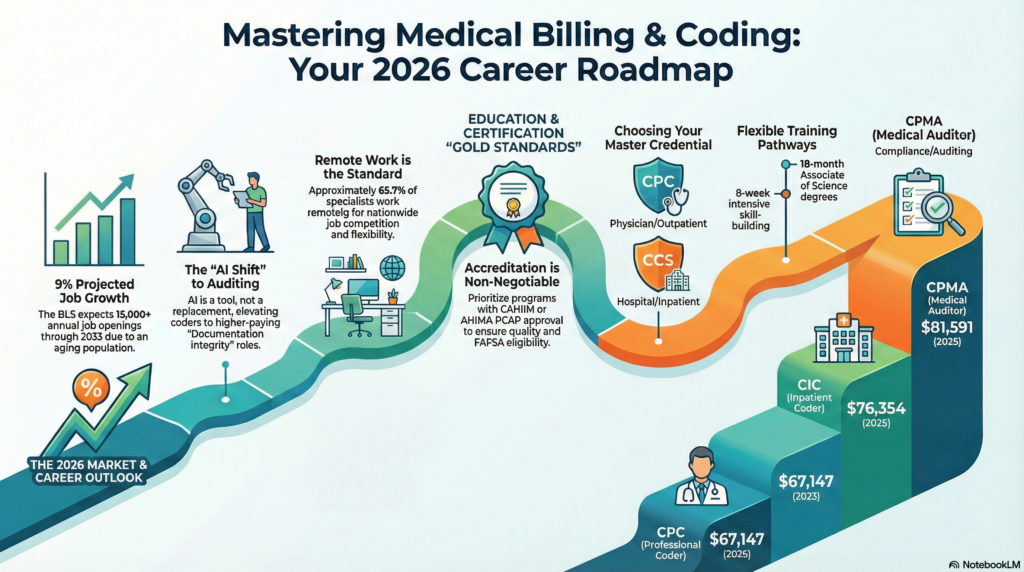
| Salary Potential | High ($50k – $81k+) | Moderate ($35k – $50k) |
| Best Certification | CPC (AAPC) or CCS (AHIMA) | CPB (AAPC) or CMBS |
Learning Insight: The “so what?” is simple: An analytical person who thrives on data-heavy research will find the constant interpersonal conflict of billing exhausting. Conversely, a social problem-solver will find the rigid, solitary nature of high-level coding tedious.
4. The Credential Hierarchy: Evaluating AHIMA, AAPC, and NHA
In the current labor market, credentials are the primary currency. However, a significant disparity exists between “introductory” certifications and “mastery” certifications. Employers use credentials to verify “proficiency to produce,” not just a “readiness to learn.”
- AAPC (American Academy of Professional Coders): Provides the CPC (Certified Professional Coder). This is the undisputed “Gold Standard” for outpatient or physician-based settings. It focuses heavily on professional fee coding (CPT).
- AHIMA (American Health Information Management Association): Offers the CCS (Certified Coding Specialist). Regarded as the “Mastery Level” credential for inpatient hospital coding, it requires deep knowledge of ICD-10-PCS.
- NHA (National Healthcareer Association): Offers the CBCS. While useful for entry-level billing exposure, it is often insufficient for high-level coding roles.
The Timeline to Mastery
Anatomy, Terminology, Pathophysiology.
ICD-10, CPT Guidelines, Coding Clinics.
Sit for CPC or CCS Exam.
Practicode or Work Exp to remove “A” status.
5. Dr. Belh Framework: The Applied Approach
Success in this field is not about memorizing codes; it is about understanding the architecture of the industry. I apply a tri-fold framework to evaluating career paths in health information.
1. Observation
The Market Reality: The demand for data integrity is rising, but the tolerance for error is dropping. Employers are moving away from “on-the-job training” models.
2. Context
The Digital Shift: With ICD-11 on the horizon and AI automating simple charts, the human role is shifting from “input” to “audit” and “validation”.
3. Solution
Specialization: Generalists will struggle. The solution is to niche down into high-complexity areas like Interventional Radiology or Inpatient Coding.
6. Educational Pathways: Certificate vs. Degree
One of the most common questions concerns the necessity of a college degree. Unlike clinical roles (nursing, MD), medical coding does not strictly require a degree, but rather a certification. However, the path you choose dictates your long-term ceiling.
University Programs: Large-scale universities (e.g., Purdue Global, UMA) are excellent for those seeking long-term management roles. These often include the NHA CBCS in their practicum.
Vocational High-Intensity: Programs like The Andrews School focus purely on “by the book” rigor. While they may lack the general education credits of a degree, their graduates often boast pass rates on the CCS exam significantly higher than the national average.
Ensure any program you select offers Healthcare Certification preparation that is recognized by the industry.
Key Educational Checkpoints
- Accreditation: Ensure the program is CAHIIM or PCAP accredited.
- Instructor Vetting: Instructors must hold the credentials they are teaching (CCS/CPC).
- Book Dependency: Avoid programs that rely solely on “Encoders” (software). You must learn to code manually first.
- Apprentice Removal: Look for courses offering the 80-hour education credit to shorten your “Apprentice” status.
7. The 2026 Horizon: Remote Work and the AI “Shift to Audit”
By 2026 and beyond, Artificial Intelligence is not replacing the coder; it is evolving the role into an auditor. Simple, routine cases (like standard office visits) are being automated. This explains the industry’s aggressive shift toward “Coding Auditors” and “Documentation Integrity” roles.
To be future-proofed, your education must go beyond basic selection. You must understand the why behind the code. Furthermore, mastery of “by the book” coding is the only way to survive AI audits and employer pre-hire testing, which often forbids the use of software assistance.
Additionally, remote work remains a staple, with over 65% of specialists working from home. However, this privilege is reserved for those with proven accuracy and certification for doctors‘ offices or hospitals.
Medical Coding vs. Billing:
8. Clinical FAQ
Is medical coding hard to learn?
Yes. It requires learning a new language. It involves anatomy, physiology, and complex logic trees. It is not a data-entry job; it is a clinical analysis role.
Can I work from home immediately?
Rarely. Most employers require 6-12 months of on-site work to verify accuracy and HIPAA compliance before allowing remote access.
Do I need to be good at math?
For billing, yes. For coding, no. Coding is about logic and reading comprehension; Billing is about numbers and accounts receivable.
What is the “Apprentice” (CPC-A) status?
It signifies you passed the exam but lack 2 years of experience. You can remove it early through an 80-hour education course and the AAPC Practicode module.
How does ICD-11 affect new students?
ICD-11 is a fully digital coding system. Students entering the field in 2026 should ensure their curriculum includes ICD-11 orientation to remain employable globally.
Dr. Belh Clinical Editorial Standards © 2026 | Compliance: HIPAA / GDPR / OIG