Observation: The modern regulatory landscape has evolved from a passive administrative burden into a dynamic, high-stakes operational imperative. Organizations face existential threats not from market competition, but from regulatory misalignment.
Pathology: Professionals entering this field often suffer from “analysis paralysis” due to the fragmented nature of accreditations—struggling to distinguish between Healthcare Certification protocols, corporate ethics, and data privacy mandates.
Intervention: This article provides a structured, clinical dissection of the compliance career ecosystem. We will diagnose the specific certifications required for high-risk sectors, prescribe the optimal educational pathways—including Online Medical Courses—and map the trajectory for long-term professional viability.
I. Definition & Morphology: The Compliance Ecosystem
To navigate a career in compliance, one must first define the anatomy of the discipline. Compliance is not merely the adherence to laws; it is the operationalization of ethics within a functional framework. It requires a synthesis of legal knowledge, operational auditing, and risk management.
According to the Compliance Certification Board (CCB), a legitimate compliance certification acts as a biomarker of competency. It signals that an individual has metabolized the complex regulatory environment and can function effectively to mitigate risk. This is particularly crucial when seeking CME Credits for Doctors or pivoting from clinical practice to administrative oversight.
The Three Pillars of Compliance Integrity
Just as a stool requires three legs for stability, a robust compliance career rests on three foundational pillars:
- Technical Skill Acquisition: Mastery of specific regulations (e.g., Stark Law, GDPR) and the ability to perform risk assessments.
- Professional Credibility: The acquisition of recognized credentials that serve as a “seal of approval” for regulators and hiring committees.
- Competitive Differentiation: The strategic use of Medical Training Programs and certifications to distinguish oneself in a saturated market.
II. Mechanistic Analysis: Cause and Effect in Regulation
Understanding compliance requires a mechanistic view of cause and effect. In a clinical setting, introducing a pathogen leads to infection. In a corporate setting, introducing unchecked data flows or unmonitored financial relationships leads to regulatory enforcement.
Consider the mechanism of action for a compliance breach:
Figure 1. The Mechanics of Regulatory Failure
(e.g., Unencrypted Data Transfer or Kickback)
(Lack of Monitoring / No Auditing Logs)
(OIG Investigation / GDPR Fine)
The Compliance Officer’s role is to interrupt this flow between the Trigger and the Failure.
Recent case studies, such as the €3.2 million fine issued by the Swedish DPA in 2024, demonstrate that the cost of failure is not linear—it is exponential. The goal of Healthcare Certification is to equip professionals with the tools to construct firewalls against these specific mechanisms.
III. The Dr. Belh Framework: Applied Compliance Strategy
To successfully navigate this career path, I propose a tripartite framework based on clinical observation principles. This framework ensures that your educational investment yields maximum professional efficacy.
1. Observation (Assessment)
Analyze the specific regulatory risks of your target sector. Does the sector fear data breaches (IT) or fraud accusations (Healthcare)? Choose Online Medical Courses that address these specific fears.
2. Context (Alignment)
Align your credentials with your jurisdiction. A US-centric Healthcare Certification is of limited utility in the EU, just as GDPR expertise is secondary in rural American hospital administration.
3. Solution (Execution)
Execute a continuous learning protocol. Regulations atrophy if not exercised. Maintain status via CME Credits for Doctors or compliance CEUs to ensure operational readiness.
IV. Sector Deep Dive: Healthcare Certification
The healthcare sector represents the highest acuity level in compliance. Because it involves human life and taxpayer funding (Medicare/Medicaid), the regulatory burden is immense. Failing to comply results not just in fines, but in exclusion from government programs—a death sentence for any medical provider.
For physicians and administrators, engaging in Medical Training Programs focused on compliance is no longer optional. It is a survival mechanism. The OIG-LEIE (Office of Inspector General List of Excluded Individuals/Entities) monitoring is a daily operational reality.
Core Certifications in Healthcare
- CHC (Certified in Healthcare Compliance): The generalist standard. Covers program integrity and general legal adherence. Ideal for administrators.
- CHRC (Research Compliance): Specialized for clinical trials and research institutions. Vital for academic medical centers.
- CPCO (Certified Professional Compliance Officer): Issued by the AAPC, this is heavily focused on billing, coding, and fraud prevention. Highly technical.
Physicians looking to transition into these roles often find that their existing CME Credits for Doctors can partially apply to these certifications, provided the content overlaps with ethics and regulatory updates.
Related Reading: The Physician’s Guide to Transitioning into Administrative Leadership
V. The Data Privacy Matrix: GDPR vs. HIPAA
In the digital age, compliance is synonymous with data protection. However, distinct pathologies exist between the American and European models. The successful compliance officer must be able to diagnose which framework applies and prescribe the correct handling procedures.
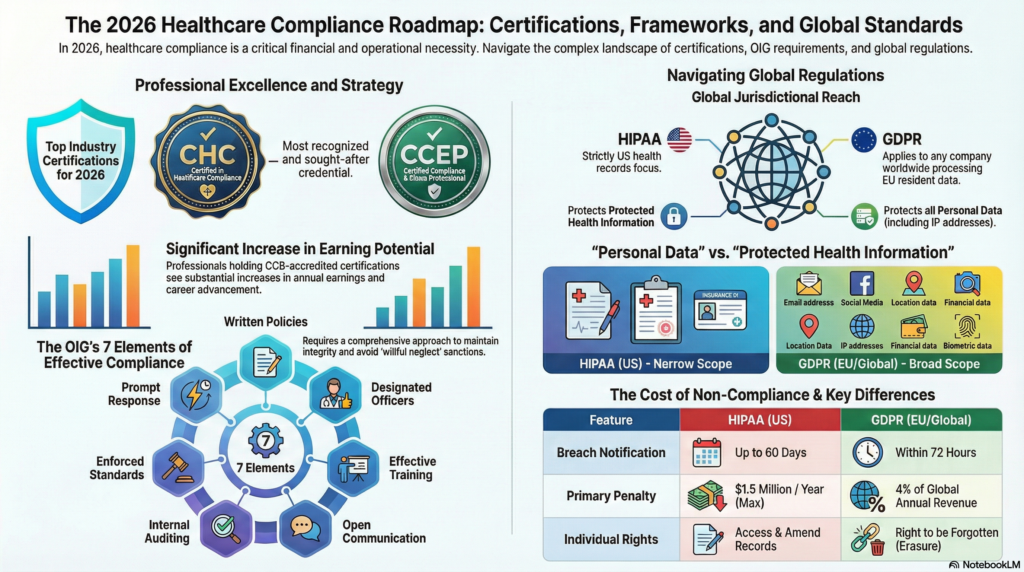
HIPAA (Health Insurance Portability and Accountability Act): This is a sectoral law. It applies only to “Covered Entities” (hospitals, insurers) and their business associates within the US. It protects PHI (Protected Health Information).
GDPR (General Data Protection Regulation): This is an omnibus law. It treats data privacy as a fundamental human right. It protects “Data Subjects” (EU residents) regardless of the industry. The fines are capped at €20 million or 4% of global revenue—whichever is higher.
The Stricter Rule Principle
When an organization operates globally, the compliance officer must apply the “Stricter Rule” principle. For example, regarding breach notification:
- HIPAA: Allows up to 60 days to notify.
- GDPR: Requires notification within 72 hours.
- Clinical Decision: The organization must adopt the 72-hour standard globally to ensure safety across all jurisdictions.
VI. The Compliance Career Timeline
A career in compliance is not a sprint; it is a progression of increasing responsibility and scope. Below is the typical trajectory for a professional committed to this specialization.
Role: Analyst / Auditor.
Focus: Transactional monitoring, learning Online Medical Courses, basic policy reviews.
Role: Manager / Privacy Officer.
Focus: Obtaining CHC/CIPP, managing audits, interpreting CME Credits for Doctors requirements.
Role: Director / CCO.
Focus: Corporate culture, Board reporting, high-level risk strategy.
VII. Comparative Synthesis: Certification Data
To assist in your prescription of a career path, the following table synthesizes the primary certifications, their issuing bodies, and their maintenance requirements.
| Credential | Focus Area | Maintenance (CEUs) | Primary Benefit |
|---|---|---|---|
| CHC (HCCA) | General Healthcare | 40 CEUs / 2 Years | Industry Standard |
| CPCO (AAPC) | Medical Practice/Billing | 36 CEUs / 2 Years | Technical Mastery |
| CIPP (IAPP) | Data Privacy & Law | 20 CPEs / 2 Years | Legal Authority |
| CCEP (SCCE) | Corporate Ethics | 40 CEUs / 2 Years | Cultural Leadership |
VIII. 2026 Healthcare Compliance Roadmap
IX. Clinical FAQ: Addressing Common Symptoms of Uncertainty
1. Do online medical courses count towards compliance certification?
Answer: Yes, but with strict caveats. The course must be accredited by the relevant body (e.g., CCB or AAPC). Generic online courses without CEU accreditation are useful for knowledge but useless for credential maintenance.
2. Can I use my CME Credits for Doctors for compliance renewal?
Answer: Frequently, yes. There is significant overlap in the domains of “Practice Management,” “Ethics,” and “Risk Management.” However, clinical CMEs (e.g., Cardiology updates) will not apply to a compliance certification.
3. Which path is more lucrative: Healthcare Certification or Corporate Ethics?
Answer: Historically, Healthcare Certification roles command a premium due to the complexity of the regulatory environment and the high cost of failure (OIG fines). However, specialized IT/Privacy roles (CIPP) in the tech sector are rapidly closing that gap.
4. Is the CPCO better than the CHC?
Answer: They treat different conditions. The CHC is for hospital-wide system management. The CPCO is for physician practice management and billing precision. Choose the credential that matches your “patient” (the organization).
5. What is the prognosis for this career field?
Answer: Excellent. As regulations become more complex (AI governance, interoperability), the demand for skilled practitioners who can interpret these laws into operational code will only increase.
Dr. Belh’s Final Prescription: The field of compliance offers a robust, recession-resistant career path for those willing to master its intricacies. Whether you are seeking Medical Training Programs to pivot from clinical work or building a corporate governance strategy, the key is specificity. Do not be a generalist in a world of specialists. Diagnose your sector, acquire the targeted Healthcare Certification, and maintain your immunity through continuous education.