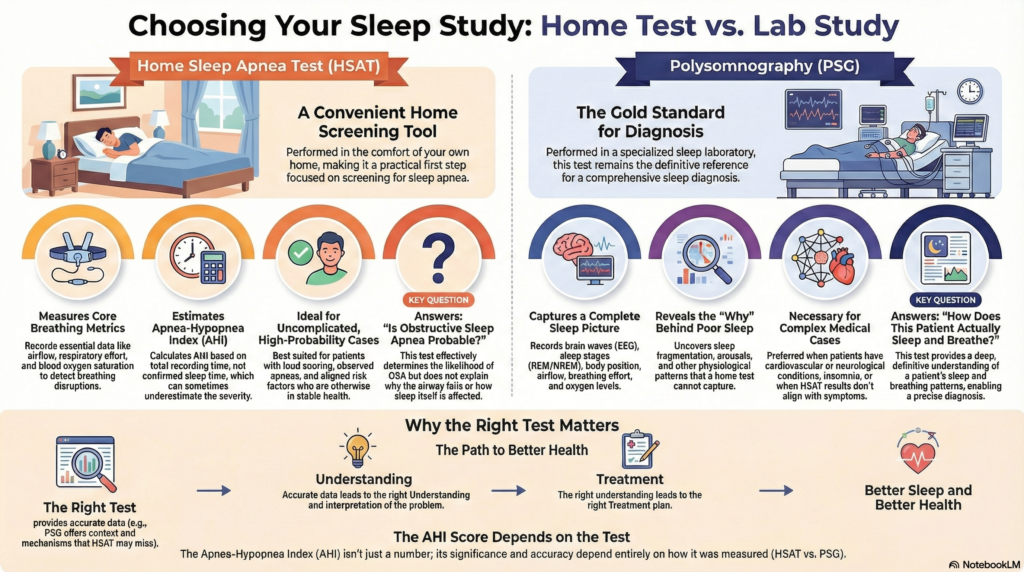
Definition: HSAT vs. Polysomnography
Home Sleep Apnea Testing (HSAT) is a concentrated diagnostic procedure utilizing portable equipment to monitor respiratory parameters in a naturalistic environment. It serves primarily as a screening tool for high-probability cases of Obstructive Sleep Apnea (OSA).
Polysomnography (PSG) represents the diagnostic “Gold Standard.” Conducted in a controlled laboratory, it records comprehensive neurophysiological and respiratory data, including EEG, EOG, and EMG, to map sleep architecture and identify complex pathologies.
Mechanistic Analysis: The Data-to-Diagnosis Chain
The core mechanistic difference lies in the scope of biological variables captured. A home test focuses on peripheral oxygenation and airflow, providing a “snapshot” of respiratory events. However, it lacks the neurological context provided by brainwave monitoring.
In contrast, lab-based PSG integrates respiratory data with sleep stages (N1, N2, N3, REM). This mechanistic depth allows clinicians to correlate breathing disruptions with neurological arousals, ensuring that the diagnosis addresses the root cause of sleep fragmentation rather than just the symptoms of airway obstruction.
The Dr. Belh Framework: The 3 Pillars
01. Observation
Quantify subjective symptoms (snoring, fatigue) and comorbidities (hypertension, BMI) to establish clinical suspicion.
02. Context
Evaluate the patient’s environment. HSAT offers ecological validity, while PSG offers technical precision in complex cases.
03. Solution
Synthesize data to prescribe targeted therapies, from CPAP titration to surgical or behavioral interventions.
Clinical Workflow Diagram
(HSAT for Simple Cases | PSG for Complex)
Synthesis: Technical Comparison
| Feature | Home Test (HSAT) | In-Lab (PSG) |
|---|---|---|
| Environment | Ecological (Your Bed) | Controlled Laboratory |
| Data Channels | 4-7 Channels | 16+ Channels (inc. EEG) |
| Diagnosis Scope | Limited (OSA) | Comprehensive |
| Supervision | None (Self-Applied) | Real-time Technologist |
Diagnostic Path Timeline
Consultation & Risk Assessment
Conducting Sleep Study (HSAT or PSG)
Data Scoring & Clinical Review
Treatment Initiation & Monitoring
Why the Right Sleep Study Is Your First Step to a Better Night’s Sleep
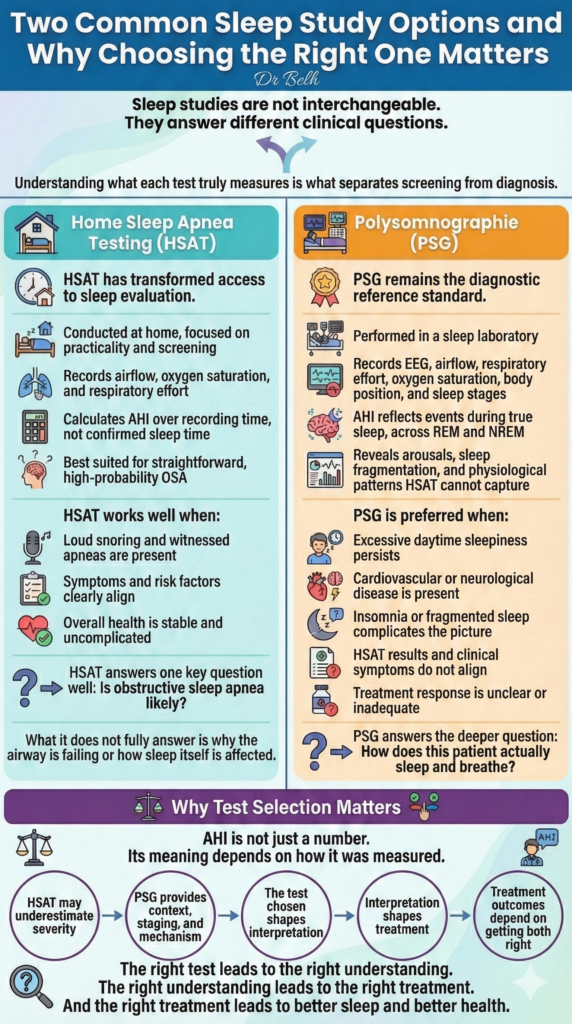
Frequently Asked Questions
1. Can a home test detect insomnia?
No. HSAT measures breathing, not sleep stages. Insomnia requires clinical evaluation or PSG.
2. Is HSAT as accurate as PSG for apnea?
It is accurate for moderate-to-severe OSA but may miss mild cases due to the lack of EEG data.
3. Will my insurance cover PSG?
Most insurers require a “medical necessity” justification or a failed HSAT before approving PSG.
4. How long does a PSG take?
Typically 7-9 hours of overnight monitoring in a specialized clinic.
5. Can I move during a PSG?
Yes. While you are wired to sensors, the wires are long enough for you to turn and shift comfortably.