Hair loss is not a cosmetic defect; it is a clinical bio-indicator of systemic metabolic triage. When the thyroid gland fails to regulate energy efficiently, the organism sacrifices follicular integrity to preserve vital organ function. This protocol analyzes the ATP-dependent mechanism of shedding and the pathway to metabolic restoration.
Table of Contents
1. The Metabolic Triage: Hypothyroidism Defined
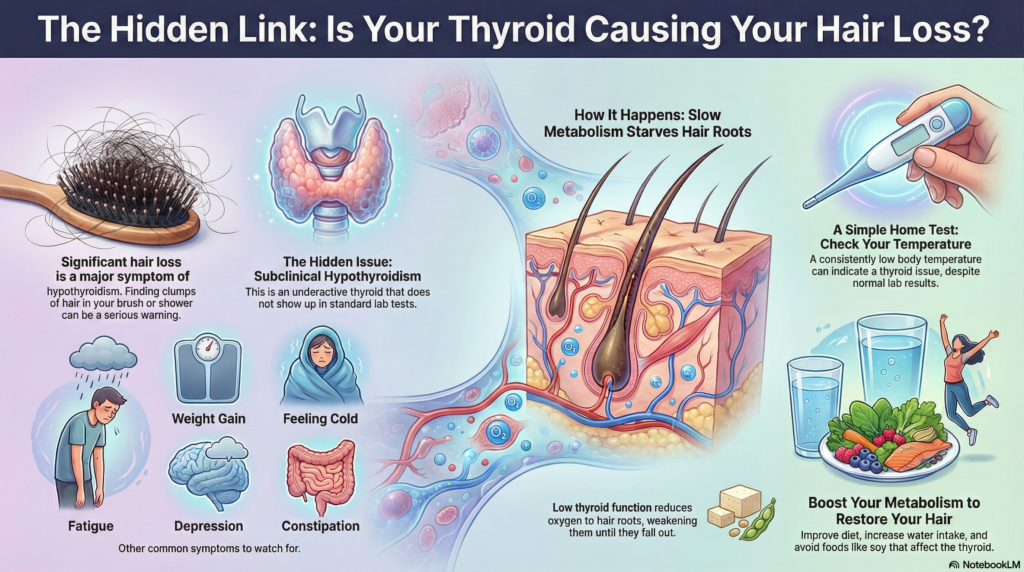
The hair follicle is a non-essential, highly metabolic tissue. In clinical practice, we observe Subclinical Hypothyroidism—a state where laboratory values appear normal, yet cellular function is compromised. This triggers a survival mechanism: “Metabolic Triage.” The body diverts scarce energy (ATP) away from the scalp (peripheral) to the heart and brain (central), causing mechanical failure of the hair root.
2. Mechanistic Analysis: The Thyroid-ATP Axis
Metabolism is the conversion of oxygen and nutrients into energy. Hair growth is dependent on this precise biochemical chain.
Thyroid Hormone (T3)
Mitochondrial Action
SYSTEM FAILURE (Low T3)
3. The Dr. Belh Framework: Applied Physiology
We utilize a three-phase cognitive approach to reverse the pathology.
1. Observation
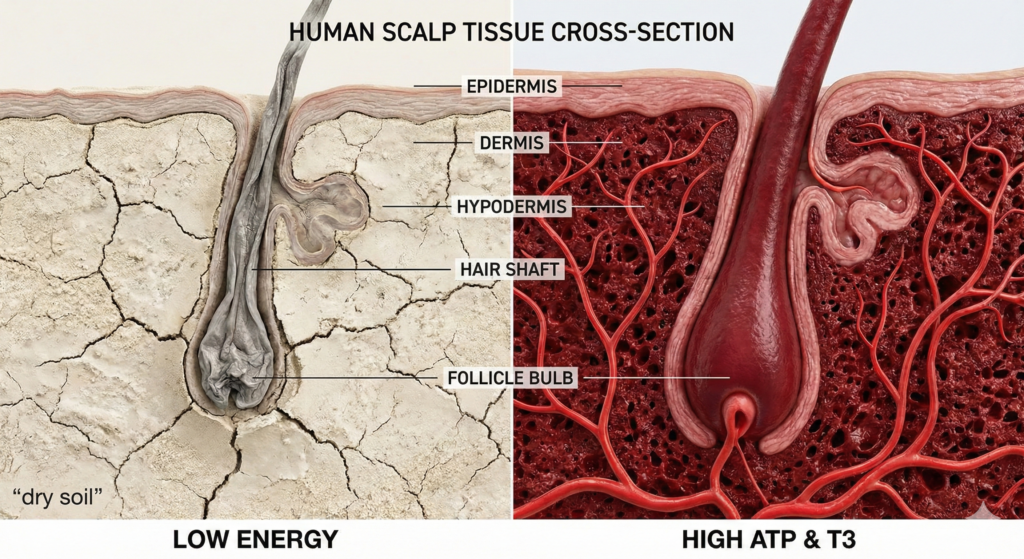
Hair loss is a “lagging indicator.” It reflects a metabolic deficit that began weeks prior. The “Plant in the Wind” analogy applies: weak soil (low energy) leads to weak roots.
2. Context
The environment dictates function. Presence of anti-thyroid agents (goitrogens like soy) or lack of cellular hydration creates an environment hostile to protein synthesis.
3. Solution
Do not treat the scalp. Refuel the engine. By restoring body temperature and pulse rate, we confirm ATP production is sufficient to support peripheral tissues.
4. Diagnostic Extraction Zone
- The Thermometer Method: Low body temperature is the most accurate proxy for low thyroid function.
- Mechanical Weakness: Without ATP, the hair shaft lacks the structural grip to withstand routine handling.
- Systemic Prioritization: The body shuts down hair growth to conserve energy for thermogenesis and neurology.
5. Symptomatic Profile Synthesis
| Physical Symptom | Metabolic Implication | Status |
|---|---|---|
| Cold Extremities | Inability to generate thermic energy (ATP failure). | Critical |
| Chronic Fatigue | Systemic depletion; neurological regulation failure. | Critical |
| Diffuse Shedding | Resource withdrawal from peripheral structures. | Warning |
6. The Restoration Timeline
Recovery is biological, not immediate. Adherence to hydration and goitrogen elimination yields the following trajectory:
7. Visual Reference Data (Image Prompt)
Hair Loss: Thyroid Warning Signs
8. Clinical FAQ
Why is my TSH normal but my hair is falling out?
TSH is a pituitary signal, not a thyroid cellular action. You likely have normal signaling but poor cellular conversion of T4 to T3, resulting in subclinical tissue starvation.
Does biotin stop metabolic hair loss?
No. Biotin provides raw material, but without ATP (energy), the body cannot “build” with it. It is akin to delivering bricks to a construction site with no workers.
How does hydration affect the thyroid?
Water is the medium for all enzymatic reactions. Dehydration stalls the transport of hormones and increases cortisol, which further suppresses T3 production.
Why are cold hands a symptom?
Heat is a byproduct of ATP production. If your extremities are cold, your core metabolism is throttled, and peripheral circulation (scalp included) is compromised.
What is the first step to recovery?
Remove metabolic inhibitors. Eliminate unfermented soy and vegetable oils, and re-introduce proper hydration (“agüita”) to facilitate cellular transport.