Chronic stress disrupts metabolic homeostasis, specifically driving cortisol-dependent visceral fat accumulation. This phenomenon creates a neuroendocrine imbalance that diet alone often fails to correct. This article analyzes the clinical efficacy of Withania somnifera (Ashwagandha) in restoring the HPA axis and managing stress-related body weight.
Table of Contents
Clinical Definition
Ashwagandha (Withania somnifera) is an adaptogenic herb historically utilized in Ayurvedic medicine. In a modern clinical context, the term “adaptogen” defines metabolic regulators that enhance an organism’s non-specific resistance to environmental stressors.
Regarding weight management, it is distinguishable from stimulant-based thermogenics. It functions as a neuroendocrine modulator, specifically targeting the Hypothalamic-Pituitary-Adrenal (HPA) axis to mitigate the physiological cascade of chronic stress.
Mechanistic Analysis
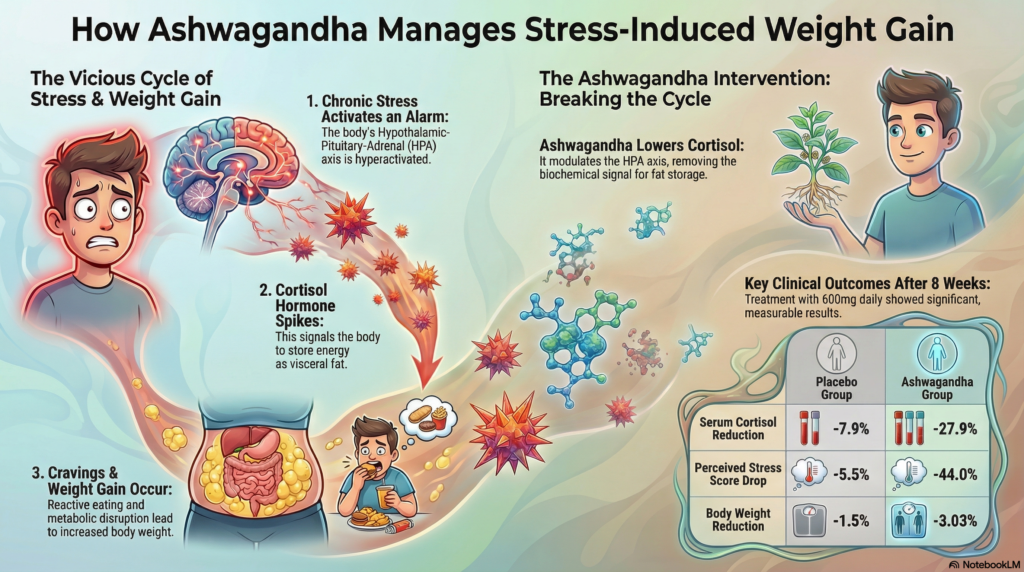
The correlation between chronic stress and weight gain is driven by elevated serum cortisol, which induces insulin resistance and stimulates visceral adipose tissue deposition. The mechanism of action involves the inhibition of this pathway.
The Dr. Belh Framework
To evaluate the clinical utility of this root extract, we apply a tripartite analysis based on observation, context, and solution.
01. Observation: The Stress-Weight Axis
Clinical data indicates a direct positive correlation between high Perceived Stress Scale (PSS) scores and increased Body Mass Index (BMI). Stress is not merely psychological; it is a metabolic disruptor.
02. Context: Evolutionary Mismatch
Modern chronic stress triggers ancient survival mechanisms. The body perceives stress as resource scarcity, prompting a biological directive to hoard calories and increase “food cravings” as a survival reflex.
03. Solution: Root Extract Modulation
Treatment with high-concentration full-spectrum Ashwagandha root extract (300 mg b.i.d.) significantly reduces serum cortisol, thereby removing the biochemical signal for fat storage.
Efficacy Timeline
Based on double-blind, randomized, placebo-controlled data (PMC5352455), the temporal efficacy of the treatment follows this distinct trajectory over 8 weeks.
Baseline
High PSS, High Cortisol Levels
Initial Response
Downward trend in PSS scores
Clinical Significance
Peak Cortisol & Weight Drop
Key Clinical Outcomes
- Cortisol Reduction: The treatment group showed a 27.9% reduction in serum cortisol levels compared to placebo.
- Stress Reduction: Perceived Stress Scale (PSS) scores dropped by 44.0% in the Ashwagandha group.
- Weight Loss: Significant reduction in body weight (mean reduction of 3.03%) and BMI.
- Craving Control: Marked improvement in Food Cravings Questionnaire (FCQ) scores, indicating reduced reactive eating.
Comparative Data Synthesis
The following table synthesizes the outcomes at the conclusion of the 8-week trial period.
| Outcome Measure | Placebo Group | Ashwagandha Group | Status |
|---|---|---|---|
| Serum Cortisol | -7.9% change | -27.9% change | Significant |
| PSS Score | -5.5% change | -44.0% change | Significant |
| Body Weight | -1.5% change | -3.03% change | Effective |
| Safety Profile | Mild/None | Mild/None | Safe |
Ashwagandha and Stress Weight Gain
FAQ
What is the recommended dosage for weight management?
The clinical standard utilized in studies is 300 mg of high-concentration root extract twice daily, totaling 600 mg per day.
How long does it take to see results?
Initial stress reduction may be perceptible within 4 weeks, but statistically significant impact on body weight and cortisol was observed after 8 weeks.
Does Ashwagandha burn fat directly?
No. It functions as an upstream regulator. By reducing stress-induced cortisol, it mitigates cravings and halts visceral fat storage signals. It addresses the hormonal root cause.
Can I take it without being stressed?
While safe, its primary weight-loss mechanism depends on cortisol reduction. Its efficacy for weight loss in non-stressed individuals with normal cortisol levels is not established by current data.
Are there side effects?
In the referenced clinical trials, the extract was safe and well-tolerated. Adverse events were mild, transient, and comparable to the placebo group.