Glycemic Control : Clinical observation reveals that many Type 2 diabetes patients experience a glycemic plateau despite strict adherence to standard pharmacotherapy. This resistance is often driven by persistent systemic oxidative stress and declining beta-cell function. Clinical evidence now validates the structured integration of Nigella sativa oil as a decisive metabolic adjuvant to overcome these barriers and stabilize glycemic indices.
Content Navigator
Pharmacological Definition and Context
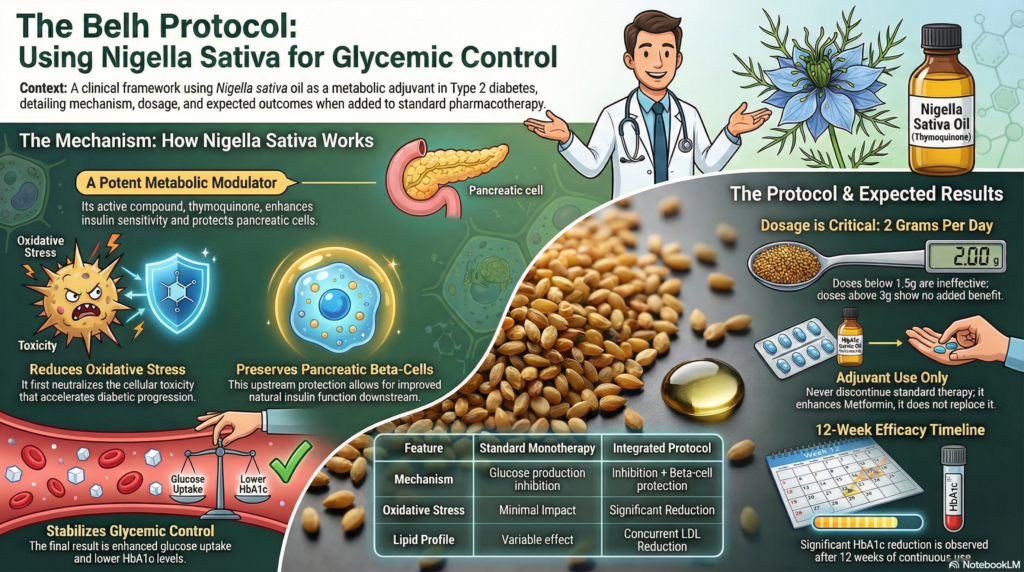
Nigella sativa is a therapeutic botanical agent whose fixed oil fraction delivers thymoquinone, a potent insulin-sensitizing compound. In clinical practice, this is not a nutritional supplement but a metabolic modulator. Its primary utility lies in its dual capacity to enhance peripheral glucose uptake while simultaneously neutralizing the oxidative toxicity that accelerates diabetic progression.
Analysis of Metabolic Mechanisms
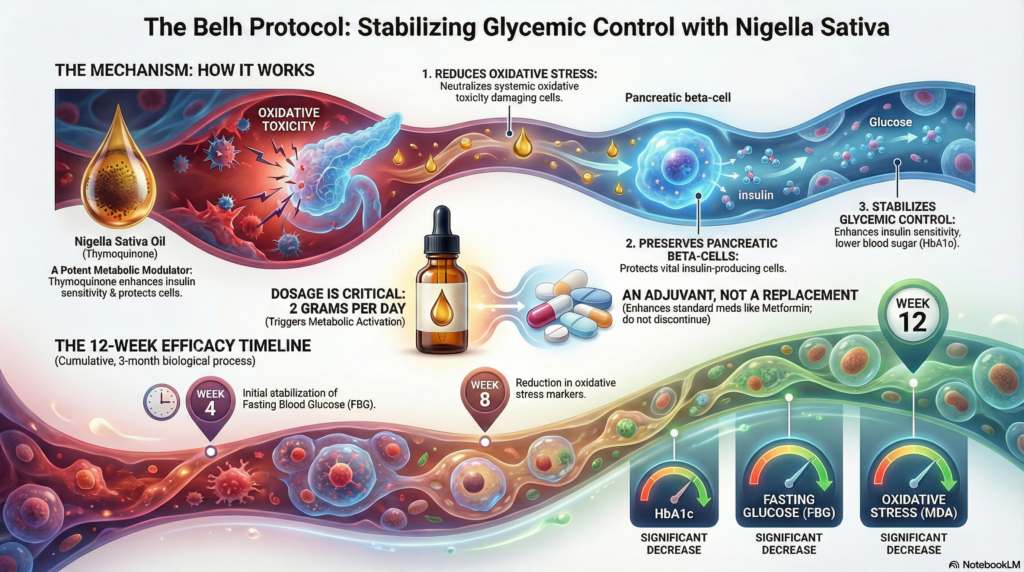
The therapeutic impact follows a hierarchical pathway. The diagram below illustrates the sequential metabolic correction:
Figure 1: Mechanism of Action Flowchart
This cascade confirms that the agent works upstream (protecting organs) to deliver downstream results (lower blood sugar).
Applied Clinical Protocol (Dr. Belh Framework)
Effective integration requires adherence to strict parameters. Speculative dosing yields negligible results.
Dosage Specificity
Strict Requirement: 2 grams per day.
Doses below 1.5g fail to trigger metabolic activation. Doses above 3g do not yield additional benefit.
Adjuvant Positioning
Clinical Rule: Never discontinue standard pharmacotherapy.
Nigella sativa is a potentiator. It optimizes the efficacy of Metformin or Glimepiride; it does not replace them immediately.
The 12-Week Efficacy Timeline
Metabolic restructuring is a cumulative biological process. Clinicians must manage patient expectations according to this timeline:
Baseline
Week 4
Week 8
Week 12
Therapeutic Approach Comparison
| Feature | Standard Monotherapy (Metformin only) | Integrated Protocol (Standard + N. Sativa) |
|---|---|---|
| Mechanism | Glucose production inhibition | Inhibition + Beta-cell protection |
| Oxidative Stress | Minimal Impact | Significant Reduction |
| Lipid Profile | Variable effect | Concurrent LDL Reduction |
| Hypoglycemia Risk | Low | Moderate (Requires monitoring) |
Synthesis of Clinical Outcomes
Data derived from randomized controlled trials demonstrates the following impact on key biomarkers:
| Biomarker | Observed Effect | Clinical Value |
|---|---|---|
| HbA1c | ↓ Significant Decrease | Reduced long-term complication risk |
| Fasting Glucose (FBG) | ↓ Significant Decrease | Improved daily metabolic stability |
| Malondialdehyde (MDA) | ↓ Significant Decrease | Protection against cellular death |
| Total Cholesterol | ↘ Moderate Decrease | Secondary cardiovascular benefit |
Frequently Asked Questions
Can Nigella sativa replace Metformin?
No, it is an adjuvant designed to work synergistically with Metformin to enhance its efficacy, not to replace it as a monotherapy.
When will patients see results?
Measurable improvements in HbA1c and fasting glucose are clinically significant after a continuous 12-week intervention period.
@ Dr. Belh
This content adheres to rigorous evidence-based standards based on data from PMC6770822.