The Lateral Incisor: The Secret Hero of Your Smile
They sit right next to your “big front teeth.” While often overlooked, lateral incisors are the true architects of your facial charm. But be warned: they are also the most unpredictable teeth in your mouth!
When we talk about dental aesthetics, we often focus on whiteness or alignment. But have you ever closely observed the shape of your “number 2” teeth (the ones flanking the central incisors)?
The lateral incisor is unique. It adds the touch of “softness” or “character” to a smile. If it’s too small, the smile can look childish. If it’s missing, the entire balance of the face is disrupted.
Why is this tooth so special?
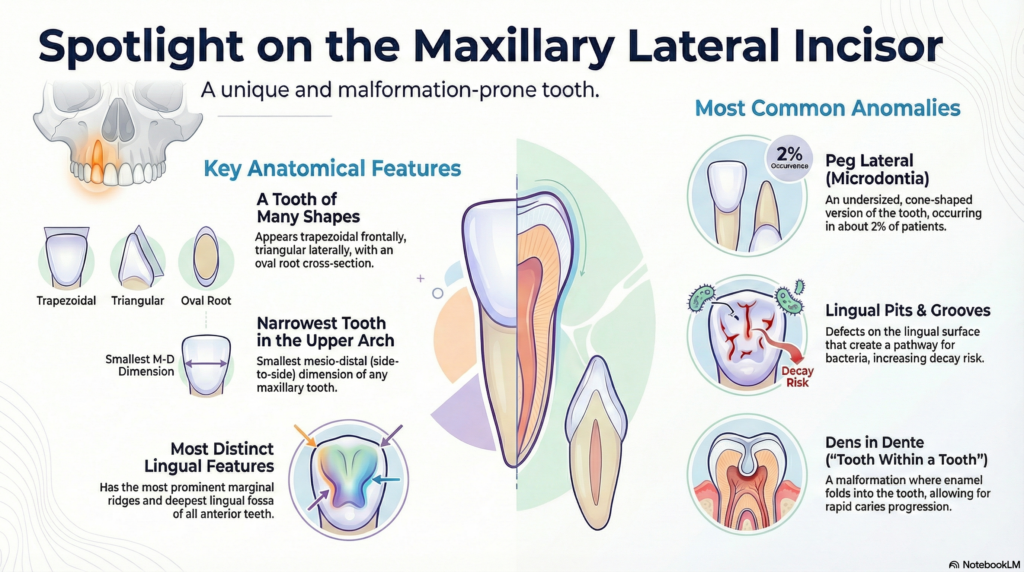
It is the “Queen of Variability.” Aside from wisdom teeth, this is the tooth most likely to be malformed or missing entirely. To simplify, here is the technical profile of this extraordinary tooth.
Harmony & Charm
“Peg Lateral” (Rice-shape)
The Back “Pit” (Lingual)
Absent in ~2% of people
3 Common Problems (and Solutions)
- 1. The “Peg Lateral”
This is when the tooth is unusually small and pointy.
✅ The Solution: A ceramic veneer or direct composite bonding to restore its natural shape without damaging the tooth. - 2. The Missing Tooth (Agenesis)
The tooth never developed.
✅ The Solution: A dental implant or a bonded bridge to fill the gap invisibly. - 3. The Lingual Pit
A tiny natural hole on the back of the tooth that traps bacteria.
✅ The Solution: A preventive sealant applied by your dentist.
Frequently Asked Questions
A: Yes, it is very common for one side to be slightly different from the other (microdontia). Aesthetic bonding can easily balance the symmetry.
A: We can perform non-invasive bonding (composite) as early as the teenage years. Permanent veneers are usually recommended after growth is complete (around 18-20 years old).
A: Generally, no. Fixing a shape issue with bonding often requires little to no drilling, meaning no anesthesia is needed in many cases.
Expert Opinion
Don’t underestimate the power of this small tooth. Patients often come to me wanting a full smile makeover, when sometimes, simply correcting the shape of a single lateral incisor is enough to completely transform facial harmony.
Ready to enhance your smile?
A simple aesthetic diagnosis can determine if your lateral incisors are playing their role correctly.