Clinical Protocol: Self-Regulation
Cognitive Restructuring
of Emotion Myths
Auth: Dr. Belh
1. Defining Emotion Myths
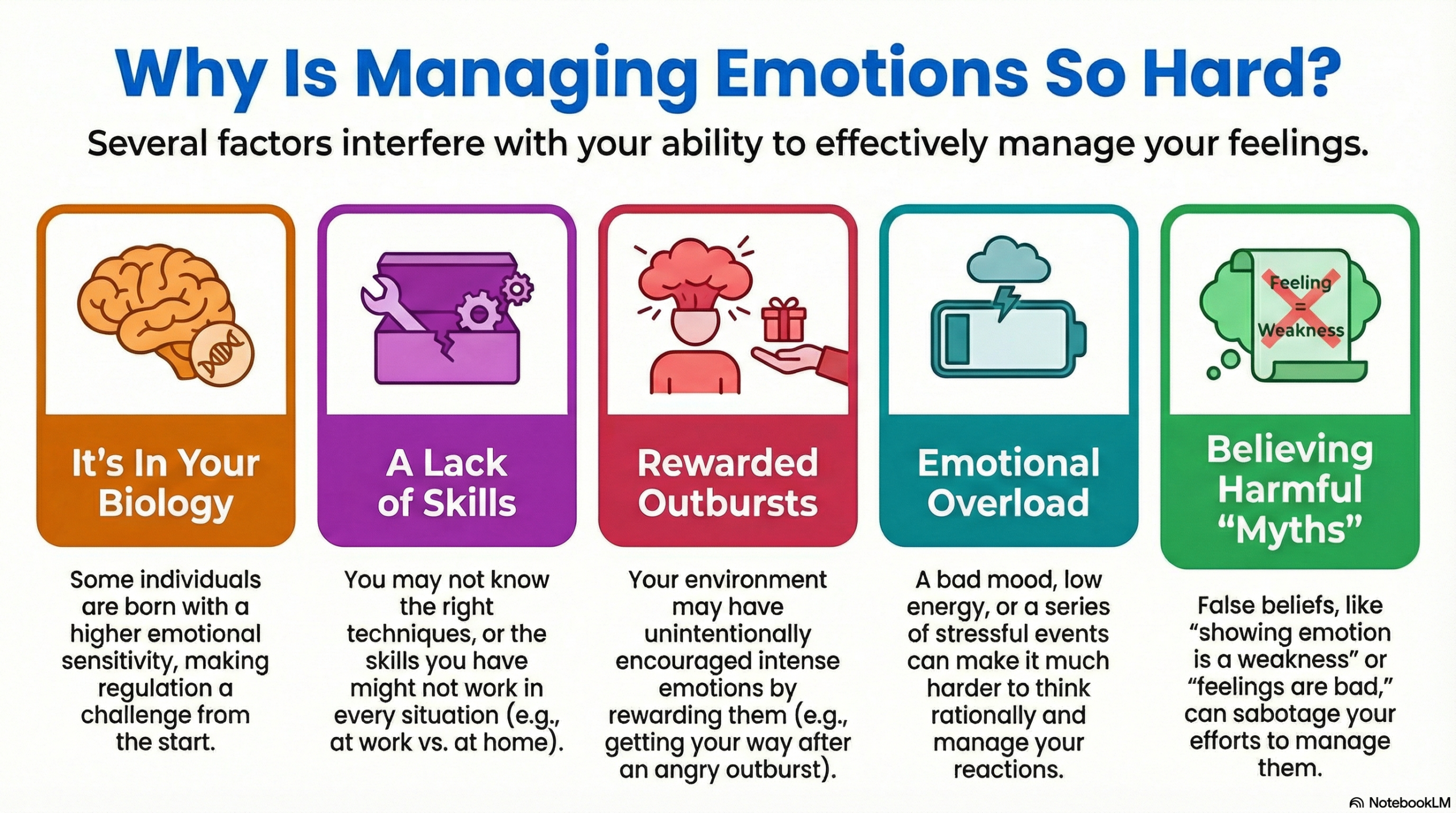
Emotion myths are culturally or familially inherited beliefs that erroneously categorize specific emotional states as inherently dangerous, shameful, or indicative of character flaws. They act as rigid cognitive schemas, fundamentally altering the feedback loop between affective triggers and behavioral responses.
2. The Mechanics of Maladaptive Beliefs
Origin: Fear of Exclusion
The persistence of emotion myths stems primarily from the fear of social rejection. The nervous system misidentifies vulnerability as a survival threat.
Result: The Rebound Effect
Suppression creates a paradox: the attempt to ignore “negative” feelings increases their intensity and duration, leading to reactive dysregulation.
3. Clinical Methodology
Differentiation of Feeling and Identity
Emotions are transient physiological events, not permanent character traits. Recognizing that “feeling anger” is distinct from “being an angry person” creates the necessary psychological distance for regulation.
Validation of Emotional Utility
Every emotion serves a specific evolutionary function. Treating emotions as neutral data points—rather than judgments—allows for objective analysis. Anger signals boundaries; sadness facilitates processing.
Cognitive Reappraisal
Enduring change requires actively substituting the myth with a verifiable fact. The transition from “showing pain is weak” to “communicating needs builds trust” rewires neural pathways.
4. Comparative Analysis
| Core Myth | Behavioral Consequence | Adaptive Restructuring |
|---|---|---|
| “Showing feelings is a weakness.” | Isolation; refusal to seek assistance. | “Expression indicates trust and facilitates support.” |
| “Negative feelings are destructive.” | Avoidance of conflict; repression. | “Emotions are neutral data points.” |
| “Emotions define my identity.” | Internalizing transient states. | “I am the observer, not the emotion.” |
| “Regulation is inauthentic.” | Impulsive reactions justified as ‘real’. | “Authenticity includes value-aligned responses.” |
5. Clinical FAQ
What is the primary cause of emotion myths?
+
Can emotion myths be unlearned in adulthood?
+
Is regulation the same as suppression?
+