Clinical File • Ref: 2024-DBT-M
Mindfulness: Attentional & Emotional Regulation Protocol
Attentional instability and mental rumination constitute the constant background noise of contemporary psychological distress.
This disconnection from reality, far from being a simple lack of concentration, is the primary driver of severe emotional dysregulation.
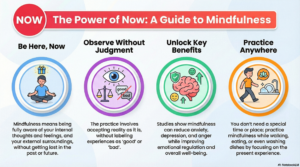
Mindfulness is not relaxation, but a strict cognitive skill enabling the individual to re-anchor in immediate reality to restore executive control.
Operational Definition
Mindfulness is the intentional act of focusing attention on the present moment, without judgment and with total acceptance of internal and external experiences.
Concretely, it involves observing the mechanics of one’s thoughts, emotions, and physical sensations (internal) as well as sensory data (external) without identifying with them or attempting to modify them instantly. It is the shift from “doing mode” to “being mode.”
Structural Analysis of Mechanisms
The default human brain tends toward rumination (focus on the past) or anxious anticipation (projection into the future). These states generate additional suffering disconnected from immediate reality.
The Lever of Attention
Attention is a finite resource. By voluntarily saturating the attentional channel with immediate sensory data (sight, hearing, proprioception), one mechanically cuts the energy supply to anxious loops.
Neutralization of Judgment
Psychological suffering is often the result of pain (inevitable) multiplied by the refusal of that pain. “Non-judgment” eliminates the secondary layer of distress (e.g., the shame of being sad), making the primary emotion manageable.
Applied Clinical Approach
Principle 1: Factual Anchoring
The mind interprets; the body feels. Returning to the senses forces the brain to process tangible information rather than hypothetical scenarios.
➔ Practical Consequence: In a crisis, do not “think”; describe what you touch and hear.
Principle 2: Radical Acceptance
Accepting the present moment does not mean approving of it, but acknowledging its existence. Rejecting reality (e.g., “I shouldn’t have to wait here”) creates useless mental friction.
➔ Practical Consequence: Replace “This is unbearable” with “I feel impatience and it is a difficult sensation.”
Principle 3: Systematic Reiteration
Attention is a muscle; wandering is normal. The exercise is not to never wander, but to bring the mind back every time it drifts, just as one trains an animal.
➔ Practical Consequence: Each return to the present is a repetition that strengthens the neuroplasticity of inhibitory control.
Key Reference Points
- ▪
Intentionality: Voluntary action of directing attention (opposite of autopilot). - ▪
Non-judgment: Observation of raw facts without “good” or “bad” labels. - ▪
One-mindfully: Doing one thing at a time to maximize cognitive efficiency. - ▪
Effectiveness: Acting according to what works for the situation, not according to emotions or rigid principles.
Differential Table
| Dimension | “Autopilot” Mode | “Mindfulness” Mode |
|---|---|---|
| Temporality | Focus on past or future | Exclusive anchor in the present instant (here and now) |
| Info Processing | Judgment, evaluation, immediate labeling | Descriptive observation, raw facts |
| Reaction to Pain | Avoidance, rejection, emotional amplification | Acceptance, curious observation, reduction of suffering |
| Control | Reactive, impulsive, dominated by mood | Intentional, chosen response, aligned with goals |
Visual Specification (Prompt)
“Ultra-realistic cinematic photography, medium shot, minimalist clinical consultation office interior, soft lateral natural light (Golden Hour) illuminating a calm and focused face, sharp textures, neutral color palette (slate gray, white, steel blue), shallow depth of field highlighting a posture of active listening, atmosphere of professional serenity and scientific rigor, 8k resolution.”
Frequently Asked Questions (FAQ)
Is this a relaxation technique?
No. It is an attentional activation technique. Relaxation may be a side effect, but the goal is lucidity, not relaxation.
How to stop thinking during practice?
Impossible and not desirable. The goal is not mental emptiness, but observing the stream of thoughts without clinging to them.
What is the concrete use of “non-judgment”?
It prevents emotional escalation. Judging a negative emotion (“I shouldn’t feel this”) creates a more durable secondary emotion.
How long should one practice?
Consistency outweighs duration. Micro-sessions of 3 minutes repeated daily modify brain structure more effectively than a long weekly session.
Can one practice while doing something else?
Yes. “Informal” practice (doing dishes, walking, listening) consists of fully engaging one’s senses in the current activity, without mental distraction.