Hepatitis B serology reports often present a confusing array of antigens and antibodies. This complexity obscures the viral lifecycle and the patient’s immune status. This article deconstructs these markers into a logical timeline using a mechanistic approach for definitive interpretation.
The Key Players: Viral Antigens
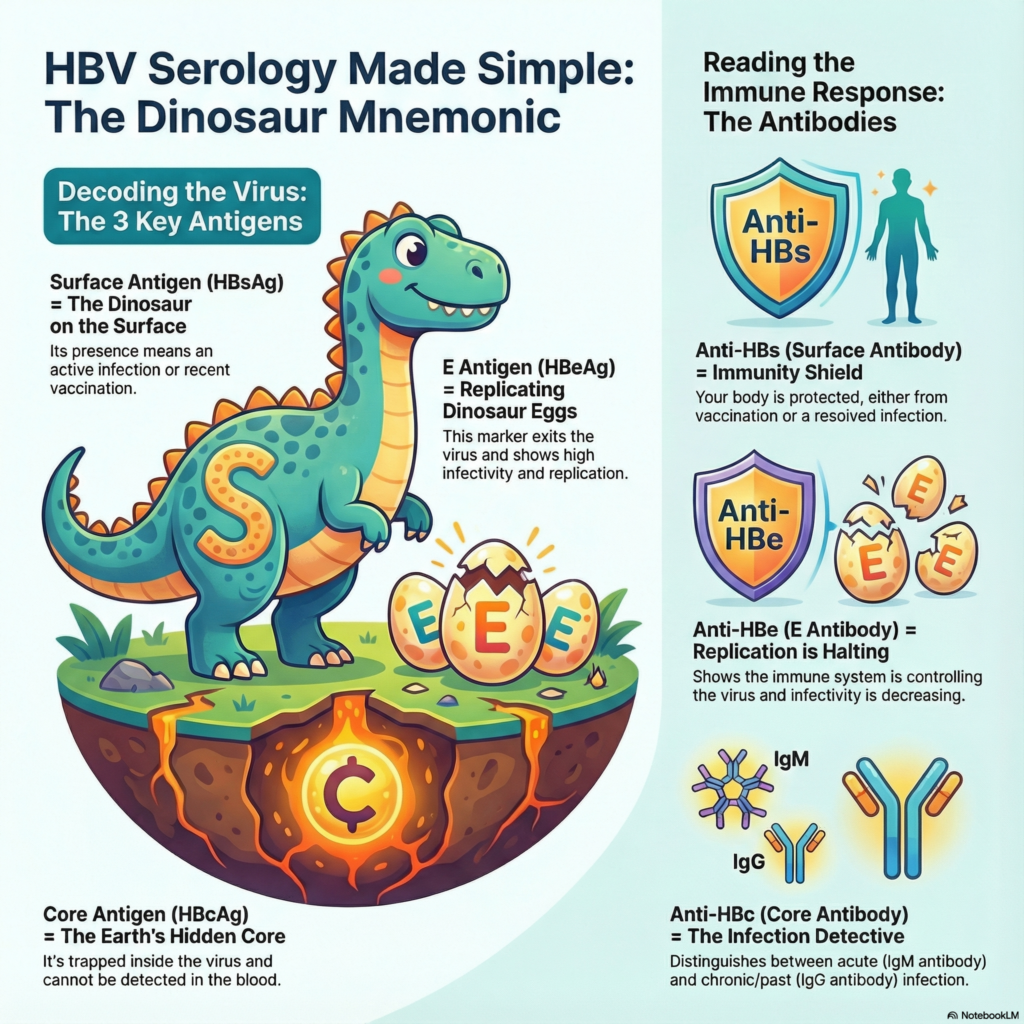
Understanding serology requires identifying the specific viral components (Antigens) and the immune system’s counter-measures (Antibodies). We utilize a “Dinosaur” mnemonic to anchor the clinical significance of each marker.
Viral Structure Mnemonic
“The Dinosaur”
Found on the viral surface. Indicates Active Infection.
“The Eggs”
Secreted during replication. Indicates High Infectivity.
“Core of the Earth”
Trapped inside. Not detectable in serum.
Mechanistic Analysis: The Immune Response
The body produces specific antibodies to neutralize the viral antigens defined above. The presence of these antibodies marks the transition from infection to immunity or control.
- Anti-HBs (Surface Antibody): The “Hero.” It clears the surface antigen. Its presence signifies Clinical Immunity (either from recovery or vaccination).
- Anti-HBe (E Antibody): Indicates the immune system is suppressing viral replication. “The eggs are being destroyed.” Infectivity drops.
- Anti-HBc (Core Antibody): The “Timekeeper.” Since we cannot see the Core Antigen, this antibody is our proxy.
- IgM Anti-HBc: Acute/Recent infection (First responder).
- IgG Anti-HBc: Chronic or Past infection (Scar tissue).
The Dr. Belh Framework: Applied Serology
To interpret any panel correctly, apply these three sequential principles.
1. Observation (The Surface Status)
Look at HBsAg first. If positive, the dinosaur is present (Active Infection). If negative, check Anti-HBs to see if the hero has won (Immunity).
2. Context (The Core Chronology)
Check Anti-HBc to define the timeline. IgM means acute war zone. IgG means history. This distinguishes a “carrier” from a “new case.”
3. Solution (The Window Gap)
Beware the “Window Period.” If both Surface Antigen and Surface Antibody are negative, but IgM Core is positive, the patient is infected but in immune transition.
Serological Timeline
Weeks 1-4
HBsAg rises.
HBeAg (Replication) peaks.
Weeks 4-12
Symptoms appear.
Anti-HBc IgM detectable.
Transitional
Gap Zone.
HBsAg neg.
Anti-HBs neg.
Only IgM Anti-HBc pos.
Months 6+
Anti-HBs appears (Immunity).
IgG Anti-HBc persists.
Clinical Extraction Zone
- Viral Load: HBV DNA PCR is the definitive test for quantification, not serology.
- Chronicity Definition: Persistence of HBsAg for >6 months defines Chronic Hepatitis B.
- Vaccination Profile: Vaccinated individuals have Anti-HBs only. They lack Anti-HBc (Core) because the vaccine is surface-only.
- Infectivity: High HBeAg roughly correlates with high viral DNA and high transmissibility.
Comparative Serology Matrix
| Clinical Status | HBsAg (Surface) |
Anti-HBs (Immunity) |
Anti-HBc IgM (Acute Core) |
Anti-HBc IgG (Total Core) |
|---|---|---|---|---|
| Acute Infection | Positive | Negative | Positive | Negative |
| Window Period | Negative | Negative | Positive | Negative |
| Resolved (Natural Immunity) | Negative | Positive | Negative | Positive |
| Chronic Infection | Positive | Negative | Negative | Positive |
| Vaccinated | Negative | Positive | Negative | Negative |
Frequently Asked Questions
Why is HBsAg positive after vaccination?
This is a transient false positive. The vaccine contains HBsAg to stimulate immunity; it may be detectable for a few days post-injection.
What defines the “Window Period”?
The interval where HBsAg has cleared but Anti-HBs has not yet reached detectable levels. Diagnosis relies solely on IgM Anti-HBc.
Can you have chronic Hepatitis B with Anti-HBs present?
Rarely. This typically indicates co-infection with different subtypes or the emergence of escape mutants, but generally, Anti-HBs implies recovery.
What is the clinical significance of HBeAg?
It signifies high viral replication and high infectivity. Its disappearance (seroconversion) is a treatment goal.
How do I distinguish resolved infection from vaccination?
Resolved infection shows Anti-HBc (Core antibody). Vaccination shows ONLY Anti-HBs (Surface antibody) with no Core antibody.