The Fear of Rejection: Neurocognitive Mechanisms and Clinical Resilience
Rejection is a fundamental human anxiety that compromises two homeostatic pillars: social belonging and perceived agency. When these needs are threatened, the brain activates survival mechanisms comparable to physical pain responses. This article delineates the pathophysiology of rejection sensitivity and outlines evidence-based strategies for restoring psychological equilibrium.
Definition: The “Queen of Fears”
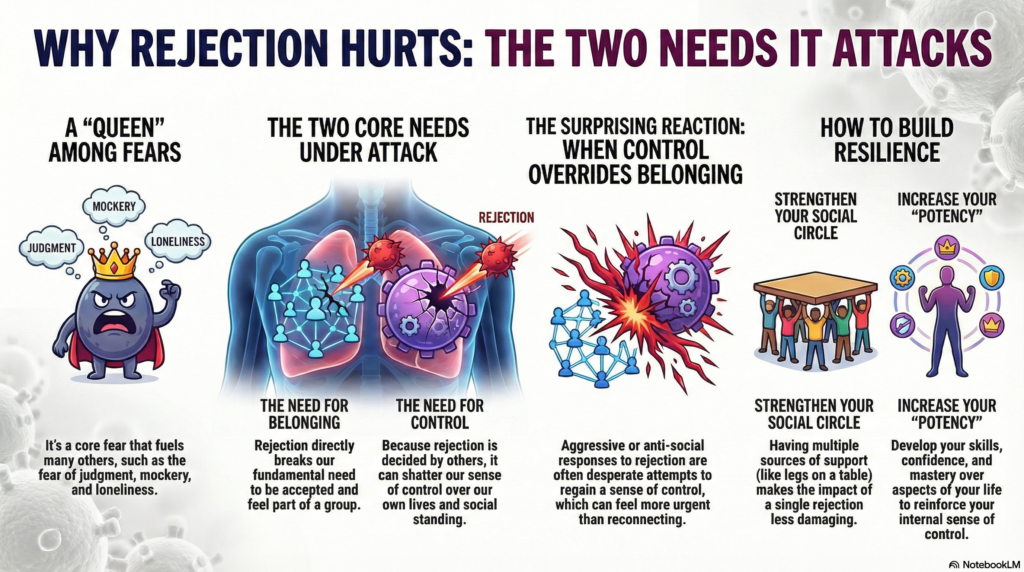
The fear of rejection is defined as an anticipated anxiety regarding social exclusion or non-acceptance. Clinically, it acts as a foundational anxiety, underpinning secondary fears such as judgment, public failure, and isolation. It is not merely an emotional state but a physiological alert system signaling a threat to the individual’s inclusion in the “tribe,” historically essential for survival.
This fear targets two core psychological substrates:
- Belonging: The imperative to be accepted as an authentic self.
- Agency (Control): The need to influence one’s own trajectory; rejection is perceived as an external imposition of force.
Mechanistic Analysis: The Brain on High Alert
Rejection sensitivity alters neurocognitive processing. The brain shifts into hyper-vigilance, prioritizing threat detection over logical analysis. This results in a feedback loop where ambiguous social cues are systematically interpreted as hostile or dismissive.
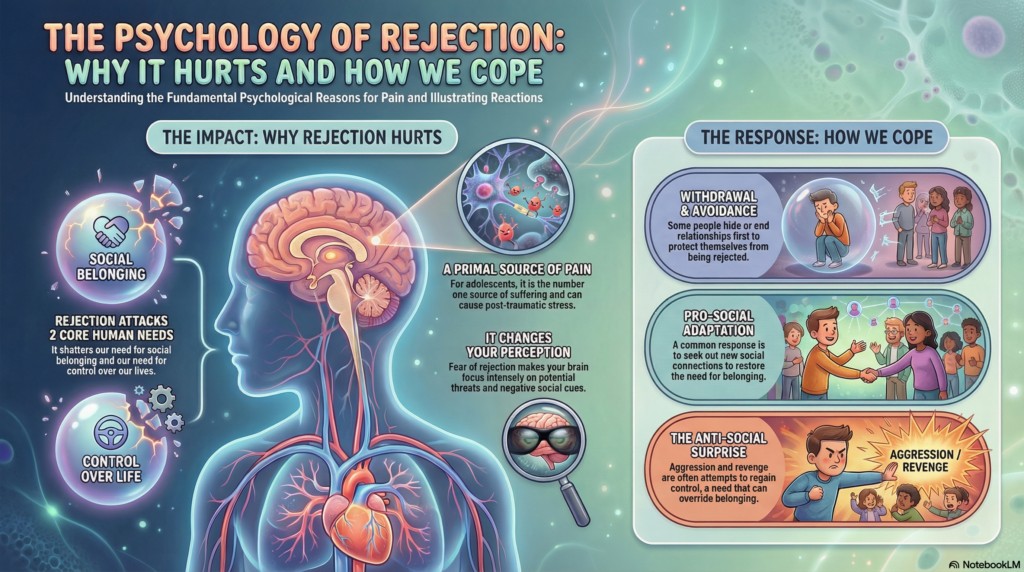
Figure 1: The Rejection Feedback Loop
Amygdala Activation
Perception Distortion
Behavioral Coping
Applied Approach: The Dr. Belh Framework
To mitigate the psychological impact of rejection, we apply a tri-phasic clinical framework focusing on observation, context, and solution implementation.
1. Observation
Identify the Path: Recognize the automatic reaction. Are you withdrawing (isolation), avoiding (preemptive rejection), seeking (prosocial repair), or attacking (antisocial control)? Diagnosis precedes treatment.
2. Contextualization
The Control Deficit: Acknowledge that the pain stems from a loss of agency. The “Table Theory” suggests diversifying support systems (“legs”) so that one failure does not collapse the entire structure.
3. Solution
Potency Building: Establish domains of mastery. By increasing competence in specific skills (e.g., social roles, hobbies), one reclaims the sense of control lost during rejection events.
Timeline of Resilience Building
Acute Rejection
Processing & Naming
Potency Actions
Integrated Resilience
Key Points: The Four Response Paths
- Withdrawal: Hiding to prevent further injury. Risk: Creates an “invisibility cloak” where true acceptance becomes impossible.
- Avoidance: Preemptive severance of ties. “I leave before you can leave me.” Strategy of isolation.
- Prosocial Action: The “Repair” drive. Attempting to regain connection, occasionally leading to submission to unhealthy dynamics.
- Antisocial Action: Aggression, revenge, or domination. An attempt to regain control rather than connection.
Synthesis: Healthy vs. Maladaptive Responses
| Reaction Type | Mechanism | Long-term Outcome | Clinical Status |
|---|---|---|---|
| **Social Withdrawal** | Isolation to ensure safety | Loneliness, Depressive symptoms | Maladaptive |
| **Aggressive Control** | Lashing out to regain agency | Further alienation, Conflict | Maladaptive |
| **Diversification** | Strengthening other relationships | Resilience, Stability | Recommended |
| **Potency Building** | Developing skills/competence | Increased Self-Worth, Control | Recommended |
Image Generation Prompt
Clinical FAQ
Why does rejection feel like physical pain?
fMRI studies indicate rejection activates the anterior cingulate cortex, the same region responsible for processing physical pain, illustrating its evolutionary importance.
Is the “Antisocial Path” common?
Yes. Aggression is often a misdirected attempt to regain the sense of control that was lost during the rejection event.
What is the “Social Table” analogy?
It is the concept that mental stability requires multiple supports (friends/family). Relying on a single “leg” makes one vulnerable to collapse if that leg breaks.
Does avoiding people cure the fear?
No. Avoidance reinforces the fear response and prevents the positive exposure necessary for the brain to learn that rejection is survivable.
What is the first step to healing?
Verbalization. Speaking or writing about the fear reduces amygdala activity and engages the prefrontal cortex for logical processing.
Ref:
The “Physical Pain” Connection (The Anterior Cingulate Cortex)Supports the claim in your “Definition” and “FAQ” sections. Source: PubMed PMID: 14551436
The Overlap of Social and Physical PainReinforces the “High Alert” mechanistic analysis.Source: PubMed PMID: 21444827
Behavioral Responses (The “Four Paths”)Supports your “Key Points” and “Synthesis Table” regarding aggression and withdrawal. Source: PMC Full Text: PMC3139070
Aggression as a Response to RejectionSupports the specific claim about “Antisocial Action” and control.Source: PubMed PMID: 11761307