Cardiogenic shock is the most lethal complication of acute myocardial infarction—carrying an untreated mortality of 50–80% (and still 40–50% even with rapid primary PCI and mechanical support). On exams and on the CCU floor, survival comes down to one core reflex: recognizing a “broken pump with a full tank” before you accidentally drown the lungs with IV fluids.
In Part 2 of the Mr. Thompson Series, we follow our anterior STEMI patient right after his catheterization lab procedure, break down the Death Spiral, lock in the DAVID and HWLCO mnemonics, compare LV vs. RV vs. Septic shock in an interactive simulator, and master the SCAI A–E Staging system.
- Blood Pressure:
80/40 mmHg(SBP < 90 mmHg for > 30 min) - Lungs & Skin: Bilateral inspiratory crackles / acute pulmonary edema, cold clammy skin (“Wet & Cold”)
- End-Organ Perfusion: New confusion, oliguria (
< 0.5 mL/kg/hr), serum lactate > 2 mmol/L - Classification: SCAI Stage C (Classic Cardiogenic Shock)
1. Pathophysiology: The “Broken Pump” & The Death Spiral
- Cardiogenic Shock (LV failure): HIGH preload (PCWP > 18 mmHg) + LOW cardiac output (CI < 2.2 L/min/m²) + HIGH SVR (vasoconstricted, cold & clammy).
- Septic Shock (contrast): LOW preload + HIGH cardiac output (early) + LOW SVR (vasodilated, warm & flushed).
>40% LV Necrosis → ↓ Cardiac Output (CO) → ↓ Blood Pressure → ↓ Coronary Perfusion Pressure → Worsening Myocardial Ischemia → ↑ LV Filling Pressure → Pulmonary Edema → Hypoxia → Even Worse Pump Failure.
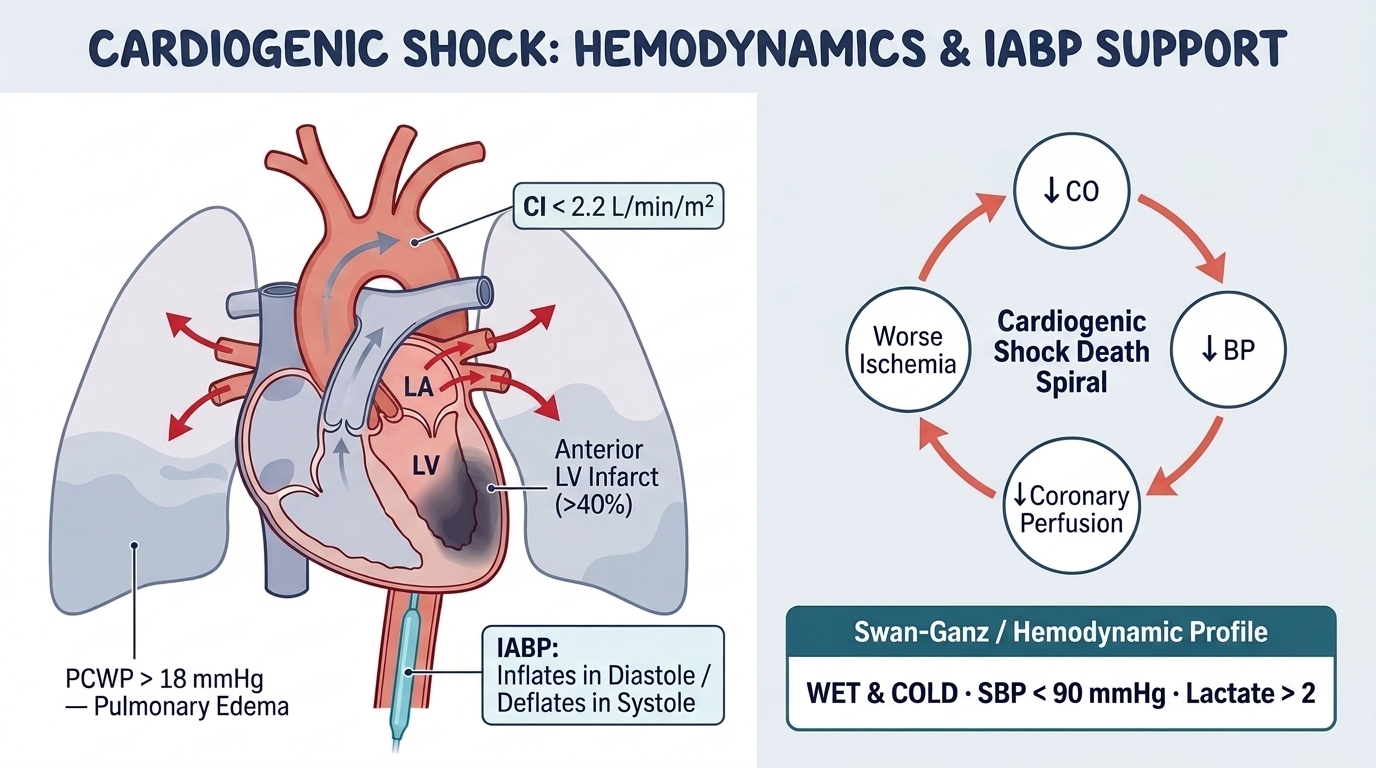
PCWP > 18 mmHg, CI < 2.2 L/min/m², high SVR), and how the Intra-Aortic Balloon Pump (IABP) breaks the spiral by inflating in diastole and deflating in systole.2. High-Yield Mnemonics: “HWLCO” & “DAVID”
Lock in both the hemodynamic diagnosis and the lifesaving rescue sequence using two unforgettable memory anchors:
PCWP > 18 mmHg = full tank backing up into the lungs) + Low Cardiac Output (CI < 2.2 L/min/m² = broken pump).
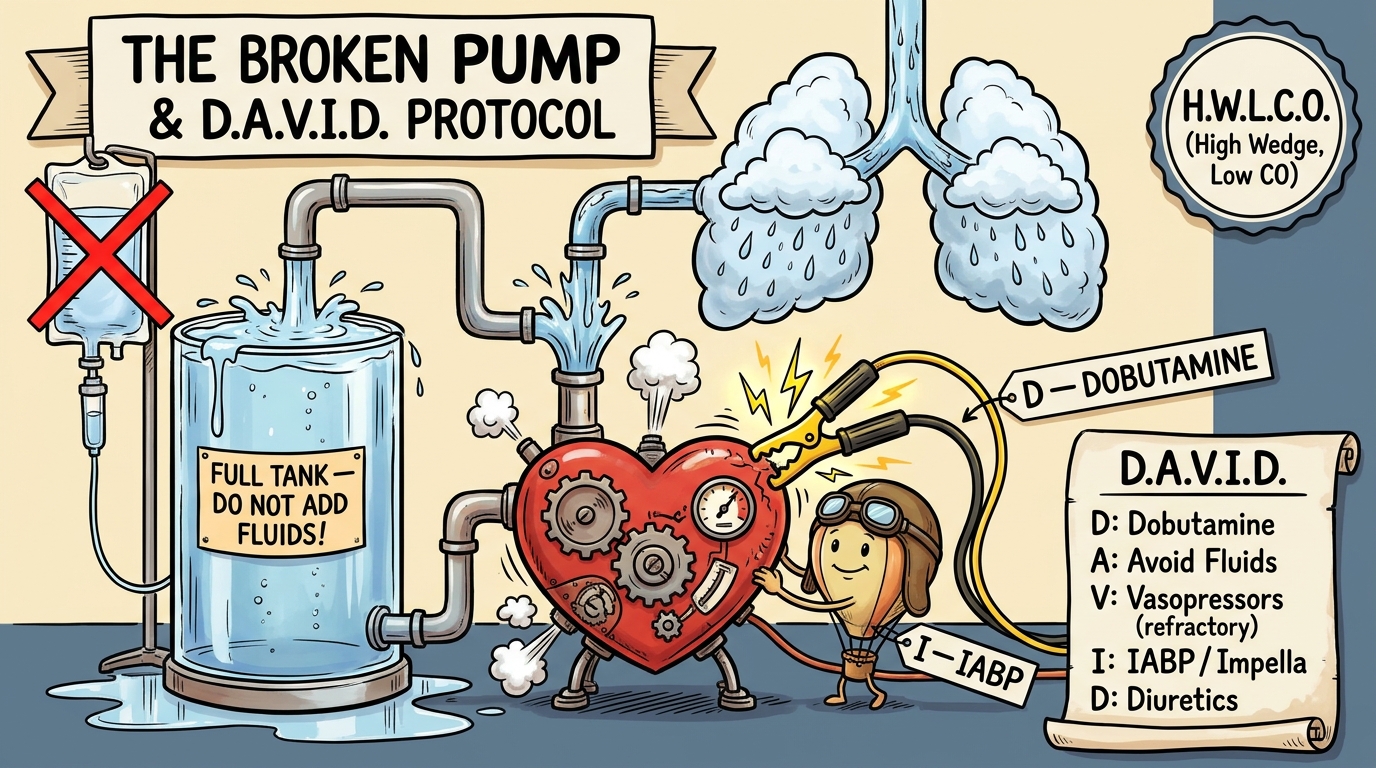
3. Interactive Broken Pump & IABP Hemodynamics Simulator
Test your clinical reflexes right now! Switch between Mr. Thompson’s LV Cardiogenic Shock, an Inferior MI with RV Infarction, and Septic Shock—then click the bedside treatments below to watch the Swan-Ganz gauges, alveolar fluid level, and animated descending-aorta IABP balloon respond in real time.
Interactive Simulator: Broken Pump, Swan-Ganz & IABP
Pick a shock phenotype, then test IV Fluids, Dobutamine, IABP, or Nitrates to see who stabilizes—and who crashes.
4. Diagnostic Criteria & SCAI Shock Staging (A–E)
Before jumping into staging, memorize the classic 3-part bedside diagnosis of cardiogenic shock:
- Persistent Hypotension:
SBP < 90 mmHg for > 30 minutes(or needing vasopressors/inotropes to keep SBP ≥ 90 mmHg). - End-Organ Hypoperfusion: Cold, clammy extremities; confusion/altered mental status; oliguria (
< 0.5 mL/kg/hr); elevated serum lactate > 2 mmol/L. - Pulmonary Congestion (in LV shock): Bilateral crackles, hypoxia, and pulmonary edema (“wet & cold”), backed by
PCWP > 18 mmHgandCI < 2.2 L/min/m².
Table 1 — SCAI Cardiogenic Shock Classification (Stages A to E)
| SCAI Stage | Name | Bedside Presentation & Labs | Clinical Action |
|---|---|---|---|
| Stage A | At Risk | Large STEMI (e.g., proximal LAD) or severe HF, but currently normotensive, warm, normal lactate. | Rapid primary PCI, close CCU telemetry, avoid negative inotropes. |
| Stage B | Beginning | Early relative hypotension or tachycardia without tissue hypoperfusion (lactate still normal). | Early hemodynamic monitoring, urgent revascularization, bedside echo. |
| Stage C | Classic (Mr. Thompson) |
SBP < 90 mmHg + hypoperfusion (cold/clammy, oliguria < 0.5 mL/kg/hr, lactate > 2) + crackles. | DAVID Protocol: Start Dobutamine, avoid fluids, add IABP / Norepinephrine as needed. |
| Stage D | Deteriorating | Failing to respond to initial inotrope/pressor therapy; rising lactate, worsening hypoxia/acidosis. | Escalate vasopressors and upgrade mechanical support (Impella / VA-ECMO team). |
| Stage E | Extremis | Refractory circulatory collapse, ongoing CPR or multiple maximal pressors, severe metabolic acidosis. | Emergent VA-ECMO / salvage mechanical circulatory support (if candidate). |
5. Shock Hemodynamics: LV Shock vs. RV MI vs. Septic Shock
Boards love testing whether you can read a Swan-Ganz catheter table in 5 seconds. Notice how RV Infarction (from an inferior STEMI) is the exact hemodynamic mirror image of LV shock in the lungs—raised JVP + CLEAR lungs—meaning it actually needs IV fluids!
Table 2 — Swan-Ganz & Bedside Shock Comparison
| Parameter | LV Cardiogenic Shock (Anterior LAD MI · Mr. Thompson) |
RV Infarction Shock (Inferior RCA STEMI) |
Septic Shock (Early Distributive) |
|---|---|---|---|
| Preload (PCWP) | HIGH (> 18 mmHg) | Low / Normal (< 12 mmHg) | LOW (< 12 mmHg) |
| Cardiac Index (CI) | LOW (< 2.2 L/min/m²) | LOW (< 2.2 L/min/m²) | HIGH (> 3.5 L/min/m²) |
| Afterload (SVR) | HIGH (vasoconstricted) | HIGH (vasoconstricted) | LOW (vasodilated) |
| JVP / CVP | Elevated | Markedly Elevated (+ Kussmaul sign) | Low |
| Lungs & Skin | WET & COLD (crackles, edema) | CLEAR LUNGS & cold/hypotensive | Clear lungs & WARM/FLUSHED |
| First-Line Rx | Dobutamine + IABP (AVOID fluids!) | IV Fluid Bolus (NEVER nitrates!) | IV Crystalloids + Norepinephrine + Abx |
6. The DAVID Protocol & Essential Bedside Workup
In acute MI complicated by cardiogenic shock, early coronary revascularization (primary PCI) is the cornerstone that reduces mortality from 50–80% toward 40–50%. Alongside PCI, follow the DAVID protocol to break the death spiral:
Table 3 — DAVID Protocol: Drugs & Mechanical Support
| Step | Agent / Device | Mechanism & Mental Hook | Key Clinical Rule & Caution |
|---|---|---|---|
| D | Dobutamine | β1-agonist (↑ contractility & HR) — “jump-starting a car battery”. | First-line inotrope in classic low-output LV shock (Mr. Thompson). Watch for arrhythmias and mild β2 vasodilation. |
| A | Avoid Fluids | Prevents overflowing an already full LV tank into the alveoli. | Do NOT give empirical crystalloids in “wet & cold” shock. Exception: small cautious challenge only if PCWP < 15 or clear-lung RV MI. |
| V | Vasopressors (Norepinephrine) |
Potent α1 (>β1) agonist restores MAP and coronary perfusion pressure. | Add if refractory severe hypotension persists (preferred over dopamine due to lower arrhythmia/mortality risk). |
| I | IABP / Impella | “Co-pilot for a struggling engine.” IABP inflates in diastole (↑ coronary flow) and deflates in systole (↓ afterload). | Stabilizes bridge-to-recovery (brought Mr. Thompson to 95/60 mmHg!). Contraindicated in severe aortic regurgitation or aortic dissection. |
| D | Diuretics (IV Furosemide) |
Loop diuretic unloads pulmonary venous congestion. | Use carefully once SBP is supported by inotropes/IABP so you relieve hypoxia without tanking BP further. |
Table 4 — Rapid Diagnostic Investigations in Post-MI Shock
| Investigation | Key Findings in Cardiogenic Shock | Why It Changes Immediate Management |
|---|---|---|
| Urgent Bedside Echo (TTE) | Severely reduced LVEF, anterior wall akinesis, or a hidden mechanical complication. | Must do immediately to rule out papillary muscle rupture (acute MR), ventricular septal rupture (VSR), or free-wall rupture/tamponade! |
| 12-Lead ECG (+ Right-Sided V4R) | Anterior ST elevation (V1–V4 = LAD) or Inferior STEMI (II, III, aVF) + ST elevation in V4R. | Identifies acute stent thrombosis, new infarct territory, arrhythmias, or RV infarction (which flips fluid therapy!). |
| ABG, Serum Lactate & Renal Panel | Lactate > 2 mmol/L, metabolic acidosis, hypoxemia (PaO2 ↓), rising creatinine / oliguria. | Confirms SCAI Stage C tissue hypoperfusion and tracks minute-by-minute response to Dobutamine + IABP. |
| Portable CXR & Swan-Ganz (PAC) | CXR: bat-wing alveolar edema, Kerley B lines. PAC: PCWP > 18, CI < 2.2 (HWLCO). |
Separates “wet” LV failure from “clear-lung” RV MI or septic shock and guides titration of inotropes/diuretics. |
7. Five High-Yield Exam Traps to Never Fall For
8. Quick USMLE / PLAB Self-Check Quiz
PCWP > 18 mmHg) + Low Cardiac Output (CI < 2.2 L/min/m²) + reflexively High SVR. (Option A is early septic shock; Option B is hypovolemic/RV MI shock.)