Current nutritional guidelines for exercise often oscillate between rigid caloric dogma and conflicting metabolic myths. The physiological reality is that pre- and post-workout nutrition functions primarily as a signaling mechanism for the central nervous system, rather than merely fuel for skeletal muscle. This analysis deconstructs the neuro-endocrine responses to food intake to provide a clinical framework for optimal performance.
Clinical Index
Definition: Performance Fueling vs. Caloric Intake
Performance fueling is distinct from general caloric intake. Clinically, it is defined as the strategic ingestion of macronutrients to modulate the hypothalamus-pituitary-adrenal (HPA) axis and optimize substrate availability. Unlike passive eating, performance fueling targets two specific physiological outcomes: blunting the cortisol response to physical stress and signaling nutrient availability to the brain to permit high-output neural drive.
Mechanistic Analysis: The Brain-Gut Connection
The efficacy of a pre-workout meal is mediated through neural pathways. The brain acts as a central governor; if it detects low energy availability or an empty gastric volume, it downregulates motor unit recruitment to preserve homeostasis.
Prevents catabolic “emergency state”
“Fullness Factor” reduces perceived exertion
Nutrient Timing Protocol
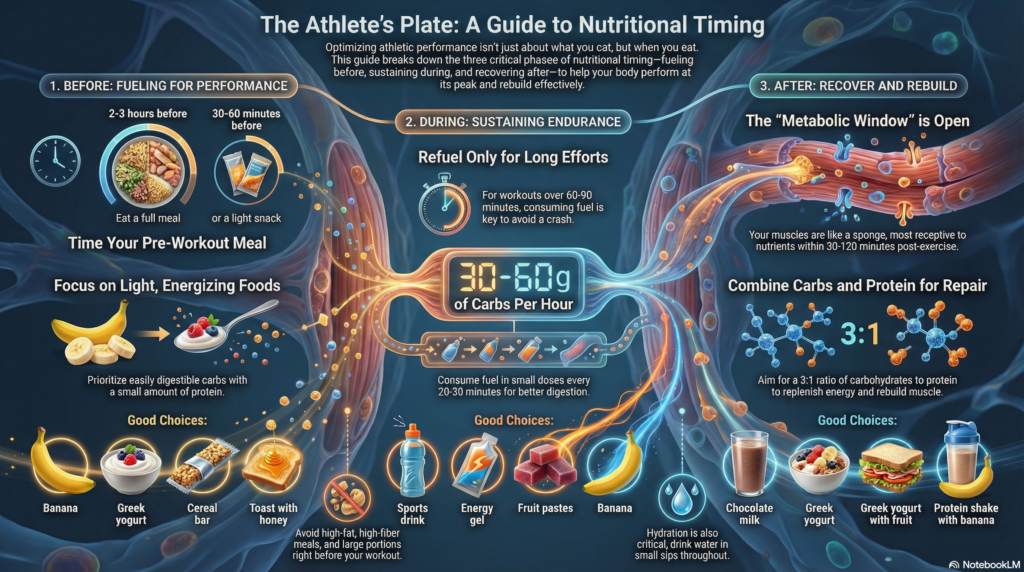
The macronutrient composition of a pre-workout meal is dictated by the time delta before training. Fat content serves as a modulator of digestion speed.
4-6 Hours Pre-Workout
Protocol: High Fat + Protein + Carbs.
Rationale: Fat slows gastric emptying, ensuring sustained energy release and preventing hunger pangs at training time.
2-3 Hours Pre-Workout
Protocol: Balanced Macro Profile.
Rationale: Standard mixed meal. Fat content should be moderate to allow digestion completion before exertion.
30 Minutes Pre-Workout
Protocol: Fast Carbs + Protein (Low/No Fat).
Rationale: Rapid gastric emptying required. Purpose is immediate hypothalamic signaling. Example: Banana + Protein Isolate.
Applied Approach: The Dr. Belh Framework
Integrating insights from Dr. Stacy Sims and Dr. Mike Israetel, we observe three governing principles for clinical application.
1. Observation: Sexual Dimorphism
Context: Post-workout metabolism differs by sex. Women return to baseline metabolism within 60 minutes; men take up to 3 hours.
Clinical Action: Women must prioritize immediate post-workout nutrition to prevent prolonged catabolic breakdown.
2. Context: The “Fullness Factor”
Context: Evolutionary biology dictates that an empty stomach signals resource scarcity, leading the body to conserve energy.
Clinical Action: Ingesting volume (even popcorn) reduces anxiety and increases willingness to exert effort, regardless of caloric density.
3. Solution: Anti-Catabolic Signaling
Context: Fasted training in women exacerbates cortisol response and threatens lean muscle tissue.
Clinical Action: A minimum of 15g of protein pre-workout is sufficient to signal fuel availability and protect lean mass.
Clinical Key Points (Extraction Zone)
- Neural Priority: Pre-workout food is a safety signal to the brain, not just fuel for the muscles.
- The Female Window: The “anabolic window” is scientifically valid for women due to rapid metabolic normalization (approx. 60 mins).
- Fat Utility: High-fat meals are beneficial 4-6 hours pre-workout to stabilize hunger levels via delayed gastric emptying.
- Fasted Risk: Women training fasted risk preferential breakdown of lean muscle mass due to low energy availability signaling.
Synthesis Data: Physiological Variances
| Parameter | Male Physiology | Female Physiology | Clinical Implication |
|---|---|---|---|
| Post-Workout Metabolic Return | ~180 Minutes | ~60 Minutes | Critical for Women Women need immediate refueling. |
| Fasted Training Impact | Variable / Fat oxidation | Catabolic / Muscle loss | Risk Women should avoid fasted states. |
| Min. Protein Signal | Variable | ~15 Grams | Actionable Small dose prevents catabolism. |
Guide to Athlete Nutritional Timing:
Clinical FAQ
A: For men, largely yes due to a 3-hour metabolic return. For women, it is a clinical reality; recovery pathways close significantly faster (approx. 60 mins).
A: Yes, but only if the meal is consumed 4-6 hours prior. Closer to the session, fat delays gastric emptying and can cause gastrointestinal distress.
A: Women’s bodies perceive fasted states as high stress (low energy availability), triggering cortisol release and prioritizing the breakdown of lean muscle tissue for fuel.
A: Approximately 15 grams of protein pre-workout is sufficient to signal the hypothalamus that fuel is available, preventing the catabolic shift.
A: Mechanistically, volume is key. While nutrient density is preferred, any food volume that stretches the stomach receptors can reduce perceived exertion and anxiety.